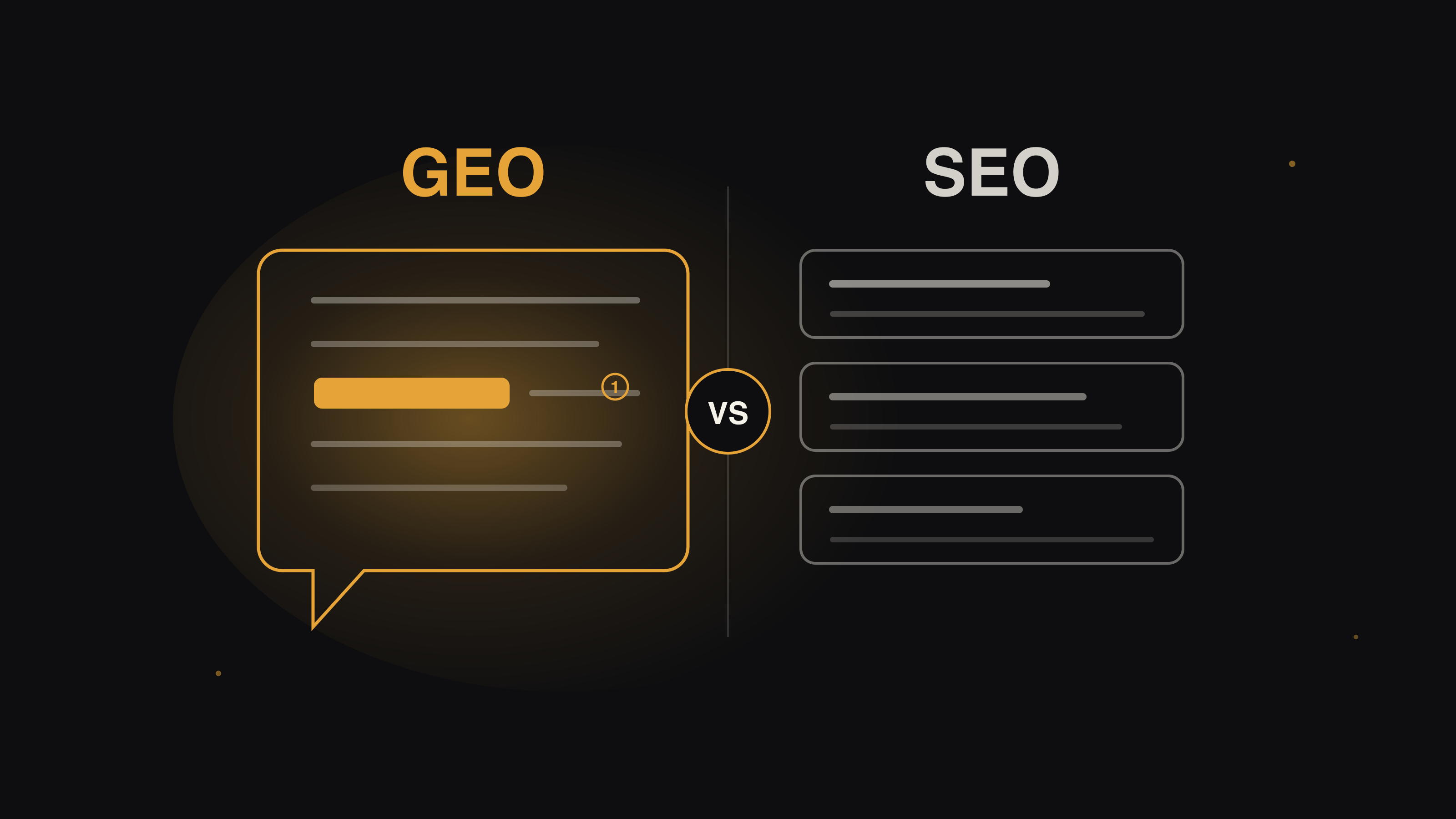

SEO gets your pages into search results; GEO gets your brand into AI answers. The two are complementary, not substitutes. In the age of AI search, a brand has to manage both its ranking visibility in search and its brand visibility inside AI answers.
Your SEO is great, so why won't AI recommend you?
A lot of brands assume that if their SEO is solid, AI will naturally recommend them.
Reality rarely works that way.
Your site might rank well on Google with steady organic traffic, yet when a prospect asks ChatGPT, Perplexity, Gemini, or Google AI Mode:
the answer AI gives back might not include you at all.
That is the single biggest difference between GEO and SEO:
SEO determines whether users can find you in search results; GEO determines whether AI understands, cites, and recommends you in its answers.
The two aren't substitutes; they're complementary. In the era of AI search, a brand has to manage both its ranking visibility in traditional search results and its brand visibility across AI search, AI Q&A, and generative answers.
GEO vs SEO: the difference in 30 seconds
SEO optimizes a page's ranking, exposure, and clicks on the search results page. GEO optimizes how often a brand is mentioned, recommended, and cited in AI-generated answers, and how accurately it's described.
Put simply:
- SEO helps users find you in search results on Google, Baidu, Bing, and the like;
- GEO helps AI answers from ChatGPT, Perplexity, Gemini, and Google AI Overviews / AI Mode understand you, cite you, and recommend you;
- SEO focuses on keywords, pages, rankings, and organic traffic;
- GEO focuses on real questions, brand entities, trustworthy sources, AI mention rate, and competitors' Share of Voice;
- GEO doesn't replace SEO, it extends the scope of what SEO manages into AI search and AI Q&A.
| Dimension | SEO | GEO |
|---|---|---|
| What's optimized | A page's performance on the search results page | A brand's performance inside AI answers |
| Core goal | Rankings, exposure, clicks, organic traffic | Mentions, recommendations, citations, accurate description |
| User behavior | Types keywords, clicks a page | Asks a full question, reads the AI answer directly |
| Competitive arena | Competing for clicks on the results page | Competing for a slot in the AI answer's candidate set |
| Core question | Can users find you? | Will AI proactively recommend you? |
In one line:
SEO gets your page into search results; GEO gets your brand into the AI answer.
Why does GEO matter right now?
In the past, the questions behind search visibility were clear: when users searched on Google, Baidu, or Bing, could they see us? Did our pages rank near the top? Would users click?
Today, those questions are getting more complicated.
More and more users no longer type a few keywords; instead, they put a full question straight to an AI:
In these moments, the user doesn't see a list of search result links; instead, they see a single, synthesized answer generated by AI. A brand is no longer just fighting for a search ranking; it's fighting to make it into the AI answer, to be described correctly, to be recommended, and to be backed by trustworthy sources.
That directly shapes whether a user puts you on the shortlist. Pew Research Center's analysis of Google search visits in March 2025 found that when a search page showed an AI summary, users clicked through to traditional search result links less often than when no AI summary appeared, a sign that AI summaries are reshaping the path users take from search results to actually clicking through to a page.
In other words:
Ranking visibility is not the same as answer visibility.
That's the backdrop against which GEO emerged.
What Is SEO?
SEO, or Search Engine Optimization, is the practice of optimizing a site's technology, content, structure, and authority signals to improve how crawlable and indexable its pages are, how they rank, and how much organic traffic they earn in search engines.
As Google's SEO Starter Guide explains, the goal of SEO is to help search engines understand your content and to help users discover your site through search and decide whether to visit it.
SEO maps to a familiar user journey:
A user types a keyword, the search engine returns a results page, and the user scans titles, snippets, URLs, ranking positions, and brand familiarity before deciding whether to click through to a page.
The core value of SEO remains clear:
- Make pages discoverable and understandable to search engines.
- Improve keyword rankings.
- Capture organic search traffic.
- Build long-term content assets.
- Reduce reliance on paid advertising for acquisition.
- Help the brand show up when users actively search.
SEO is not obsolete. Google itself notes that AI search features such as AI Overviews and AI Mode still rely on fundamental SEO best practices: a page has to be indexed and eligible to appear in search before it has any chance of showing up as a supporting link.
A solid SEO foundation remains an essential prerequisite for GEO.
What Is GEO?
GEO, or Generative Engine Optimization, is the practice of optimizing a brand's entity, content evidence, trusted sources, and coverage of user intent to increase the likelihood that the brand is mentioned, recommended, cited, and accurately described in AI-generated answers.
Published research describes a generative engine as an information-discovery system that synthesizes multiple sources and then uses a large language model to generate an answer, and proposes GEO as a way to improve a piece of content's visibility within those generative-engine responses. The same research stresses that optimization results vary by domain, so you can't apply one playbook across every industry.
The question GEO cares about is not "does this article rank," but rather:
- Does the AI know who the brand is?
- Does the AI correctly understand the brand's positioning, products, strengths, and use cases?
- Does the AI mention the brand on the questions your target users actually ask?
- Does the AI recommend the brand in the right contexts?
- Does the AI cite trustworthy, accurate, up-to-date sources?
- Does the AI place the brand in the competitive consideration set?
- Does the AI persistently describe the brand in an inaccurate, outdated, or negative light?
At Geolix.ai, we see GEO as neither "writing a few articles AI happens to like" nor SEO under a new name.
GEO is closer to a discipline of AI visibility management: start from real user intent, verify how the AI currently understands the brand, then go back into your site content, brand entity, and external sources to close the gaps in the evidence chain.
And to be clear:
GEO is not about manipulating AI answers.
It can't guarantee that a given brand will be recommended for every query, across every model, at all times. The goal of GEO is to give AI a fuller, more accurate, and more consistent body of evidence about the brand, so it becomes easier for the brand to enter the consideration set on the right questions.
The Core Differences Between GEO and SEO
| Dimension | SEO | GEO |
|---|---|---|
| User behavior | Types a keyword, scans search results, clicks a page | Asks a complete question and gets a synthesized AI answer directly |
| Optimization goal | Search-results ranking and organic traffic | Mention, recommendation, citation, and accurate description within AI answers |
| Presentation format | Titles, snippets, links, ranking positions | AI-generated paragraphs, brand lists, recommendation rationale, cited sources |
| Optimization target | Web pages, keywords, technical structure, content quality, backlinks | Entity information, intent clusters, content citability, source chains, the AI's understanding of the brand |
| Metrics | Rankings, impressions, CTR, organic traffic, conversions | Recommendation rate, mention rate, consideration-set inclusion rate, citation-source quality, factual accuracy, competitor Share of Voice (SOV) |
| Competitive arena | Competing for clicks on the search-results page | Competing to be included, and preferentially recommended, within AI answers |
In one sentence:
SEO manages the "search-results catalog." GEO manages the "AI-generated answer."
SEO is like making your book easier to find in the library catalog. GEO is like making sure your brand, viewpoints, and evidence are accurately cited in the survey report a researcher writes up.
The former determines whether users can find you; the latter determines whether AI folds you into its conclusion when it summarizes the answer.
If SEO Is Already Working, Why Do You Still Need GEO?
Many teams assume that if their Google rankings are solid and organic traffic is stable, AI tools will naturally recommend them too.
That assumption does not always hold.
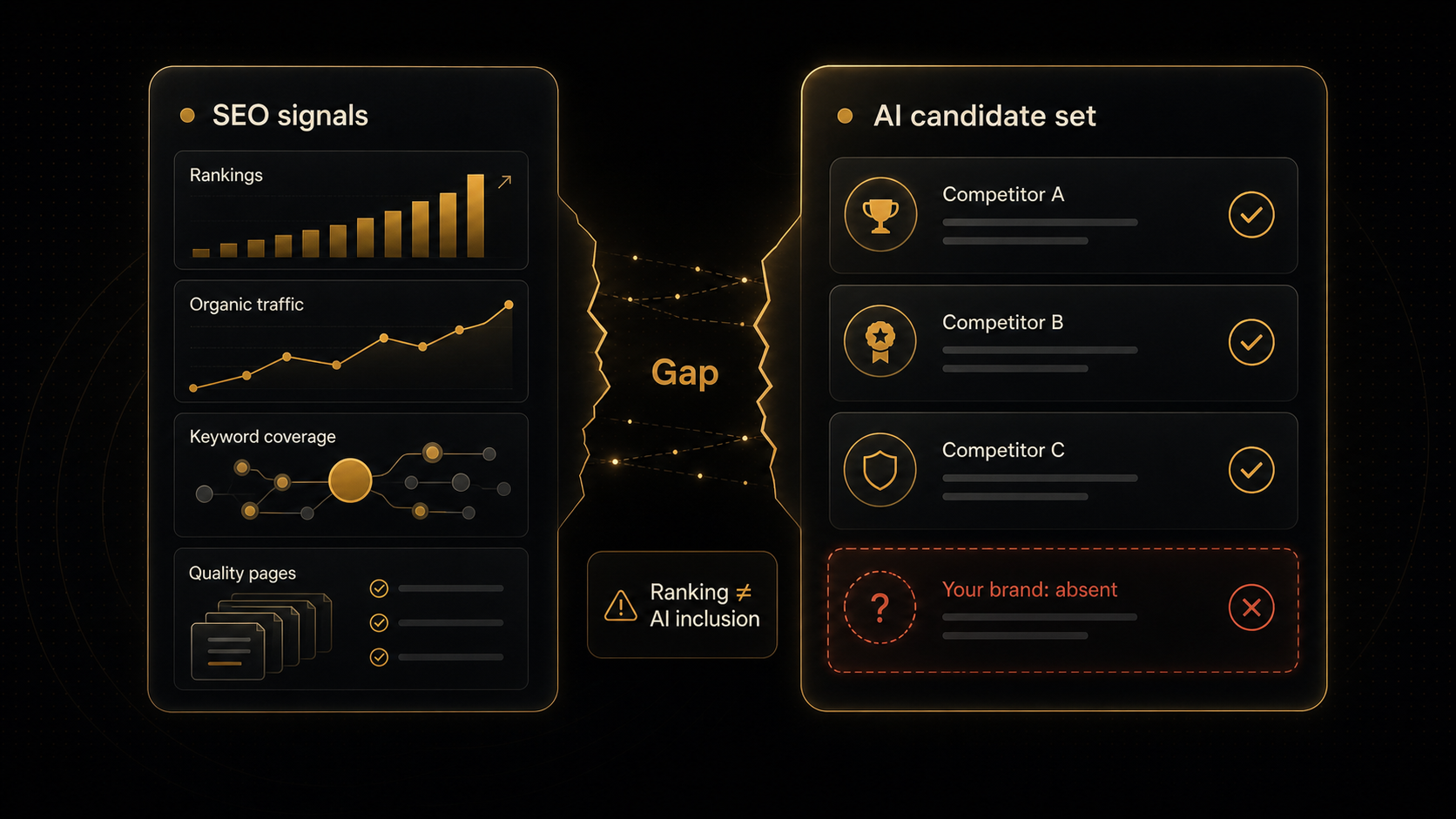
Search ranking reflects how visible a brand is on the results page; an AI recommendation reflects whether the brand is folded into a synthesized answer. The first is a question of access; the second is a question of who gets to define the narrative.
Take Google's generative AI search as an example. Google has explained that AI Overviews and AI Mode may use a query fan-out technique, breaking a single user question into several related sub-questions, searching each one, and synthesizing information across different subtopics and data sources.
That means AI answers are not a simple copy of traditional search rankings.
Across our real project samples at Geolix.ai, we see three patterns again and again.
Pattern 1: The site content is solid, but AI never puts the brand in the candidate set
Some B2B or infrastructure brands already explain their product capabilities on their site and have a reasonable SEO foundation. Yet when a user asks AI "which tools do you recommend," "what are the alternatives," or "which vendors fit this scenario," AI still defaults to competitors, aggregator sites, or the industry's default names.
This usually is not a product-capability problem. It is that AI lacks enough evidence to reliably connect the brand to that buying scenario.
Pattern 2: The brand name triggers a mention, but it rarely surfaces on high-value commercial questions
Some brands are recognized by AI when a user types the brand name directly, but their mention rate drops sharply on non-branded questions like "who is the right fit for me," "which one is easier to integrate," "what are the alternatives," and "which vendor suits a given market."
This shows that AI knows the brand exists but does not know when it should proactively recommend it.
Pattern 3: The site speaks product language while users ask in buyer language
Companies often describe themselves in product language, such as API, SDK, automation, compliance, service regions, and technical architecture.
But when buyers ask AI, they tend to use a different vocabulary:
- Who is the right fit for me?
- Which one is easier to integrate?
- Which one can reduce my failure rate?
- Which one suits a particular market or business scenario?
- Compared with a given competitor, which is better for a mid-sized team?
If this buyer language is not reflected in the site content, FAQs, comparison pages, case studies, and third-party sources, AI struggles to map product capabilities onto the real questions being asked.
The Most Common GEO Problem in Real Projects: Known, but Not Recommended
The observations below come from real GEO project samples at Geolix.ai. To protect client information, we have removed client names, domains, specific competitors, raw queries, and any traceable details, keeping only the sampling scale, intent classification, and diagnostic metrics relevant to the methodology.
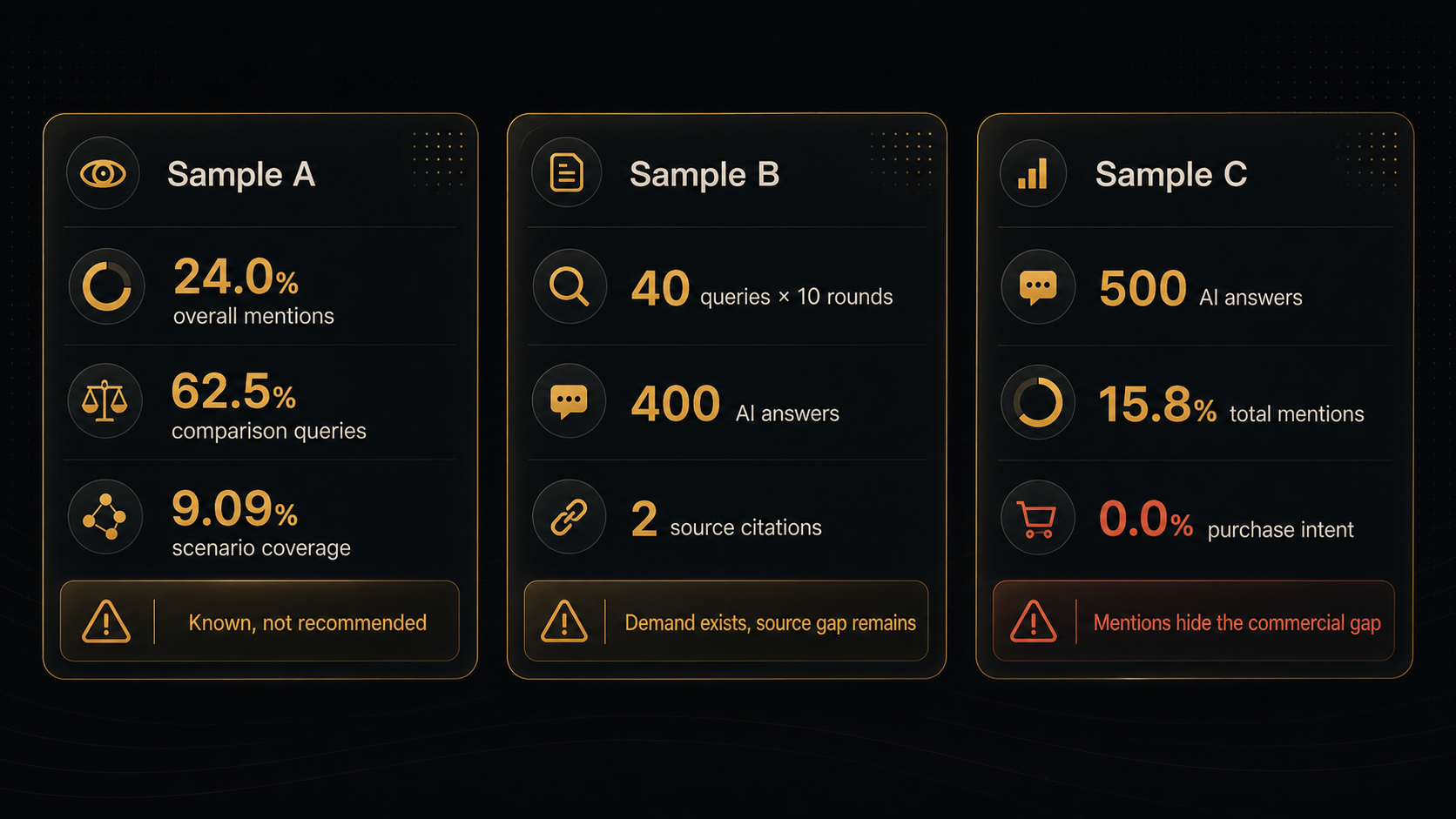
1. AI knows the brand but does not recommend it on scenario questions
In a Web3 payment infrastructure project, the brand's overall AI mention rate was 24.0%, which shows AI was not entirely unaware of it.
But once we broke the data down by intent, the gap became stark: on comparison questions, the brand's mention rate reached 62.5%; yet on scenario questions, where users only describe a business situation without naming any brand, coverage was just 9.09%.
This shows the brand can be recognized by AI yet is not reliably mapped to real buying scenarios.
In other words:
AI knowing who you are does not mean AI knows when to recommend you.
2. The demand is real, but the brand has not entered AI's source set
In a B2B infrastructure project, Geolix.ai ran 40 high-value buyer questions across 10 rounds of live AI testing, collecting 400 answers in total, and validated the demand against 100k+ Reddit and X discussions.
The results showed that demand already existed and AI was already producing vendor shortlists, yet the target brand was cited as a source in only 2 AI answers. The project's core diagnosis: the gap was not in demand but in citability and entity consistency.
This kind of problem shows:
The existence of demand does not mean AI will include you in the answer.
3. The overall mention rate looks decent, but high-value intent is still zero
In a Web3 tooling project, Geolix.ai ran repeated sampling across a set of high-value questions, producing 500 AI answers in total. On the surface, the brand already had a 15.8% in-answer mention rate.
But once we broke the data down by intent layer, the real commercial gap appeared: the mention rate on security / non-custodial questions reached 63.9%, while on questions closer to procurement and integration, such as enterprise-batch, regional recommendation, and cost comparison, several intent layers sat at 0.0%.
This shows:
An overall mention rate can mask the real gap in commercial intent.
GEO diagnosis cannot stop at asking "does AI mention me." It has to keep probing:
- On which questions does AI mention me?
- Does it appear only after the user names me, or does AI recommend it proactively?
- Does it show up on branded questions, or on non-branded buying questions?
- Is it cited from my own site, or defined by third-party sources?
- Is it recommended positively, or buried under stale information and the wrong context?
This is also one of the biggest differences between GEO and SEO: SEO mainly measures ranking and clicks within search results, while GEO focuses on whether a brand enters AI's candidate set, recommendation context, and chain of evidence.
Four common problems with how brands appear in AI answers
1. The brand simply doesn't exist
The AI has no idea your brand exists, or it never mentions you in the questions that matter.
This is typical for early-stage brands, brands creating a new category, sites that are hard to crawl, and projects with too few external sources.
2. Known, but never recommended
The AI knows you when someone asks about your brand by name, but it doesn't proactively recommend you on non-branded questions, buying questions, alternatives questions, or use-case questions.
This is the single most common problem for B2B, SaaS, infrastructure, Web3, and cross-border service brands.
3. Wrong information
The AI gets your pricing, positioning, product capabilities, target users, service coverage, or competitive relationships wrong.
Usually, this isn't because the AI is “making things up”; it's because the brand information across your own site, third-party pages, social profiles, and industry directories is inconsistent.
4. Buried under outdated or negative context
The AI mostly cites outdated, one-sided, or negative information, distorting how the brand comes across.
In one self-custodial wallet project, for example, branded questions could trigger an AI answer, but on P0 decision questions the brand scored 0/9, and its mention rate on comparison questions was likewise 0%; meanwhile, the context around its brand mentions was dominated by content tied to a past security incident.
This kind of problem isn't a matter of “not enough exposure”; it's that the AI's default narrative about the brand has been taken over by the wrong or outdated sources.
GEO priorities are not the same across AI engines
GEO can't be judged by a single answer from a single AI tool. Different AI engines retrieve, cite, and generate answers differently, so brands need to monitor each one separately.
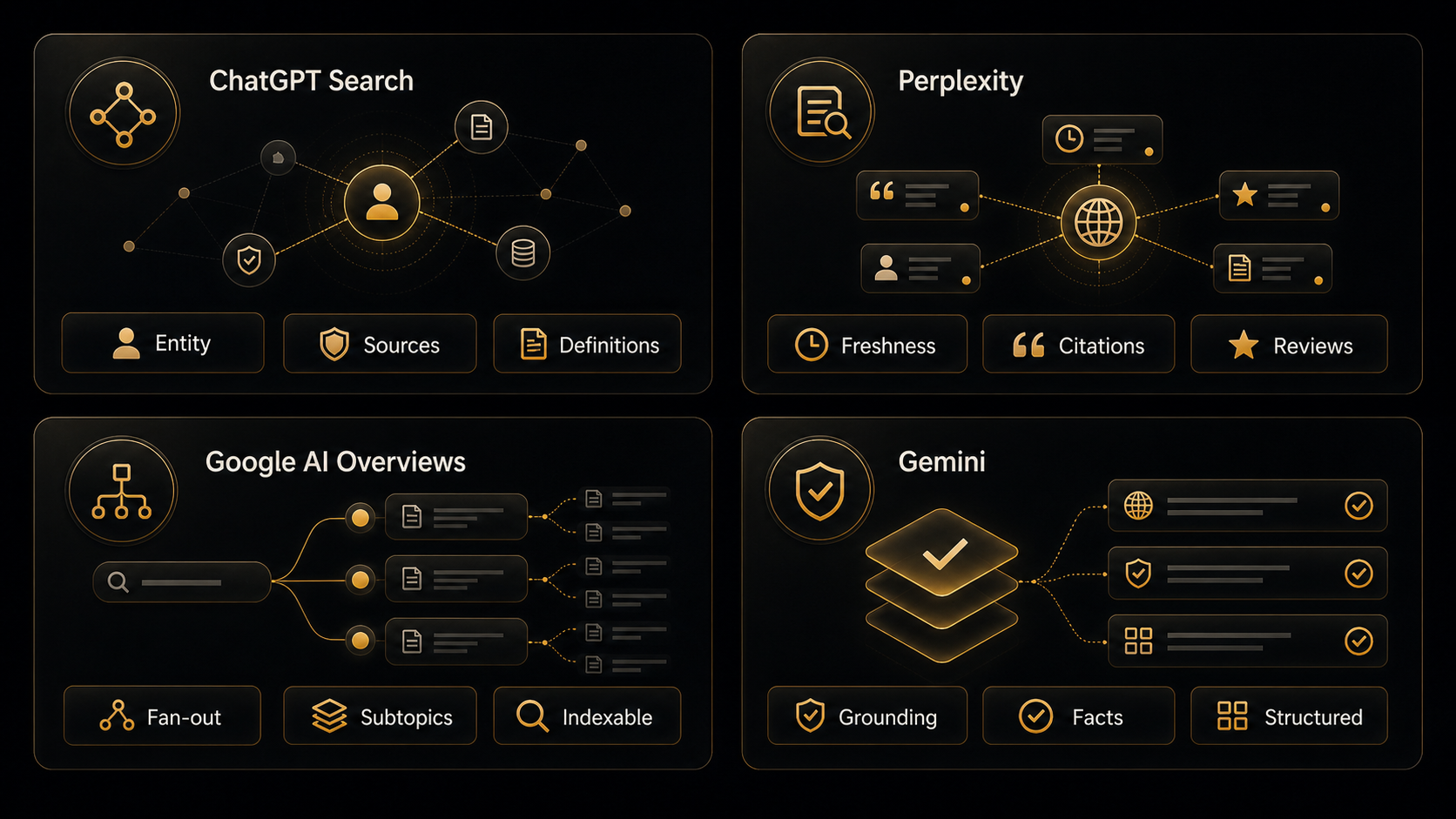
| AI engine / context | How it works | GEO priorities |
|---|---|---|
| ChatGPT Search | When ChatGPT uses search, it can display inline citations and can also surface its sources through the Sources panel. | Brand entity consistency, a crawlable site, authoritative third-party sources, clear definition and comparison pages |
| Perplexity | Perplexity's Sonar API supports web-grounded AI responses, with capabilities such as citations, conversation context, and streaming. | Page freshness, citable passages, heading structure, data sources, third-party reviews and industry directories |
| Google AI Overviews / AI Mode | Google explains that AI Overviews and AI Mode may use query fan-out, synthesizing information from multiple subtopics and sources. | Use-case coverage, sub-question coverage, on-site structure, indexable pages, non-branded intent content |
| Gemini / Google Search Grounding | Gemini's Google Search grounding connects to live web content and provides verifiable source citations. | Google crawlability, entity information, structured content, authoritative pages, verifiable facts |
So a GEO diagnosis should never stop at:
"Did ChatGPT mention me?"
Instead, it should look engine by engine at:
- whether each AI engine knows the brand;
- which sources each AI engine cites;
- whether each AI engine recommends the brand on the same class of question;
- which competitors hold a more stable position across engines;
- how your site, third-party sources, and community content each play different roles in different engines.
Will GEO replace SEO?
No.
SEO remains the foundation for a site being discovered, crawled, indexed, and understood. Google has been explicit that AI Overviews and AI Mode still follow core SEO best practices; to appear as a supporting link, a page needs to be indexed and meet the requirements for search appearance.
From Google Search's point of view, optimizing for AI Overviews and AI Mode still falls under SEO in the broader sense, because these AI features continue to rely on Google's search index, ranking systems, and quality systems.
But from the perspective of brand management and growth teams, GEO needs to be managed on its own.
That's because GEO is concerned with more than page rankings. It asks:
- whether the brand makes it into AI answers;
- whether the brand is described accurately;
- whether the brand is proactively recommended by AI;
- whether the AI cites trustworthy sources;
- where the brand stands relative to competitors;
- whether the brand is buried under wrong, outdated, or negative context.
A mature growth team shouldn't be asking:
SEO or GEO?
It should be asking:
How do we get SEO and GEO working together to serve the brand's search visibility?
How do GEO and SEO work together?
SEO gives GEO its infrastructure
A website that is crawlable, indexable, cleanly structured, and complete in its content is far easier for both search systems and AI systems to understand.
Google itself notes that structured data gives it explicit cues about what a page means, helping it understand the page's content.
For GEO, the value of SEO shows up mainly in how it:
- makes a site easier to crawl and understand;
- builds high-quality content assets;
- improves machine readability through structured data and a clean page architecture;
- helps a brand accumulate external authority signals;
- makes it easier for AI to find stable, complete, trustworthy brand information.
GEO informs SEO's question bank and content strategy
GEO upgrades SEO from "keyword matching" to "answering questions."
Traditional SEO tends to start from keywords, whereas GEO puts the emphasis on the complete questions real users actually pose to AI. For example, users don't just search for "GEO agency", they ask:
In turn, these questions help content teams surface:
- the decision-stage questions users genuinely care about;
- the content gaps the website hasn't yet answered;
- the reasons AI fails to summarize the brand correctly;
- the semantic scenarios where competitors get recommended more often;
- how third-party sources shape perception of the brand.
The value of GEO isn't only getting a brand into AI answers; it also pushes content to evolve from "keyword coverage" toward "answering questions, expressing evidence, and supporting decisions."
Should a company do SEO or GEO first?
It depends on where the company stands today, but most brands shouldn't treat the two as separate efforts.
Case 1: A weak website foundation
If the site has problems with crawling, indexing, page structure, content quality, or technical health, fix the SEO foundation first.
Prioritize:
- robots.txt;
- XML sitemap;
- page crawlability;
- indexing issues;
- site and section structure;
- page speed;
- duplicate content;
- quality of the core pages;
- structured data.
Case 2: Stable SEO traffic already in place
If the brand already has steady organic traffic, it should add GEO monitoring as soon as possible.
The point isn't to immediately publish more articles; it's to first get clarity on:
- whether AI knows the brand;
- whether AI describes the brand correctly;
- whether AI cites your own site or trustworthy third-party sources;
- whether AI recommends competitors on the questions that matter;
- whether AI overlooks the brand's strengths;
- whether AI files the brand into the wrong category.
Case 3: A complex-decision market
If the company is expanding internationally, a new category, high-ticket sales, complex decisions, or a market with strong competitors, SEO and GEO should be planned in parallel.
The reason is simple: users don't make decisions through a single channel.
AI answers, search results, media coverage, community discussion, and your own site content all shape how users perceive you.
Summary: SEO manages your search results, GEO manages your AI answers
SEO addresses how visible your brand is in search results.
GEO addresses how visible your brand is in AI answers.
In the age of AI search, users don't necessarily click through to web pages and compare vendors one by one. They may simply ask AI: who's right for me, what are my options, which provider is more reliable, which product fits my situation best.
That means a brand has to compete not only for search rankings, but for the right to define the narrative inside AI answers.
If you want to know where your brand really stands in AI search, start with a single AI-visibility diagnosis.
Geolix.ai tests how your brand performs across AI search and Q&A surfaces, including ChatGPT, Perplexity, Gemini, Google AI Overviews / AI Mode, and more, based on your target customers, core business scenarios, and main competitors, so you can see clearly:
- whether AI knows your brand;
- whether AI describes your product and positioning correctly;
- whether AI recommends you on non-branded questions;
- which competitors AI tends to recommend more often;
- which first-party and third-party sources AI is citing;
- which pages, entity information, and external sources are shaping your AI visibility.
You walk away with a clear diagnostic readout:
AI mention rate + AI recommendation rate + candidate-set entry + competitor SOV + citation-source analysis + an evidence-gap checklist.
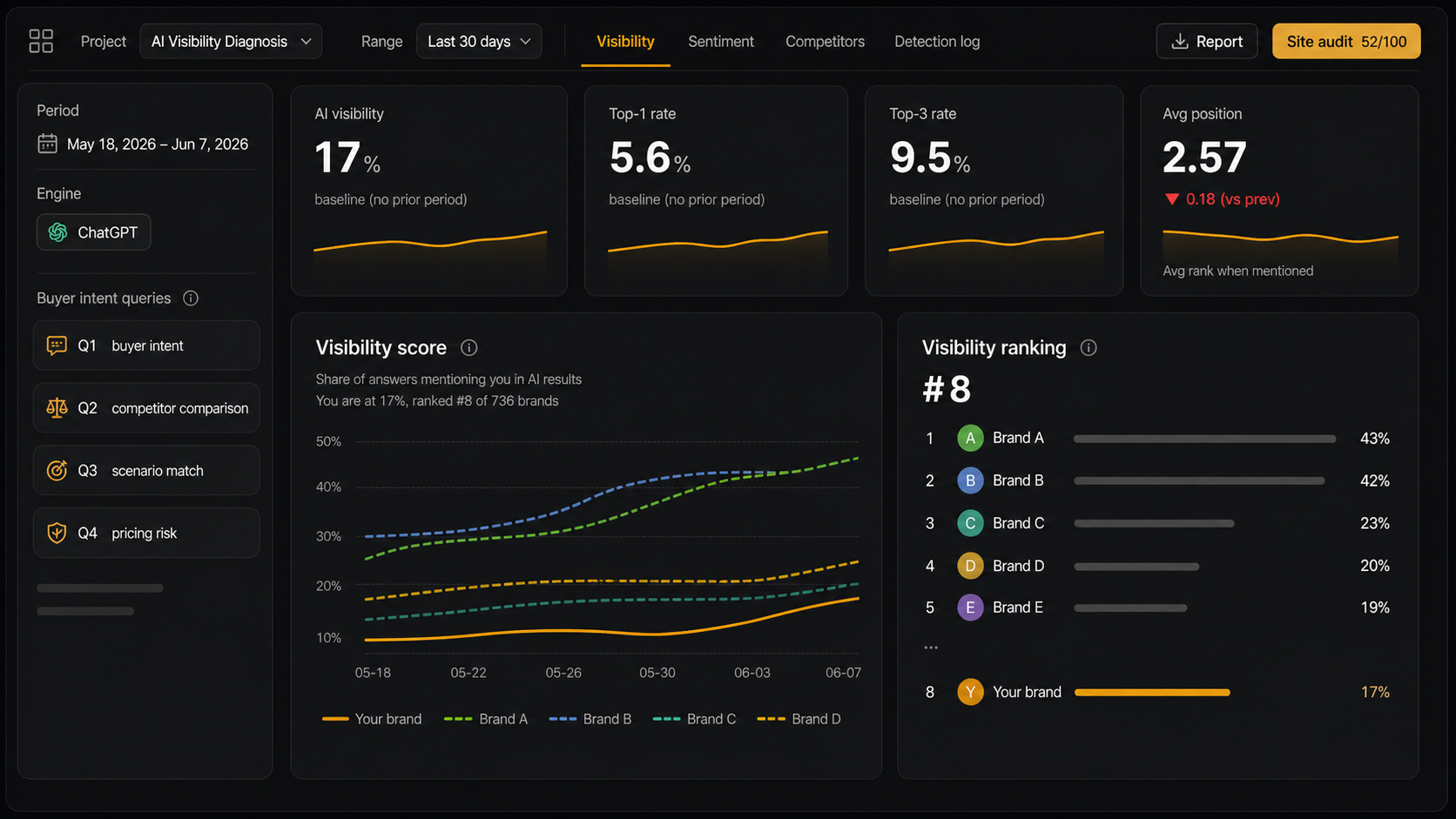
Rather than guessing whether AI understands you, the more important move is to see the data first.
Frequently asked questions
What's the biggest difference between GEO and SEO?
SEO optimizes rankings, impressions, clicks, and organic traffic on the search results page; GEO optimizes mentions, recommendations, citations, and accurate descriptions inside AI-generated answers. SEO is more about whether users can find you on the results page, while GEO is more about whether AI brings you into the answer, and on what grounds it recommends you.
Will GEO replace SEO?
No. GEO is an extension of SEO into AI search and generative answers, not a replacement for it. Traditional search, AI Q&A, social platforms, and your own site all shape user decisions together. Brands need to manage their visibility in search results and their visibility in AI answers at the same time.
If our SEO is already strong, do we still need GEO?
Yes. Strong SEO means your pages have a foundational advantage in traditional search, but when AI generates an answer it synthesizes information from your own site, third-party reviews, media, community discussions, and structured data. You still need to confirm whether AI knows you, describes you correctly, and recommends you on the questions that matter.
What does GEO mainly optimize?
GEO mainly optimizes brand entity information, clusters of user intent, citable content, a chain of trustworthy sources, and AI answer performance. The goal isn't to stuff keywords, it's to give AI enough evidence on real questions to understand your positioning, use cases, differentiators, and boundary conditions accurately.
How do you measure GEO performance?
GEO can be measured with AI recommendation rate, mention rate, candidate-set entry, answer ranking, citation-source quality, information accuracy, competitor Share of Voice, and AI referral traffic. The key is to keep the questions, engines, and sampling cadence consistent, then track changes over time, rather than drawing conclusions from a single test.
Which AI tools does a GEO diagnosis usually look at?
A GEO diagnosis typically tests several AI search and Q&A entry points at once, for example ChatGPT, Perplexity, Gemini, and Google AI Overviews / AI Mode. Different AI engines draw on different sources, cite differently, and structure answers differently, so you can't judge a brand's visibility from a single answer on a single tool.
How long does GEO take to show results?
GEO results depend on the brand's current foundation, content gaps, site crawlability, third-party source quality, and how often the AI engines update. As a rule, GEO isn't something to measure by "a fixed ranking within a few days", it's better tracked by keeping the questions, engines, and sampling cadence consistent and watching changes in mention rate, recommendation rate, citation sources, and competitor Share of Voice.
Can GEO guarantee that AI will recommend my brand?
No. GEO can't manipulate AI answers and shouldn't promise a fixed recommendation. The value of GEO is identifying where your brand has visibility gaps in AI answers, then improving the odds that AI understands and cites the brand correctly, through site content, brand entities, structured information, and third-party sources.
Can AI referral traffic fully measure GEO performance?
No. AI referral traffic is an important metric, but it isn't a complete one. Some AI-search performance can't be fully attributed to referral traffic. Take Google Search: site performance in AI Overviews and AI Mode is folded into overall Web search performance in Search Console, rather than being broken out into a separate AI report.
Why does B2B SaaS need GEO even more?
B2B SaaS buying decisions usually involve comparisons, alternatives, integration difficulty, pricing, use cases, risk, and service capabilities. Users are increasingly likely to put these complex questions straight to AI. If the brand isn't understood and recommended correctly on those questions, it may already have lost to a competitor before the prospect ever reaches its site.