

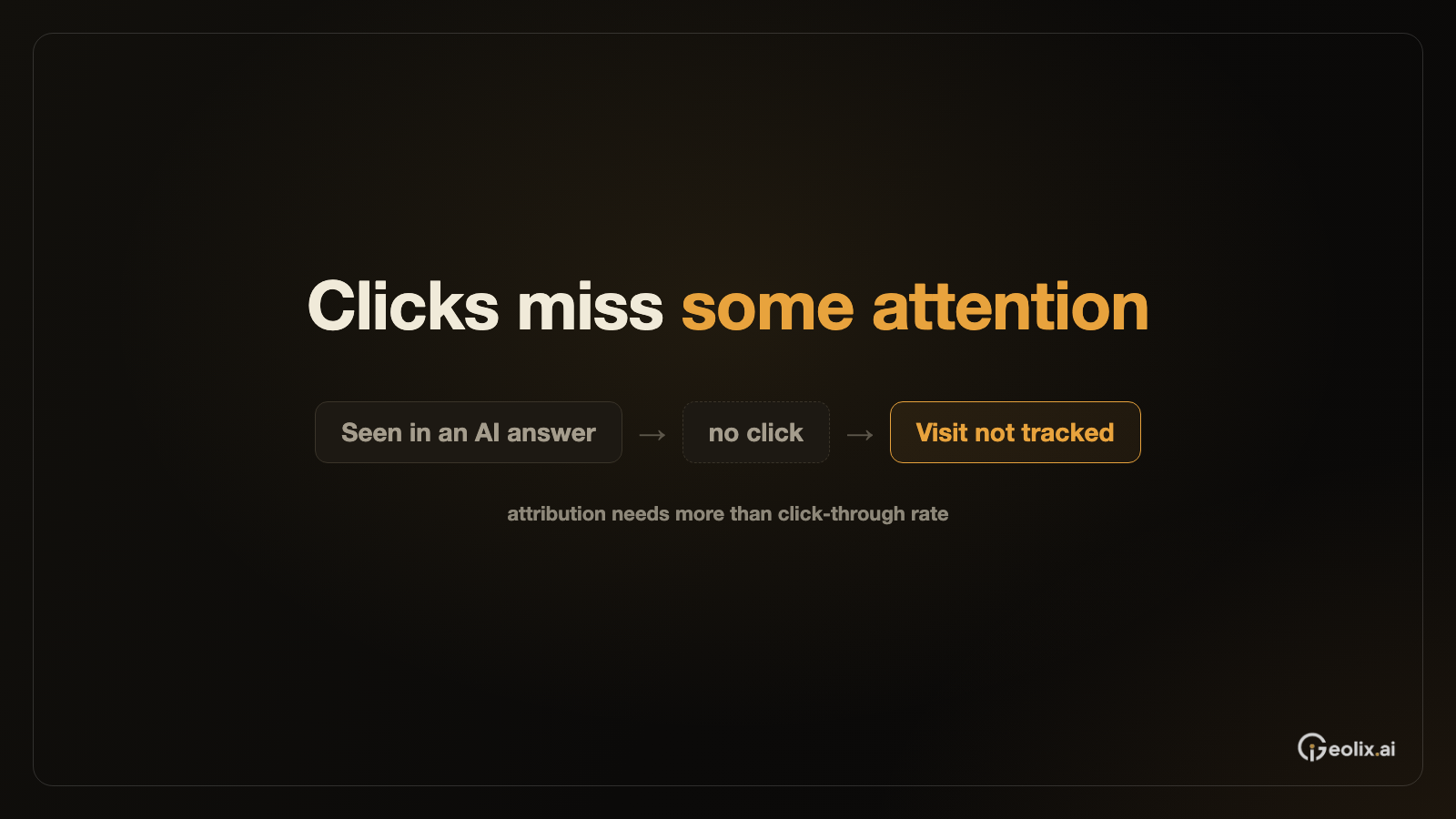

Key takeaway: The evidence supports a narrow conclusion for AI search and SEO teams: website attribution should not rely on click-through rate alone, and.
Key Takeaway
The evidence supports a narrow conclusion for AI search and SEO teams: website attribution should not rely on click-through rate alone, and advertising-platform reach should not be treated as proof of AI search visibility. Bitly’s survey points to broken landing experiences, excessive redirects, missing tracking data, and deliberate non-clicking as reasons that site analytics can understate attention. AdExchanger’s Revry interview describes a programmatic exchange built around relevant reach across diverse-owned and multicultural publishers, but it does not establish any effect on AI search rankings, citations, or organic website traffic.
For AI marketing teams, those are separate measurement questions. A brand may be visible in an AI answer without receiving a visit. A social or advertising click may arrive without a reliable referrer. An advertising platform may deliver contextually relevant reach without changing how an AI search system cites a brand. The two source materials do not prove a shared AI search improvement, so any strategy should preserve that boundary.
Separate AI search visibility from website attribution
An AI search SEO review should distinguish at least three signals: whether a brand or page appears in an AI-generated answer, whether the user visits the website, and whether analytics can identify the visit’s source. The Bitly article notes that Reddit is trusted by a meaningful share of consumers when they decide whether to click, and connects that observation with the SEO industry’s interest in sources cited by AI answers. That is a reason to monitor source visibility, not evidence that Reddit or any other platform increases AI search traffic.
The same article shows why a visit may disappear between intent and reporting. Bitly’s survey found that 79% of consumers had abandoned an action when a social link sent them to a generic homepage instead of the relevant destination. Sixty-one percent expected a social video link to reach a product page, while only 8% expected a homepage. Excessive redirects or browser security warnings caused 76% of respondents to abandon an action, and another 76% cited a promised promotion code missing from the landing page.
Those figures support a landing-page and attribution audit. They do not support a claim that short links improve AI search rankings or that a better destination automatically produces more organic search traffic.
Treat advertising-platform reach as a different signal
AdExchanger reports that Revry’s PrismRiot is a programmatic ad exchange connecting advertisers with diverse-owned and multicultural-focused publishers. The interview presents relevance as part of the value proposition: advertisers want scale without buying audience extension deals on random platforms, while publishers gain another route to advertising revenue. Revry’s FAST programming and PrismRiot therefore illustrate a media-planning question about context, audience relevance, and supply paths.
The interview does not discuss AI search crawling, generative-answer citations, SEO rankings, Google Ads performance, or website attribution from AI referrals. It would therefore be unsupported to infer that PrismRiot, FAST content, or programmatic advertising increases a brand’s AI search visibility. An AI marketing report should list ad impressions and qualified reach separately from AI-answer appearances, organic sessions, and attributed conversions.
Audit clicks when AI search measurement looks weak
The Bitly material also cautions against reading low CTR as a complete measure of interest. Its survey found that 93% of consumers had deliberately avoided clicking a link to prevent an algorithm from serving them more similar content. Forty-three percent said they did this always or often, rising to 45% among Gen Z and Millennials. A person can therefore notice a message, remember a brand, or use information without creating a measurable website session.
Attribution is also incomplete on the technical side. Marketers and creators surveyed expected social links to generate an average of 39% of their revenue over the following 12 months, yet tracking traffic across channels and formats was the most frequently cited challenge, at 36%. In-app browsers may remove tracking parameters or cookies, causing sessions to appear as direct or unattributed traffic. Teams should test links inside relevant in-app browsers, inspect the final landing page, and compare analytics with a post-purchase or post-signup “How did you hear about us?” question.
A practical report can place AI-answer mentions, cited URLs, organic sessions, direct traffic, unattributed sessions, advertising reach, and conversions in separate columns. That structure helps prevent a platform’s reach from being mistaken for an AI search outcome and prevents a missing referral from being mistaken for no demand.
Method and Limitations
Teams can verify the measurement chain by inventorying links in social profiles, pinned posts, video descriptions, and paid social placements. Record each destination, test mobile and in-app browsing, check regional or language redirects, confirm that promised codes appear on the page, and count every redirect before the final destination. If short links are used, a branded domain controlled by the company provides more ownership than embedding a vendor’s generic domain throughout published content. The team should also ask how links can be exported or redirected if the vendor relationship ends.
The Bitly survey covered 1,006 U.S. consumers and 501 U.S. marketers and creators surveyed from July 27 through August 5, 2026. It used an opt-in online panel and was unweighted, so the figures should be treated as directional rather than representative of all consumers or marketers. The reported 2.3x click lift for custom-domain links came from Bitly sales material, not from the survey itself, and cannot be used as evidence of AI search or SEO performance.
The Revry article is an interview with co-founder and chief operating officer Alia J. Daniels. It supports the description of PrismRiot’s advertising role and Revry’s FAST strategy, but it provides no AI search visibility data, citation data, organic traffic increment, or attribution test. Those missing measures are the boundary of what can be concluded from the available evidence.
References
Search Engine Journal: 79% Of Consumers Quit Social Links That Land On A Homepage – Bitly Data
AdExchanger: Programmatic, FAST And Queerness – The Trifecta Of Revry’s Future