
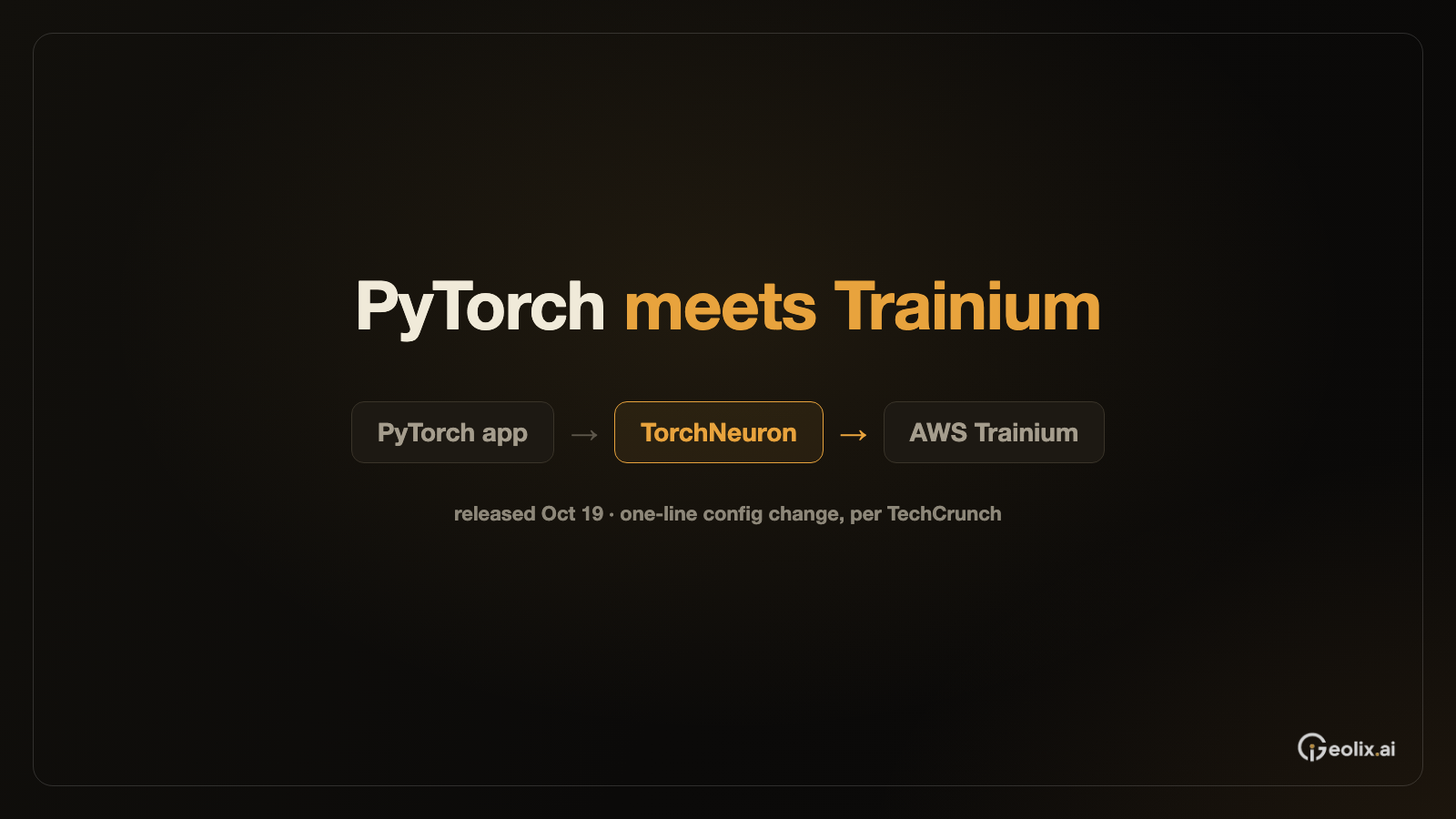

Key takeaway: Amazon Web Services released TorchNeuron on October 19, giving developers a way to move artificial intelligence applications built with PyTo.
Amazon Web Services released TorchNeuron on October 19, giving developers a way to move artificial intelligence applications built with PyTorch onto Amazon’s Trainium chip. TechCrunch reported that the tool can let a PyTorch application run on Trainium after a one-line configuration change, without requiring a code rewrite. The report presents this as an option for AI startups and developers, not as proof that every PyTorch application can be moved without additional work. Compatibility will still depend on the framework features and hardware support used by each application.
Amazon targets Nvidia’s software advantage
The competitive issue is broader than the chip itself. Nvidia’s CUDA software infrastructure has helped make its GPUs the default hardware choice for many AI applications written with PyTorch. Amazon says TorchNeuron is adapted from PyTorch, so developers who already know the framework can use familiar concepts. AWS also claims that about 85% of AI applications are written with PyTorch. That percentage is an Amazon claim reported by TechCrunch, rather than an independently verified statistic from the two sources.
Amazon said it will also contribute changes upstream to the main PyTorch project. The stated goal is to remove code that ties the framework too closely to particular chips and make PyTorch more hardware-agnostic. TechCrunch noted that PyTorch users can already port applications to AMD GPUs and Apple chips through relatively simple configuration changes. TorchNeuron is therefore not the only alternative route, and the practical effect of Amazon’s proposed changes remains unproven.
Where Trainium fits in the cloud
AWS argues that Trainium can support both training and inference. Training teaches a model, while inference is the stage in which a finished model responds to requests. Amazon says using one chip platform for both stages, together with AWS cloud infrastructure, could improve economics across a complete workload. This does not mean AWS offers the lowest price in every per-token comparison.
TechCrunch quoted Colin Brace, vice president of technology software at AWS Annapurna Labs, saying that startups can use AWS infrastructure while moving from a prototype to production instead of relying on a single-purpose compute provider. The report also cited Deepgram as an example. AWS said the voice application provider moved to Trainium and processed 70% more audio per dollar at production-grade accuracy. That figure is a company claim, not an independent measurement, and it should not be generalized to all AI workloads.
A separate AI search use case
Search Engine Roundtable reported another AI-related launch on the same date: an “Is It New?” tool developed by its operator with RustyBrick. Users can upload a screenshot, add a description, and highlight the relevant area. The tool then reads and classifies the image before matching it against non-hero images in the site’s stories from the past 23 years. Its purpose is to help determine whether a Google, Bing, or other search feature appears to be new.
Access is controlled through an emailed code that also subscribes the user to the site’s newsletter. The operator said this restriction reflects an operating cost of about seven cents per run. The service stores uploaded images for debugging, uses several AI models, limits daily scans, and can impose an additional cap when usage is high. New stories are added to the image index daily, according to the report. The tool illustrates how AI can combine screenshot interpretation with an archive, but its findings still require manual review and do not constitute an official confirmation from Google or Bing.
Method and Limitations
The two reports directly support the product releases and the operating details described here. They do not establish that TorchNeuron is broadly deployed or that it has changed Nvidia’s position in AI hardware. They also do not establish that the AI Scan tool is an official search-engine feature. Performance, cost, and compatibility claims should therefore be separated from independent validation.