
Key takeaway: Coty is investing in GEO, while AI search may narrow nonprofit discovery and favor better-documented organizations.
Key Takeaway
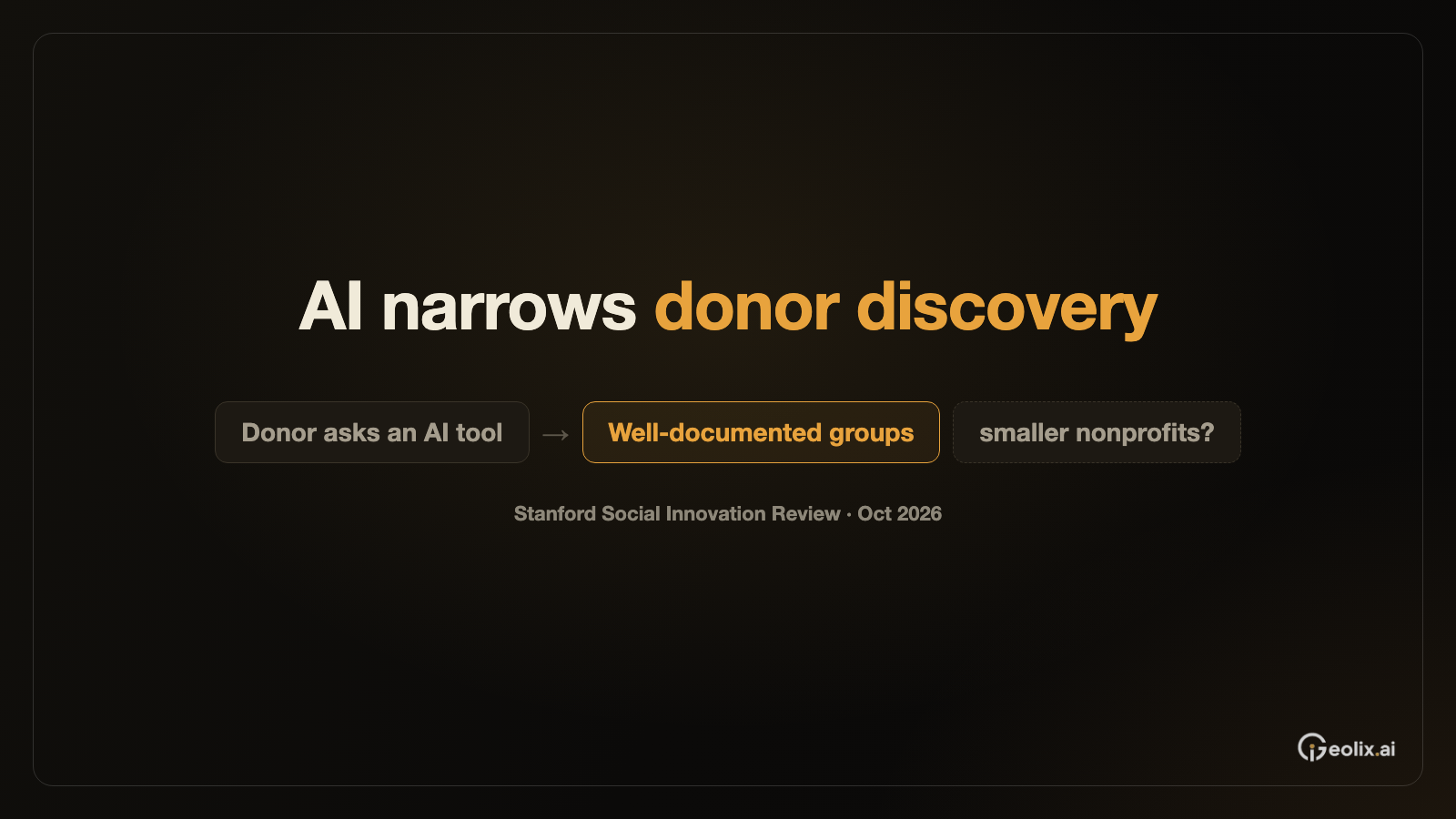
Two reports published on October 29 show how AI search is changing discovery for both commercial brands and nonprofit organizations. Coty has formed a strategic partnership with Brandlight, an AI visibility platform, to strengthen its generative engine optimization (GEO) capabilities and increase the appearance of its brands in recommendations from AI assistants and generative search platforms. Separately, Stanford Social Innovation Review reports that nonprofits face an AI search visibility gap as recommendation tools narrow donor discovery and favor organizations with stronger documentation and third-party validation.
These are different sectors and should not be treated as evidence of one advertising platform rollout or one universal ranking rule. Together, however, they point to a broader operating task beyond traditional SEO. Advertising platform and AI marketing teams increasingly need to understand whether public information is clear enough for AI systems to identify and present when users search by need, problem, or preference rather than by organization or brand name.
How Coty is applying GEO to AI marketing operations
Coty said the Brandlight partnership will give brand teams tools and insights to adapt to changing discovery behavior. The report says early pilot work covered content, product detail pages, creator assets, digital PR, and launch toolkits. Coty said these optimizations increased how often its brands appeared in AI-generated recommendations, including situations where shoppers searched for a beauty concern or need instead of a specific brand.
The article also notes that Coty previously partnered with Pencil, a generative AI marketing platform, to place AI-produced content at the center of content production for its Consumer Beauty divisions. The available reporting supports a partnership, pilot activity, and an operating focus on content and visibility. It does not establish a full rollout across all Coty markets or brands, nor does it report sales growth, advertising return, or a specific brand-ranking outcome.
What the nonprofit SEO visibility gap shows
Stanford Social Innovation Review cites M+R’s 2026 benchmark study of 180 nonprofits, which found that organic search traffic declined consistently during 2025. The study attributed the trend to AI-generated overviews discouraging clicks to source pages. The article also cites Blue State research showing a 35% decline in organic search traffic to 24 nonprofit websites during the first 10 months of 2025 compared with the same period in 2024. These figures apply to the cited samples and periods, not automatically to every nonprofit or search platform.
The article further cites a Whole Whale evaluation of multiple AI models that found a “herding effect” in charity recommendations. Lists reportedly clustered around roughly 100 nonprofits within individual cause areas, although the US social sector has more than 1.9 million registered organizations. Giving Compass’s AI search experience inside the Charity Navigator website processed more than 22,000 queries during an initial three-month pilot. About 80% were cause-based rather than organization-based, and users of the AI search tool completed donations at twice the rate of users who did not use it. That finding suggests AI can shorten the path to action while increasing the importance of which organizations and signals are surfaced.
Method and Limitations
Readers can verify the reported partnership scope, the assets included in Coty’s pilot work, and the samples, time periods, and definitions used in the nonprofit studies. The public reports do not show that Coty has deployed GEO across every brand or market, and they do not prove that AI search will favor the same organizations in every query. A practical visibility check is to compare an organization’s website, third-party profiles, annual reports, and other public records for consistent descriptions of its mission, programs, and outcomes, then test how different AI tools summarize that information. Such checks can reveal gaps in public information, but they cannot guarantee recommendation placement.