
Key Takeaway
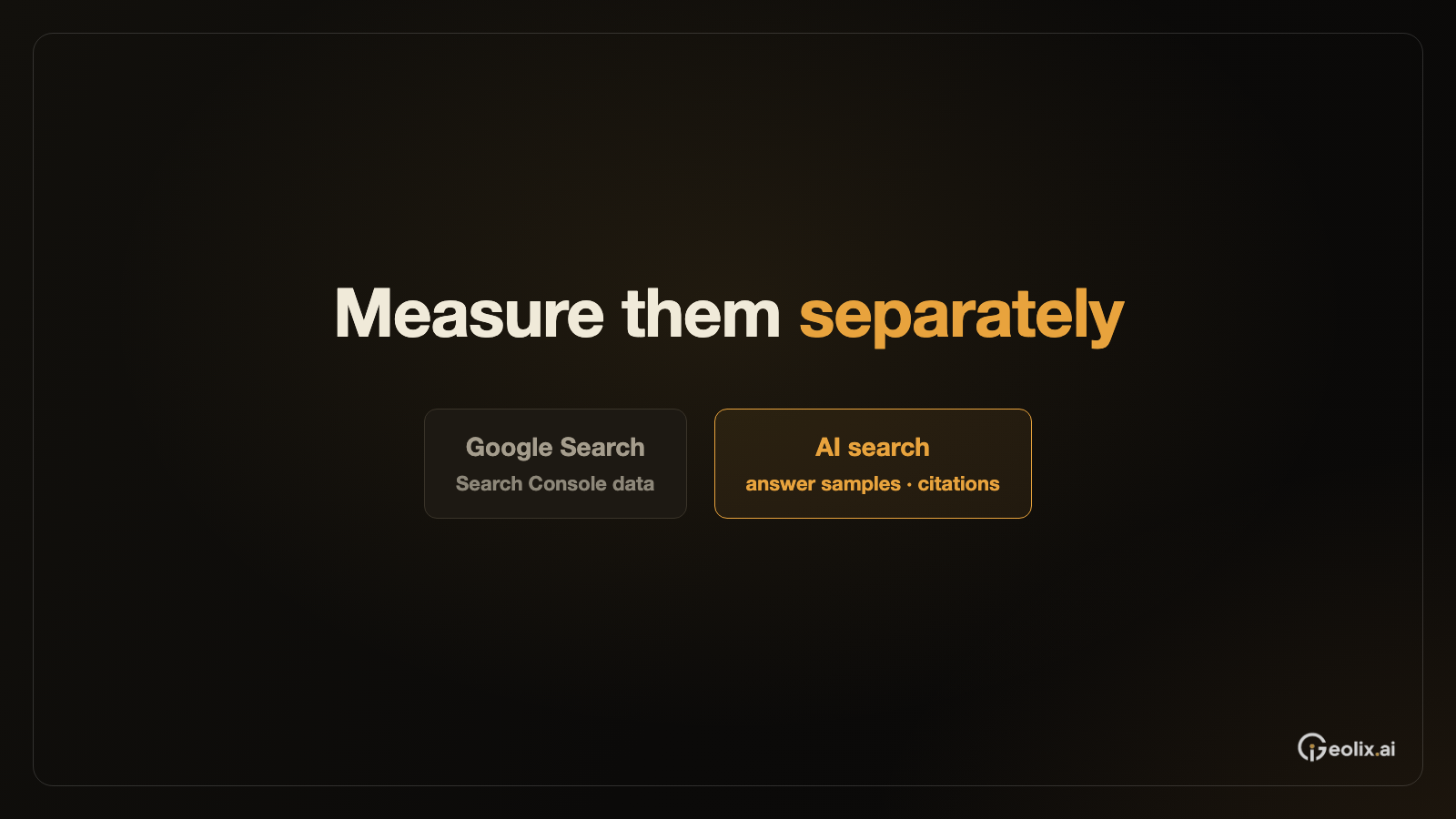
A team asking whether its brand is visible in AI search cannot answer the question with Google Search Console data alone. Google Search Console is useful for verifying a site’s performance in traditional Google Search, including the queries that produce impressions and clicks, click-through rate, average position, links, and page experience. Semrush’s account of its own AI visibility work points to a separate measurement layer: track whether a brand appears in answers to defined prompts and how often it appears compared with competitors. Both layers concern search visibility, but they measure different surfaces. Traditional search clicks should not be treated as proof of influence in an AI-generated answer.
What Google Search Console Shows About SEO Visibility
Google Search Console can serve as the evidence base for conventional SEO reporting. It provides actual query, impression, and click data for a site rather than relying only on third-party estimates based on crawled search results. Teams can use it to see which queries surfaced a page, how many impressions and clicks it received, how click-through rate changed, and how average position moved. For content teams, these reports help test whether new or revised pages expanded visibility. For technical SEO teams, page experience and index-status reports help check whether technical work affected how pages can be found in Google.
The data can also be organized around specific client or business tasks. A team can compare a period before and after a campaign, inspect a target query, review external and internal links, and check the index status of URLs on a large site. The boundary matters: Google Search Console describes a site’s performance in Google Search. It can show whether users saw and clicked a page in traditional results, but it does not by itself show whether ChatGPT, Google AI Mode, or another generative system recommended the brand.
How AI Search Visibility Should Be Measured
Semrush describes two metrics for its AI visibility work. Visibility asks whether the brand appears at all in an answer to a target prompt. Share of voice asks how frequently the brand is mentioned across those answers relative to competitors. A citation is not the same as a recommendation, and the use of a company’s content does not necessarily mean that the company has entered the buyer’s consideration set. Citation counts therefore cannot replace prompt-level visibility and competitive share-of-voice measures.
Prompt selection determines whether the measurement answers a useful business question. A broad prompt such as “AI tools” says little about whether a brand is present when buyers compare solutions. A prompt focused on enterprise AI visibility platforms is closer to a purchasing decision and can reveal whether the brand appears alongside competitors at that moment. Teams can begin by testing prompt variations manually, establish a baseline, and then record brand mentions, competitor mentions, and the accuracy of the answer. Semrush also notes that AI answers are non-deterministic: the same prompt may produce different responses within one day. A single answer should therefore not be presented as a stable trend.
How SEO and AI Search Reporting Can Work Together
The practical approach is to place both measurement layers in one visibility workflow rather than make one substitute for the other. The first layer uses Google Search Console to answer how a site performs in Google’s traditional search results: which queries produce visibility, how many impressions and clicks follow, and what happens to relevant pages and links. The second layer uses a defined prompt set to answer whether the brand appears in AI answers, how often it appears against competitors, and whether external sources describe it accurately.
The same content principles can support both layers. Clear headings, direct answers, specific evidence, and well-organized pages make information easier for search users to understand and easier for AI systems to extract. They do not guarantee that a brand will appear in an AI answer. AI systems also draw on sources beyond a company’s own domain, so teams may need to monitor pages on Reddit, LinkedIn, Medium, and industry publications when those pages are being cited. A stronger result in Google Search Console still does not prove that the brand’s competitive position in AI search improved at the same time.
Method and Limitations
A team can establish separate baselines for traditional and AI search. On the traditional-search side, record the date range, queries, impressions, clicks, click-through rate, average position, and relevant pages. On the AI-search side, define a fixed set of prompts with a clear topic or buying intent, then record visibility, competitor share of voice, and description accuracy on a regular schedule. Reports should state the platforms, prompt scope, dates, and metric definitions. Short-term movement should be treated as a signal for continued observation, not immediate proof that one content change caused the result.
The public material does not establish that any single content tactic guarantees stable AI search placement, nor does it show that Google Search Console directly measures brand recommendations inside generative answers. Semrush also says that several initiatives were run at the same time, so the individual contribution of each tactic could not be fully isolated. It further describes revenue attribution from AI influence as difficult. These metrics can help teams evaluate visibility and positioning, but they should not be presented as definitive proof of conversion or revenue causation.