
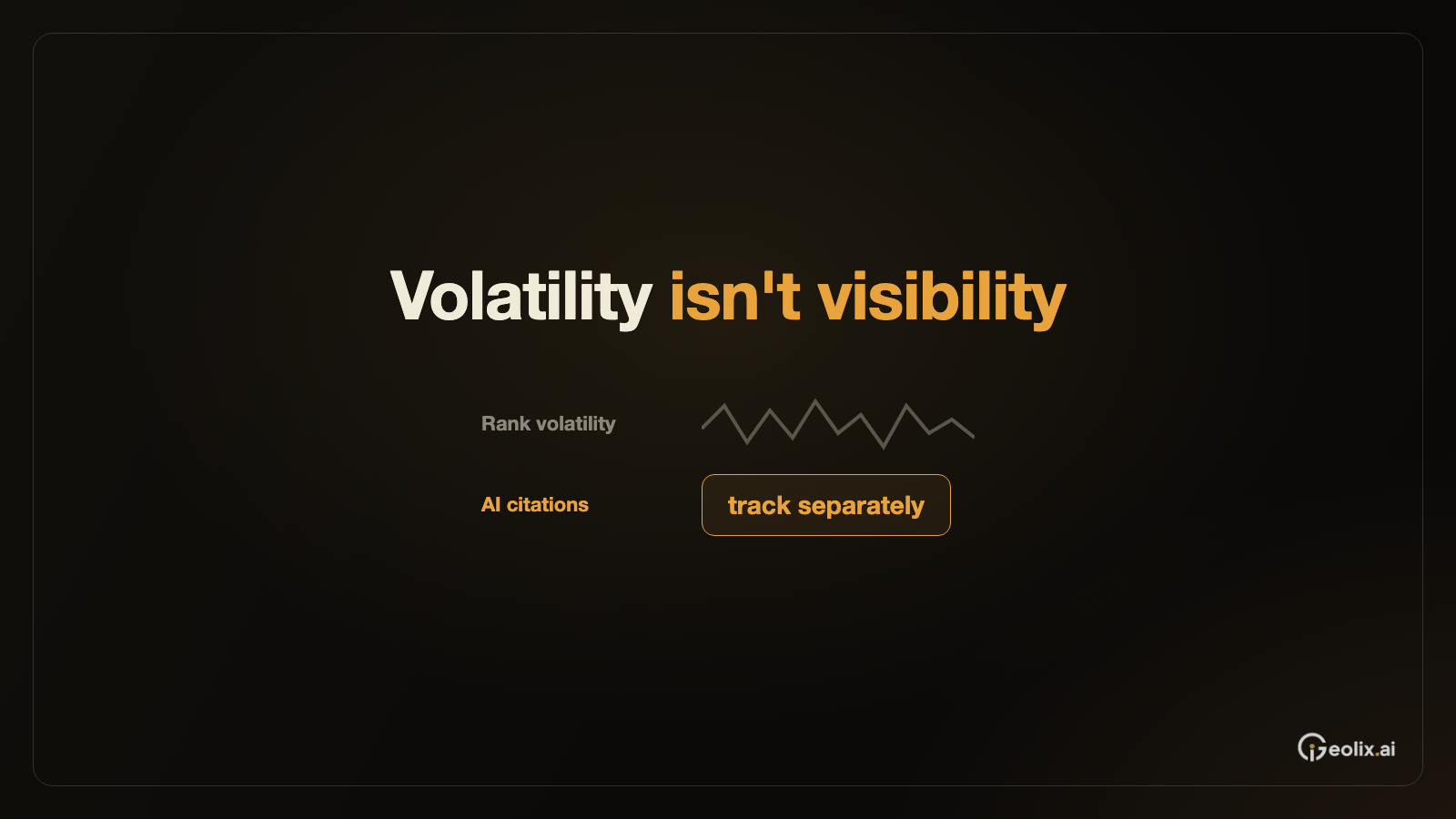

Key takeaway: Google ranking volatility does not prove an update or measure AI visibility, so track search movement and AI citations separately.
When Google rankings and traffic move sharply, marketing teams often ask two different questions as if they were one: is Google running an update, and is the brand becoming more visible in AI search? The available evidence supports a more careful approach. Traditional Google performance and AI search visibility should be measured separately. Google data can show whether search performance is behaving unusually. AI visibility measurement must show whether a brand appears in generated answers, which sources are cited, and whether those appearances cover the queries that matter.
Treat Google volatility as a signal to verify
Seroundtable reported unusually high SEO industry chatter and signs of ranking volatility on October 20 and 21, 2026. The article also warned that third-party tracking tools might still be struggling to measure the movement accurately. Its description was therefore an unconfirmed Google search ranking update, not a confirmed core update. The report collected examples of inconsistent movement in impressions, average position, clicks, real-time traffic, and conversions. Other practitioners reported traffic gains, which reinforces the point that one site or one metric cannot represent the whole search ecosystem.
For a team investigating a decline, the first action should not be to label the event a core update or attribute a click drop to AI search. Record rankings, impressions, clicks, traffic, and conversions by date, while documenting the source, observation window, and whether Discover is included. If third-party volatility tools disagree, or are still refining their tracking, treat the signals as evidence to investigate rather than proof of a specific Google event.
Measure AI visibility through queries and citations
The Search Engine Journal article on AI search visibility recommends expanding the measurement target beyond conventional rankings to brand appearances and citations in AI-generated answers. A practical starting point is to create a set of core product or service queries, test them across multiple AI platforms, and record whether the brand appears and which sources the answers cite. The basic visibility rate is the number of tested queries where the brand appears divided by the total number of tested queries.
That rate describes only the selected queries and testing period. It does not represent every user, platform, or answer. The audit also recommends comparing informational, consideration, and transactional queries. A page can perform well in traditional Google search and still fail to appear in AI answers. Educational institutions, industry publications, and comparison sites may be cited instead. For that reason, an AI visibility report should record more than a yes-or-no brand mention: capture citation position, cited pages, competing brands that appear, and whether the brand is described accurately.
Add evidence quality to the measurement model
The audit questions also indicate why mention counts alone are insufficient. Teams can review important factual claims and note whether they are supported by research, standards, certifications, regulatory documentation, or another authoritative source. Product and service pages can be checked for machine-readable specifications, compatibility information, pricing, availability, and frequently asked questions. This does not guarantee an AI citation. It helps distinguish missing information, unverifiable claims, and poor alignment with query intent.
Query design matters as well. Traditional SEO pages may target short phrases, while AI users often ask complete questions that include a team size, use case, or selection constraint. Measurement should therefore maintain separate query sets for informational, consideration, and transactional intent, using stable or comparable wording over time. Otherwise, a change in results may simply reflect a changed query rather than a real change in visibility.
Report both systems without merging them
A useful dashboard can contain two clearly separated groups. The first covers Google search performance: rankings, impressions, clicks, traffic, and conversions. The second covers AI search visibility: brand appearance rate, citation frequency, cited sources, competitive citation share, and mention accuracy. The trends can be reviewed weekly or monthly, but a change in Google rankings should not be treated as evidence of a change in AI citations.
Even when both groups move, causation is not established. Google traffic may decline while AI citations increase, meaning that the brand is appearing in some answers without producing a directly attributable click. Google rankings may remain stable while AI visibility changes because the query mix, cited sources, or answer-generation behavior is different. The source recommends connecting AI mentions with consideration and conversion metrics, but that connection must be tested with the company’s own queries, analytics, and business data. One volatile period cannot prove that a visibility change caused a business result.
Method and Limitations
The two articles support a measurement framework, not a confirmed Google update or a guaranteed AI search outcome. The Google volatility report relies on industry discussion, third-party tool signals, and individual practitioner observations, and it explicitly notes incomplete tracking. The AI visibility article focuses on audit questions and recommended actions; some of its ratios and examples come from sponsored IQRush analysis and should not be generalized to every industry without independent validation.
Teams should preserve the test date, platform, exact query, returned answer, and cited page instead of keeping only a summary score. Organic traffic, brand appearance, citation accuracy, and conversions should remain separate fields. A stronger conclusion requires a longer observation period, stable queries, and the company’s own business data. Only then can a team assess whether a content or technical change moved with AI visibility or with a measurable business outcome.