


Key takeaway: Strong traditional SEO rankings do not guarantee AI search visibility, so teams should audit citations, query fit, and verifiable content.
Key Takeaway
For teams evaluating AI search visibility, the practical conclusion is that strong traditional SEO does not prove that a brand will appear in AI-generated answers. Search Engine Journal’s audit guide describes a gap between conventional search performance and visibility in tools such as ChatGPT and Perplexity. A company may rank well in Google while being absent from answers produced for the same category. The relevant questions are not limited to keyword position or organic traffic. Teams also need to know whether AI systems cite the brand, whether its factual claims can be verified, whether its content matches conversational queries, and whether product information is easy for systems to interpret.
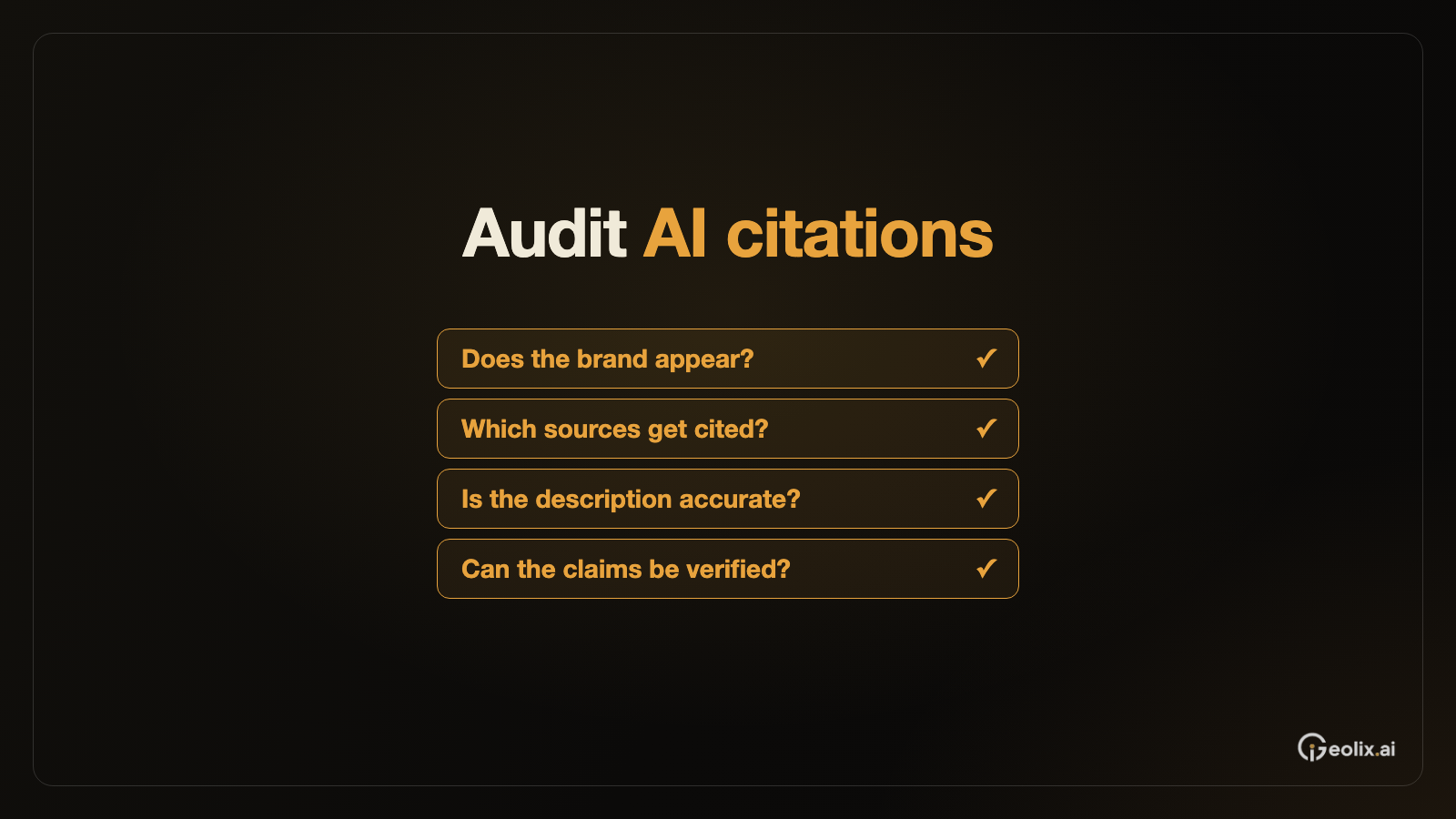
The first operational step is to test a fixed set of real customer questions across more than one AI platform. Record whether the brand appears, which sources are cited, where the brand is mentioned, and whether the description is accurate. This creates an AI search visibility baseline. It should not be treated as direct evidence of traffic, leads, or revenue.
What an AI search visibility audit should test
An audit should begin with the way customers actually ask questions, rather than simply copying a traditional SEO keyword list. The source gives the distinction between a page aimed at “best project management software” and a more contextual question such as which tool would suit a remote team of ten. Those questions may express similar subject matter but different intent. A useful test set can include informational questions, comparison questions, and transactional questions involving specifications, suitability, or purchase conditions.
The next check is whether important claims are verifiable. Teams can review statements about performance, quality standards, methods, certifications, and other factual details. Each claim should either link to an authoritative source, such as research, a standards body, a certification authority, or an industry report, or be rewritten so that it does not imply unsupported evidence. Phrases such as “industry-leading” or “trusted by thousands” do not provide the same machine-verifiable support as a named standard, documented method, or accessible source.
The audit should also examine whether pages present information in a structure that can be extracted reliably. Product pages should make specifications, compatibility, certifications, pricing, and availability clear. Comparison pages can use tables, lists, and explicit question-and-answer sections. The source discusses Product, FAQ, and Organization structured data as possible implementation areas. However, structured data is not a guarantee of citation. It can help systems interpret a page, but accuracy, completeness, relevance, and external authority still matter.
How to measure changes in AI search visibility
A marketing team can create a baseline for each priority query by recording the question, platform, test date, brand presence, citation sources, answer position, and accuracy of the brand description. Repeating the same tests at a fixed interval makes it possible to observe changes in citation frequency and relative citation share against competitors. The source recommends placing AI visibility indicators, including citation frequency and competitive share, alongside conventional SEO metrics in executive reporting.
These metrics need a clear boundary. A brand mention in an AI answer may influence consideration without producing a trackable click. It therefore should not be reported as a conversion or a guaranteed sales outcome. Rankings, organic sessions, click-through rate, and conversion data remain useful, but they do not fully describe exposure in AI search. Teams may compare visibility changes with branded search activity, visits, enquiries, or conversions, yet such comparisons show association rather than automatically proving causation.
Accuracy checking is another part of the measurement problem. LawNext reported on LawDroid’s CiteCheck AI, a tool for checking case citations in legal documents. The report says that the service accepts Word or PDF files, extracts citations using OpenAI GPT models and Google Vision OCR, cross-references cases with the CourtListener database, and creates audit trails. The same report describes limitations: valid citations may be flagged when a database lacks a Westlaw citation or when abbreviations create a case-name mismatch, and the tool does not check statutes, regulations, law review articles, or other non-case sources.
That example is useful for understanding why automated verification needs a defined database scope and human review. It does not show that a legal citation checker improves a company’s AI search visibility, and it should not be presented as an AI marketing performance case. For marketing teams, the comparable lesson is narrower: record what was checked, against which source, and what the system could not verify.
Method and Limitations
A practical process starts with a stable question set covering brand queries, category questions, comparisons, and concrete use cases. Run those questions on multiple AI platforms under documented conditions, and save the complete answers and cited links. Repeat the tests with the same wording when measuring change, while recording platform, date, and relevant context because AI responses can vary by system and time.
Content review can follow three layers. First, determine whether the page directly answers the user’s question. Second, check whether factual claims have accessible, authoritative support. Third, confirm that specifications, prices, certifications, and common questions are presented clearly enough to be interpreted. When refreshing pages, teams should add current research, industry data, standards, or technical specifications where appropriate. Changing a publication date without substantive updates is not the same as making content fresh.
The available material does not establish that any single schema type, writing format, or audit tool guarantees AI search citations. It also does not provide a universal ranking formula for every platform or industry. Some of the ratios and observations in the Search Engine Journal article come from IQRush-sponsored audits and client analyses, so they should not be treated as universal benchmarks. The LawDroid report concerns legal citation validation and cannot be converted into evidence of AI search or AI marketing results. Teams should use these findings to define checks and reporting boundaries, not as promises of visibility or business impact.