


Key takeaway: Bing AI Overviews were reported showing sponsored results, while a brand test exposed a gap between SEO visibility and AI recommendations.
Key Takeaway
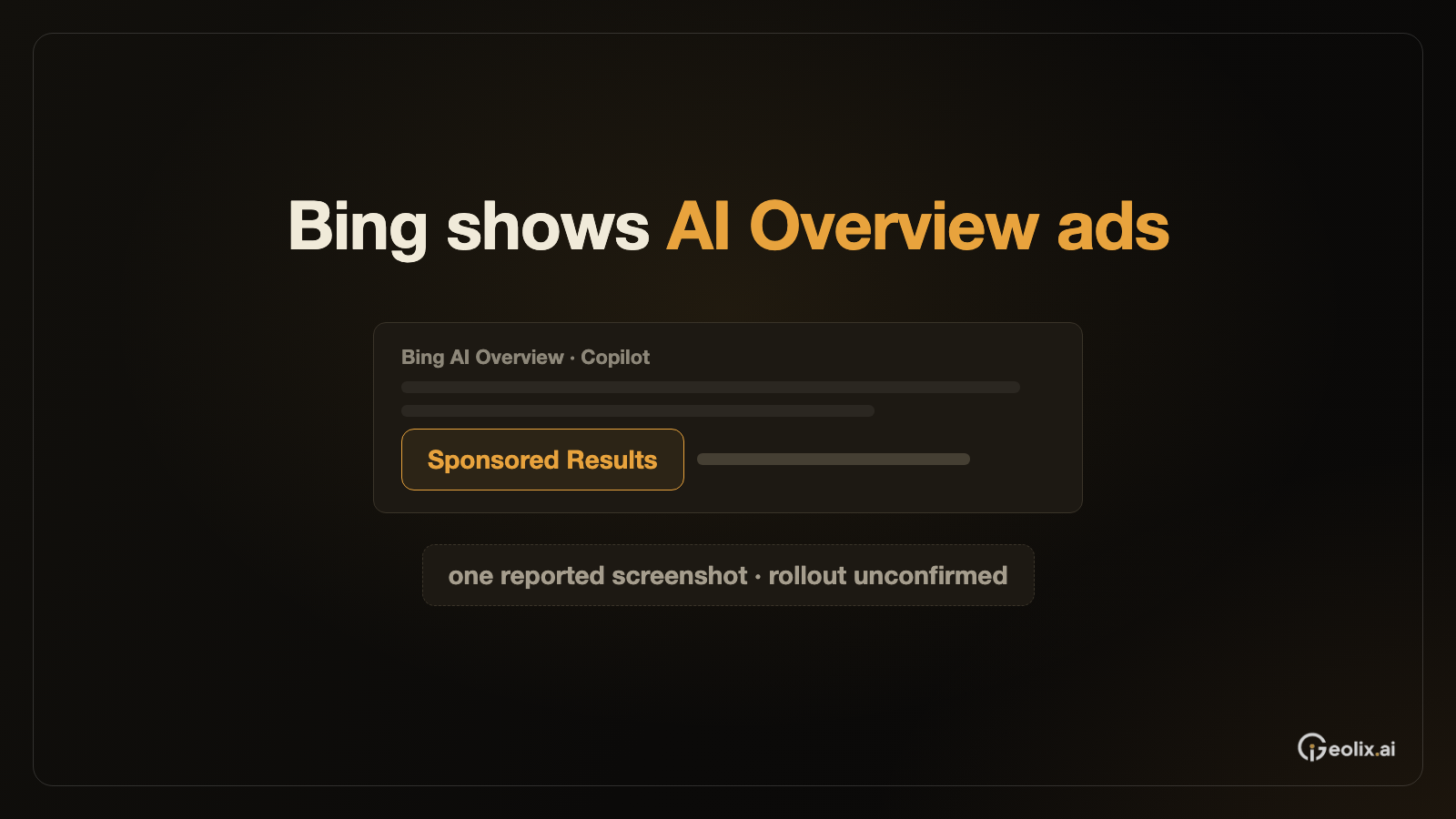
Bing Search has been reported showing a sponsored result inside an AI Overview powered by Copilot. Search Engine Roundtable cited a screenshot shared by Khushal Bherwani on X with the label “Sponsored Results.” The report also says its author could not personally trigger the result, so the evidence supports an observed example rather than a confirmed universal rollout of ads across Bing AI Overviews.
A separate Search Engine Journal article highlights a different AI search issue for SEO and AI marketing teams: being known is not the same as being recommended. Tony Uphoff tested ChatGPT, Gemini, Perplexity, and Google AI Overviews with questions that prospective buyers might ask. Across 59 answers, Uphoff on Media appeared in none of 12 category answers, while Uphoff Advisory appeared in one of 43. The engines could identify Uphoff’s career, but rarely recommended the businesses he had recently built.
What the Bing AI Overview ad report confirms
Bing renamed the Copilot Search box to AI Overviews several months ago. The available report confirms a third-party screenshot and the claim that Bing was showing sponsored results within an AI Overview. It does not establish that the placement is available to every user, explain its ad format, identify eligibility requirements, or provide delivery or performance data. Advertising teams should therefore treat the screenshot as a concrete AI search advertising signal to monitor, not as proof of a broad product launch.
Why AI search recommendations require a different SEO test
Uphoff’s experiment separates recognition from recommendation. An answer engine may describe a founder or company accurately when asked about the brand, yet omit that company when asked which providers belong on a buyer’s shortlist. The article says AI answers often draw on roundups, comparison pages, and other third-party lists. Uphoff Advisory did appear in an answer to a question about advisers for founders of B2B information and data businesses, but broad category questions produced no listing.
That distinction changes what an SEO or AI marketing report should measure. Teams can write prompts around the category, customer problem, and “who should I hire” questions buyers actually use, then run them across several answer engines. The useful observations are whether the brand is recommended, whether its description is accurate, and which sources are cited. Companies that have rebranded, merged, or changed leadership should also check whether public pages still describe an earlier version of the business. The reported test found that old organizational databases, executive directories, and press releases could continue shaping answers.
Method and Limitations
A practical check is to repeat the same buyer-oriented prompts weekly across ChatGPT, Gemini, Perplexity, and Google AI Overviews, while logging recommendation rate, wording, and citations. The Search Engine Journal article notes that the Uphoff sample covered only 59 answers and that AI responses can change from run to run. One inclusion or omission therefore cannot establish a durable trend. The Bing advertising observation is narrower still: it rests on a shared screenshot and an author’s inability to reproduce it, with no public confirmation of rollout scope, advertiser access, or commercial results.