

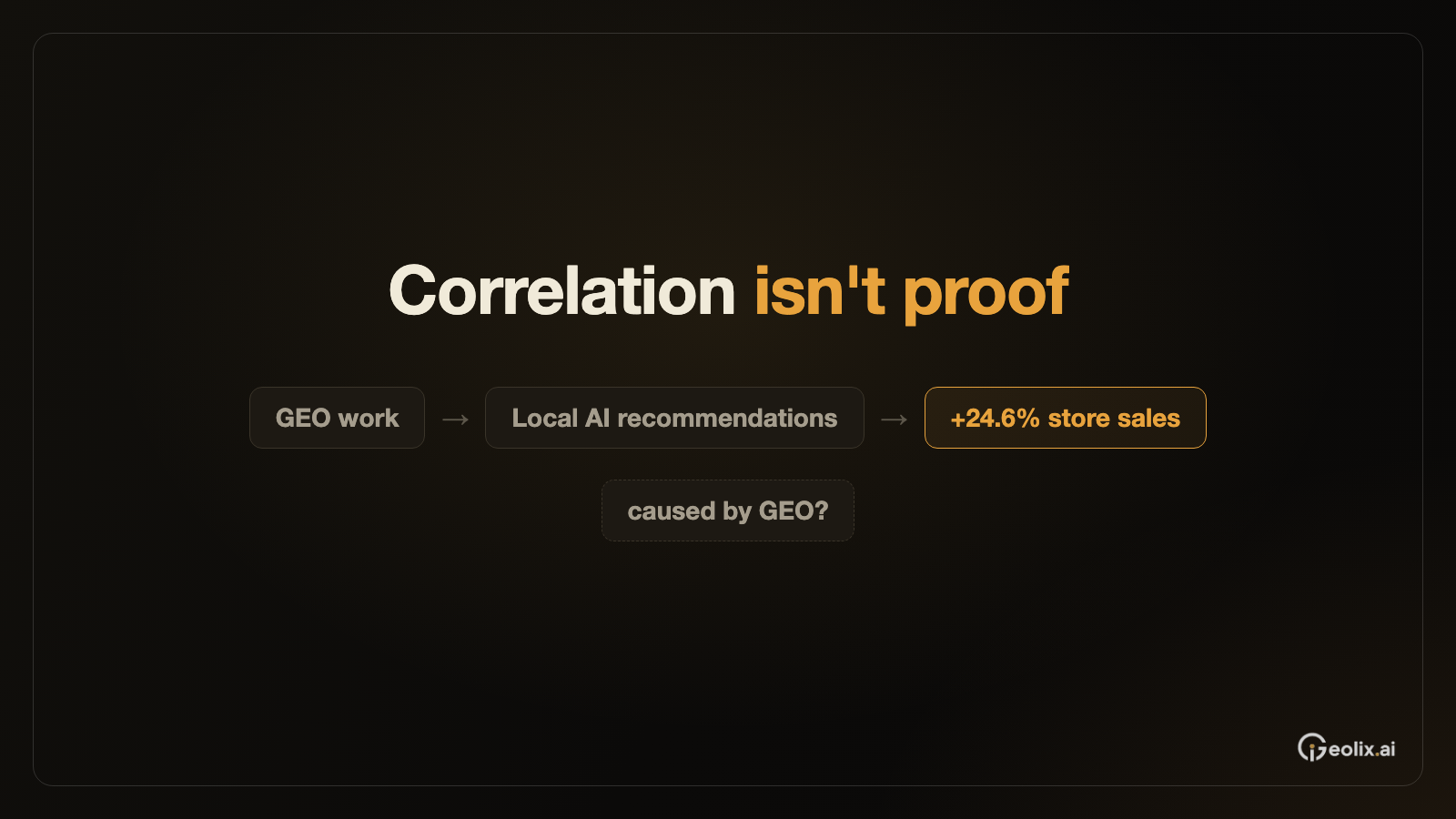

Key takeaway: GEO was linked to observed local AI search recommendations, but the reported sales change does not prove GEO caused it.
Key Takeaway
The available material supports a limited conclusion: Generative Engine Optimization, or GEO, can give local businesses a structured way to improve their chances of appearing in selected AI search recommendations, but it is not a guaranteed ranking system or a proven sales-growth mechanism. Digi-Buzz reports observed recommendations for four participating stores in Google Gemini. SearchAtlas describes GEO as the practice of structuring content so generative systems can retrieve, synthesize, and cite specific passages. Together, these sources support GEO as a visibility and testing discipline, not as a universal performance promise.
The Digi-Buzz case also reports an average 24.6% increase in total sales from June to July 2026 across the four locations. That figure is the arithmetic average of the individual percentage increases for the stores, with each location receiving equal weight. It is not the percentage change in the locations’ combined revenue. The source explicitly says that the comparison documents sales growth after the GEO launch but does not isolate the share caused by GEO. That boundary is essential when an AI marketing team evaluates the result.
What the GEO case actually observed in AI search
The practical question for a local business is not whether it can appear in every AI answer. It is whether its location, products, and local relevance can be recognized when a user asks a specific shopping question. Digi-Buzz says its initiative focused on four participating franchise locations and their communities rather than the national brand. The stated goal was to support visibility for individual stores in recommendations related to the products they sell.
The case documents observed Gemini recommendations for particular queries. Disc Replay Rockford appeared in an observed response to a question about the best place to buy video games in Rockford. Mega Replay Peoria appeared in an observed response to a question about the best place to buy movies in Peoria. These are examples of observed answers on particular dates, not evidence of a permanent position, a broad market share, or a guaranteed outcome for other locations.
The same material separately records store-related content appearing on the first page of Google Forums results. That is a different search visibility observation from an AI-generated recommendation. A team measuring AI search should therefore separate Gemini mentions, forum results, traditional organic visibility, and business outcomes instead of combining them into one score. The case does not report Google Ads placements, paid media performance, or an advertising-platform result.
How GEO relates to SEO and search visibility
SearchAtlas presents GEO as a technical and architectural practice for improving the probability that content will be extracted, synthesized, and cited in AI-generated answers. Its framework distinguishes conventional SEO from GEO by the unit being optimized. Traditional SEO commonly treats a web document and its search-result position as the main unit, while GEO emphasizes retrievable passages, clear factual relationships, and the structure of rendered content.
For a business, that means a page should identify the relevant entity, attribute, and fact clearly rather than forcing an AI system to infer what a pronoun or detached claim refers to. Important answers should remain close to their headings, and comparative or factual information should have an unambiguous structure. SearchAtlas also describes a retrieval process in which systems first draw on an indexed web corpus, collect candidate documents, evaluate passages, and then synthesize a multi-source answer. On that account, technical SEO and indexability remain prerequisites for entering the candidate pool.
GEO therefore complements SEO rather than replacing it. A local business still needs consistent, crawlable information about its locations, products, and brand. GEO adds a way to test whether those facts are being selected and cited in AI search responses. It should not be treated as a formatting shortcut that guarantees visibility, citations, traffic, or conversion.
How to measure a local GEO test
A useful test should define the locations, product categories, question wording, AI search product, observation dates, and result fields before measurement begins. For every query, the team can record whether the business was mentioned, whether the recommendation was factually correct, whether a source link appeared, and whether the answer changed across dates. The Digi-Buzz case illustrates the value of naming the participating stores and the actual local questions instead of reporting an unexplained visibility score.
Sales can provide business context, but a sales change does not by itself establish GEO attribution. If sales are included, the measurement should preserve the comparison period, the stores covered, the calculation method, and the underlying client reports. AI recommendations and sales should remain separate fields. In this case, the 24.6% number must be read specifically as an equal-weight average of four stores’ individual total-sales percentage changes from June to July 2026. It does not control for seasonality, differences between stores, other marketing activity, or changes in consumer demand.
A stronger internal evaluation would repeat the same queries over time, preserve complete answer records, verify citations, and compare AI search observations with conventional SEO visibility and business data. Such a design can show whether mentions recur and whether the information remains accurate. It still cannot automatically prove that GEO caused a commercial result.
Method and Limitations
The public case does not disclose Digi-Buzz’s complete execution process; it says detailed methods are proprietary. The reported work covers four participating stores and focuses on those franchise locations rather than the national brand. AI-generated recommendations may vary by query and date. The SearchAtlas framework explains possible content, retrieval, and citation considerations, but it does not establish that every site will receive an AI recommendation or citation.
The two sources also do not provide a controlled experiment comparing GEO with a non-GEO group. They do not establish a universal sales effect, a Google Ads outcome, or a guaranteed improvement in SEO rankings. Teams can responsibly use the material to design a local AI search visibility test, document observed recommendations, and define attribution limits. They should not convert the reported sales average into a forecast, a return-on-investment claim, or a promise for another business.