
Key takeaway: Google expands UGC spam guidance for publishing platforms, while MorBizAI launches a free AI search visibility audit for small businesses.
Key Takeaway
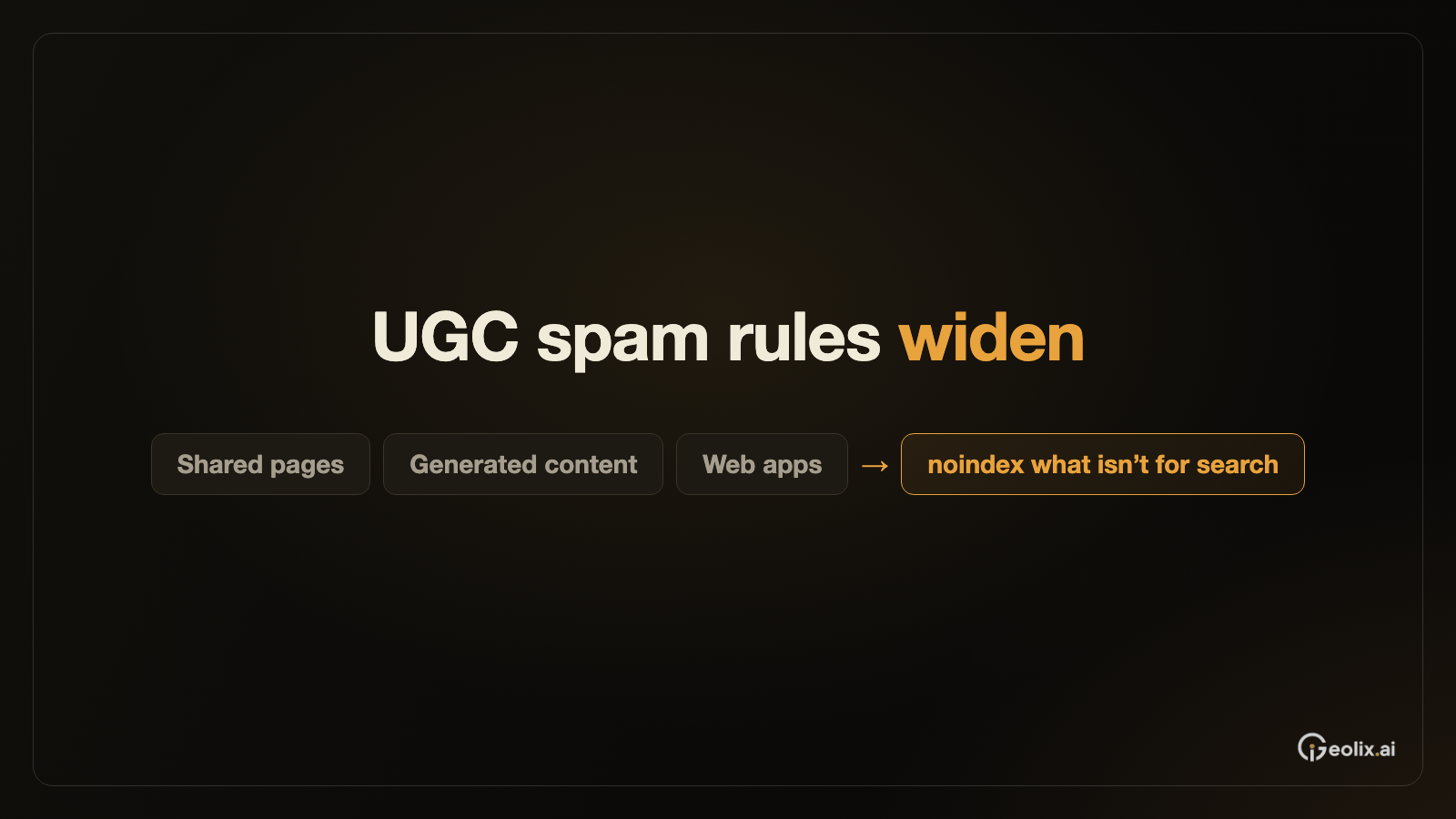
Google has expanded its user-generated content spam guidance to explicitly cover platforms and tools that let users publish shared pages, generated content, or web apps. The update puts more attention on platform-level SEO risk and tells operators to distinguish material intended for public search from pages created mainly for sharing, collaboration, or utility. Google recommends using noindex or blocking crawling for the latter. It also advises platform owners to verify sites in Search Console, watch for manual-action and security alerts, and monitor unusual changes in indexed pages, impressions, queries, and user-generated URLs. The guidance is relevant to SEO and AI search visibility, but it does not announce that a new enforcement campaign has already begun.
A separate October 27 release from MorBizAI describes a free site audit for small businesses. The audit reportedly returns results in about 15 seconds and checks whether a site is ready to be read and cited in answers from tools such as ChatGPT and Google AI Overviews. It also reviews SEO, page speed, accessibility, and privacy. The audit is available through morbiz.ai and is presented as part of MorBizAI, an AI marketing tool, not as a Google product or certification.
What Google’s platform guidance changes for SEO
The revised guidance makes sharing services, tools, and applications that let users create pages more explicit targets of the UGC spam discussion. Google says platforms should index only content meant for Search. Pages intended for direct sharing, collaboration, or utility can use a robots meta tag or X-Robots-Tag with noindex, or be blocked from crawling by default through robots.txt.
For platform operators, the practical question is not whether every user-created page should be public. It is whether that page has a legitimate search purpose. Google also recommends tracking platform-level creation and indexing metrics, including anomalies in newly published public pages or cases where a small group of users generates a large share of indexable URLs. SEO teams auditing clients should check whether third-party publishing services are being used manipulatively for links, rankings, or AI search influence.
How small businesses can check AI search visibility
MorBizAI’s audit places AI search visibility beside conventional SEO, speed, accessibility, and privacy checks. The release says it asks whether a business appears when a customer seeks an AI recommendation and positions the audit as the first step in a broader content workflow. The company also describes features that use Google Search Console to find “striking distance” keywords ranking between positions 4 and 20, plus publishing to several social platforms. Those are product descriptions, not independently verified ranking or traffic results.
Businesses using an audit like this should record AI-answer visibility separately from conventional rankings, conversions, and brand mentions. The public material does not establish that the audit can guarantee inclusion in Google AI Overviews or ChatGPT, nor does it say that Google endorses MorBizAI’s scoring method.
Method and Limitations
Platform teams can use Search Console to check manual actions, indexing patterns, and search performance, then compare those reports with new-page creation, indexable URL, and query data. They should also classify pages individually according to whether they are intended for public discovery or only for sharing, collaboration, or direct use.
The Google guidance describes prevention and monitoring steps but does not confirm that broader enforcement has started. MorBizAI’s audit scope, scoring, and real-world effect have not been independently tested in the material reviewed. Features such as automated publishing, video clipping, and social distribution are claims made in the product release, not customer case studies or performance guarantees.