

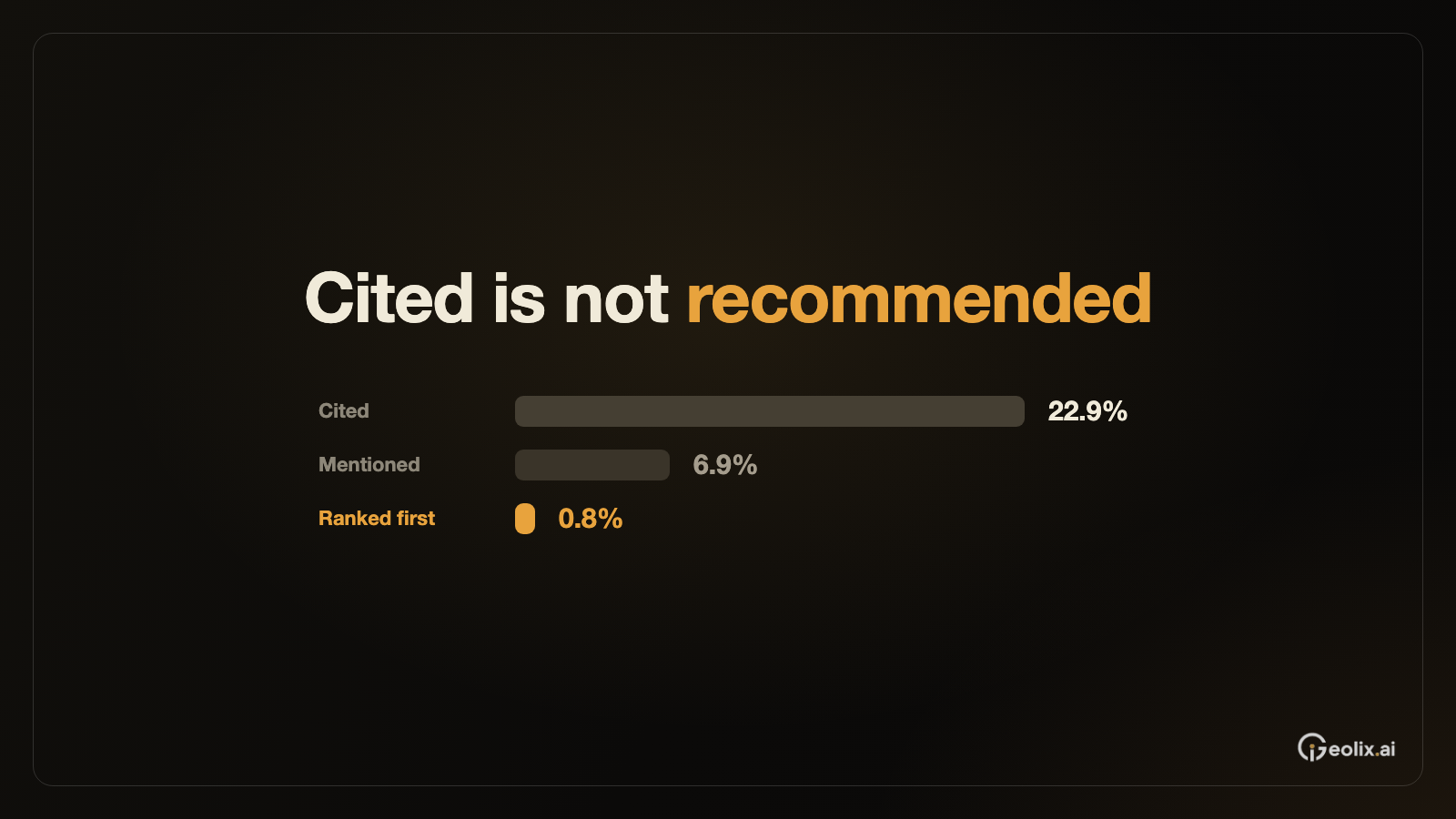

A page can appear in an AI answer's citations while the brand behind it stays off the shortlist. In one English-language fintech monitoring case, Geolix.ai found that ChatGPT cited the target brand's own domain in 22.9% of answers, named the brand in 6.9%, and ranked it first in 0.8%. The sample covered nine purchase-intent questions and 15,495 valid answers collected in July 2026. It is Geolix's own case, published in “The GEO Market Is Splitting Into Four Delivery Models”, not a market benchmark. Its value is the separation it makes visible: citation, mention, and recommendation are different outcomes.
Count citations, mentions, and recommendations separately
An SEO report tells a team whether a page was indexed, appeared for a query, and earned a click. An AI answer exposes another possibility. The system may use a page as evidence without placing the company in the buyer's consideration set. A brand mention can also be inaccurate or lukewarm. Rolling all three states into one “AI visibility” score makes the dashboard tidy and leaves the editor unsure what to change.
Read the answer before editing the page
When citations outnumber recommendations, read the answers. Did the system cite a product page, an explainer, or a third-party directory? What question was it answering at that point? Does the cited page describe who the product serves, its fee conditions, and its limits, or does it only explain the category? The gap between two percentages cannot establish a cause. The answer text and cited URLs can. If an outside source defines the brand while the company's own pages say little, the work may extend beyond the website.
Do not combine Google and ChatGPT metrics
Google says AI Overviews and AI Mode use its Search index and core quality systems. Crawlable, indexable, useful pages remain a foundation for visibility in Google's AI search; Google offers no special markup that guarantees a place in an answer. Google's guide to generative AI features in Search supports a practical division of work: maintain the SEO foundation, then inspect what AI answers actually say. ChatGPT and other products need their own source and referral checks. Google's rules cannot simply be projected onto them.
Measurement also differs by platform. Google's Generative AI performance reports record URL impressions and page exposure in its AI features; they do not establish how often a brand was recommended in answer text. OpenAI's publisher guidance advises sites that allow OAI-SearchBot to track ChatGPT referral traffic in analytics. That is a different unit again.
The useful management question is where a brand drops out of the evidence chain. Search data shows whether a page can be found. Answer samples show whether the brand is described correctly and considered for the buyer's task. A page that gets cited but never recommended may need stronger product evidence or a correction to outside sources. Its keyword ranking alone will not tell the team which.
References
Geolix.ai, “The GEO Market Is Splitting Into Four Delivery Models”, July 2026. The fintech figures are Geolix first-party monitoring observations.
Google Search Central, “Optimizing your website for generative AI features on Google Search”, for Google's description of AI Search and SEO.
Google Search Central, “Introducing Search Generative AI performance reports in Search Console”, for URL impression data in Google's AI features.
OpenAI Help Center, “Publishers and Developers FAQ”, for OAI-SearchBot and ChatGPT referral guidance.