

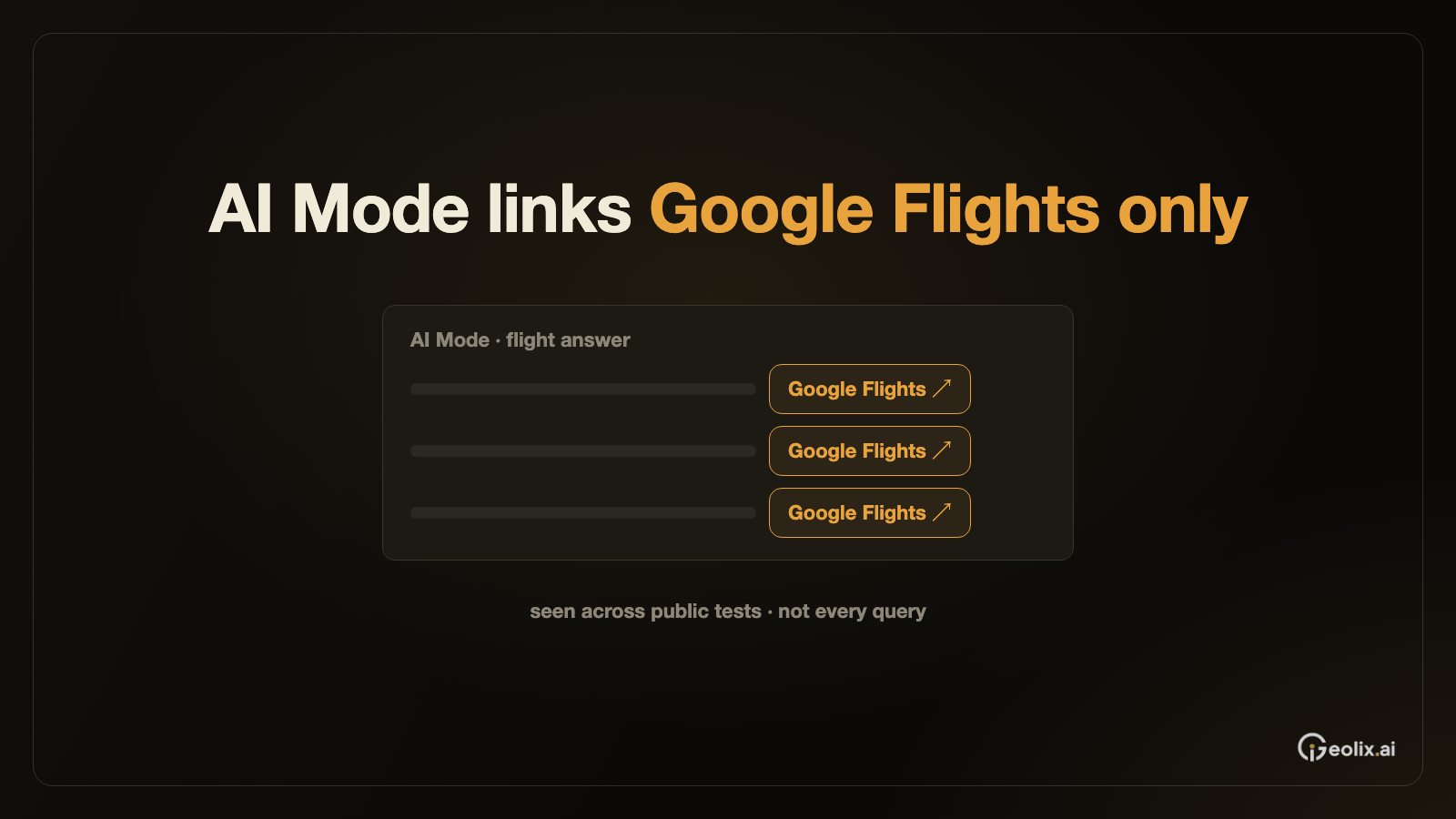

Key takeaway: A public test found Google AI Mode linking flight answers only to Google Flights across selected domestic and international searches.
Key Takeaway
A public test found that Google AI Mode linked flight-related answers only to Google Flights in the examples reviewed. The testing covered both domestic trips within the United States and international destinations. That is a limited observation, however, and does not establish that the same link behavior applies to every user, location, or flight query.
Where Google AI Mode Sent Flight Search Users
The test involved asking Google AI Mode for flight information for several destinations. The report says that, in every test, the links shown inside the AI Mode responses led to Google Flights. It also cites an earlier example from Natzir on X, posted on October 30, showing the same pattern. The report’s author then ran additional tests and said they captured dozens of screenshots.
For the examples described, users following links from the AI-generated flight answers were directed to Google’s own flight service rather than to other flight websites. The available evidence supports a claim about the links displayed in those responses. It does not show that other travel sites lost rankings, search traffic, or visibility across Google, and it does not provide performance data for SEO or AI search visibility.
What the Observation Does and Does Not Show for SEO
The tested scenario is narrow: Google AI Mode responding to flight-information requests and displaying links within those answers. The report does not provide click-through rates, traffic figures, ranking data, advertising results, or a comparison with other travel platforms. It also does not establish that Google has formally launched a universal rule requiring every flight answer in AI Mode to link only to Google Flights.
The report notes that this type of behavior could attract attention from officials concerned with the European Digital Markets Act. It does not say that regulators have opened an investigation, issued a decision, or taken enforcement action over the tests. The event should therefore be read as a reported observation about Google’s AI search link selection, not as a confirmed SEO impact study or a Google Ads announcement.
Method and Limitations
The directly described evidence consists of the author’s tests across multiple domestic and international destinations, the author’s reported collection of dozens of screenshots, and the X example cited from Natzir. The public account does not list every query, testing condition, account setting, location setting, or comparison result. It also does not establish whether the same presentation appeared for users outside the tested cases.
Accordingly, the supported conclusion is limited to the reported tests: all links observed in those Google AI Mode flight responses pointed to Google Flights. Broader claims about Google’s permanent product policy, regional variation, other query types, or effects on search visibility remain unconfirmed by this report.