

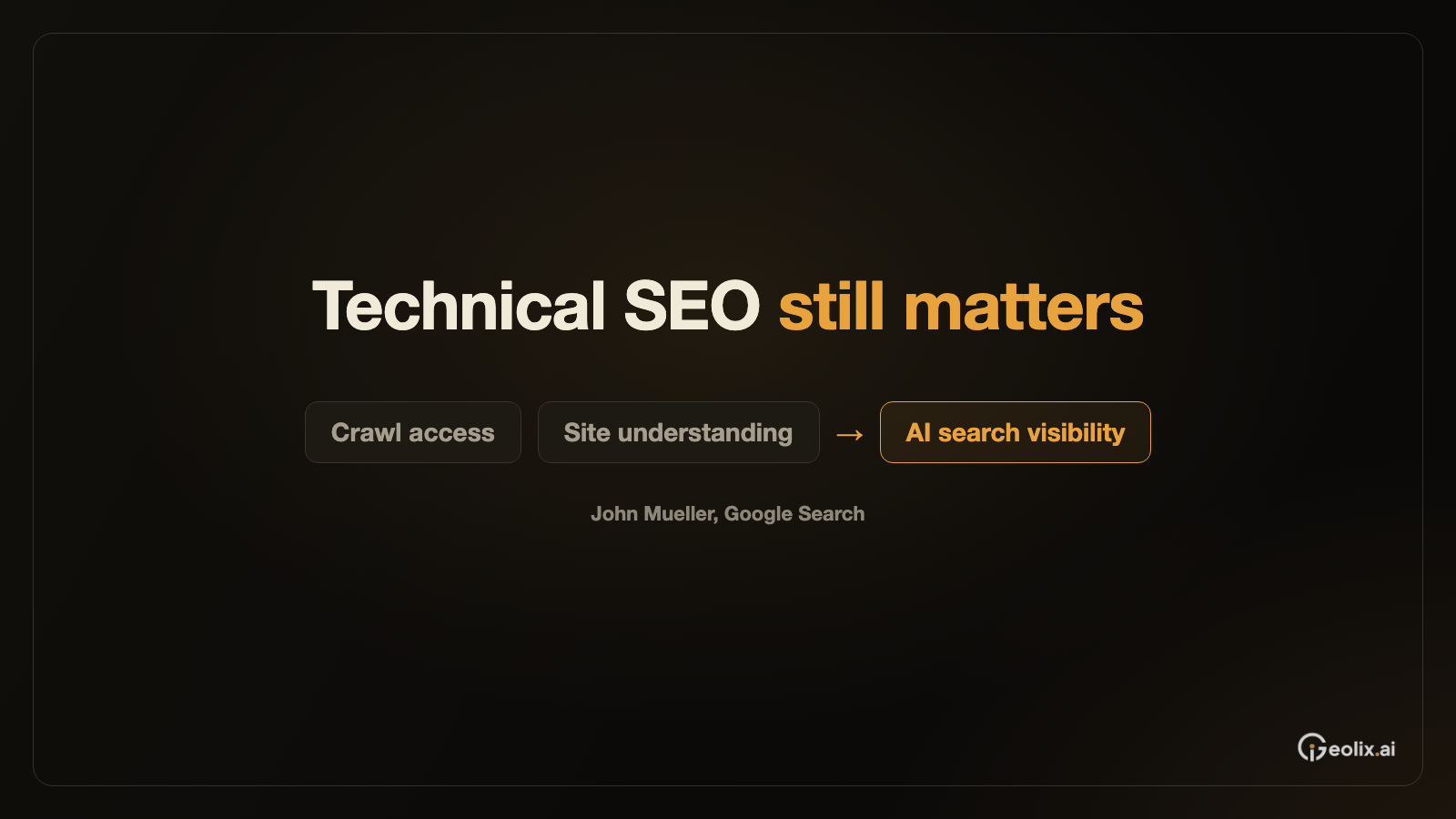

Key takeaway: Google Search’s John Mueller said in a recent interview that AI search does not make traditional SEO irrelevant.
Key Takeaway
Google Search’s John Mueller said in a recent interview that AI search does not make traditional SEO irrelevant. Technical SEO, in particular, should remain important because AI systems still depend on access to and understanding of websites. Mueller said AI systems may crawl with different objectives, such as training or finding fresher content, but he described that difference as another form of technical SEO rather than evidence that established SEO has disappeared.
A Semrush study published separately adds a content-side view of AI search visibility. The company reviewed 2,850 articles about Semrush published by partners in its own affiliate program between September 14 and October 7, 2026. About 22% appeared in at least one tracked AI answer. That is a Semrush affiliate-program sample, not a universal benchmark for every industry, brand, or AI search system.
Which Affiliate Content Appears in AI Answers
Within the Semrush sample, listicles and comparisons were the formats most often cited. Listicles and top lists represented about 54% of cited partner pieces, followed by comparisons at about 39%, tutorials at about 21%, reviews at about 18%, and coupon or free-trial pages at about 10%. The study reported different rates across platforms: about 8% of partner pieces were cited in Google AI Overviews, 7% in Google AI Mode, 2% in Gemini, and 1% in ChatGPT.
Those figures describe citations detected by Semrush, not guaranteed visibility from using a particular format. The study also found affiliate links on 74% of cited web pages, while about 40% marked those links as sponsored or nofollow. Pages with affiliate links or disclosures were not cited less often, but the findings do not show that the links caused citation. The useful signal was the surrounding content, such as a comparison that explains when a product fits a particular need.
Why Google Warns Against Short-Term AI SEO Tactics
Mueller questioned the idea of making listicles the foundation of an AI SEO strategy. He said that when a tactic becomes widespread, systems may eventually identify low-value versions as spam, causing the tactic’s effectiveness to fade. Businesses therefore should not rely entirely on listicles, special pages created for AI crawlers, or other short-term methods. Mueller’s stated priority was a stable website foundation and content that search engines and AI systems will want to show over time.
He also advised businesses to monitor what outside SEO providers actually do rather than accepting their claims without scrutiny. The warning applies to familiar practices as well as newer AI SEO pitches, including keyword stuffing, buying links, or showing different content to crawlers and users. The interview did not establish a new Google ranking rule; it reaffirmed the continuing relevance of technical foundations.
Method and Limitations
The two pieces support different parts of the picture. Mueller’s interview provides Google’s view on the ongoing role of technical SEO in AI search. Semrush’s figures describe citation patterns in its own affiliate content and AI visibility monitoring. Neither source proves that affiliate partnerships guarantee visibility, that one format will perform across all AI systems, or that traditional SEO has gained a new set of ranking rules. Teams assessing AI search visibility should therefore check crawlability, page quality, user value, and whether third-party coverage offers specific, independent product context.