

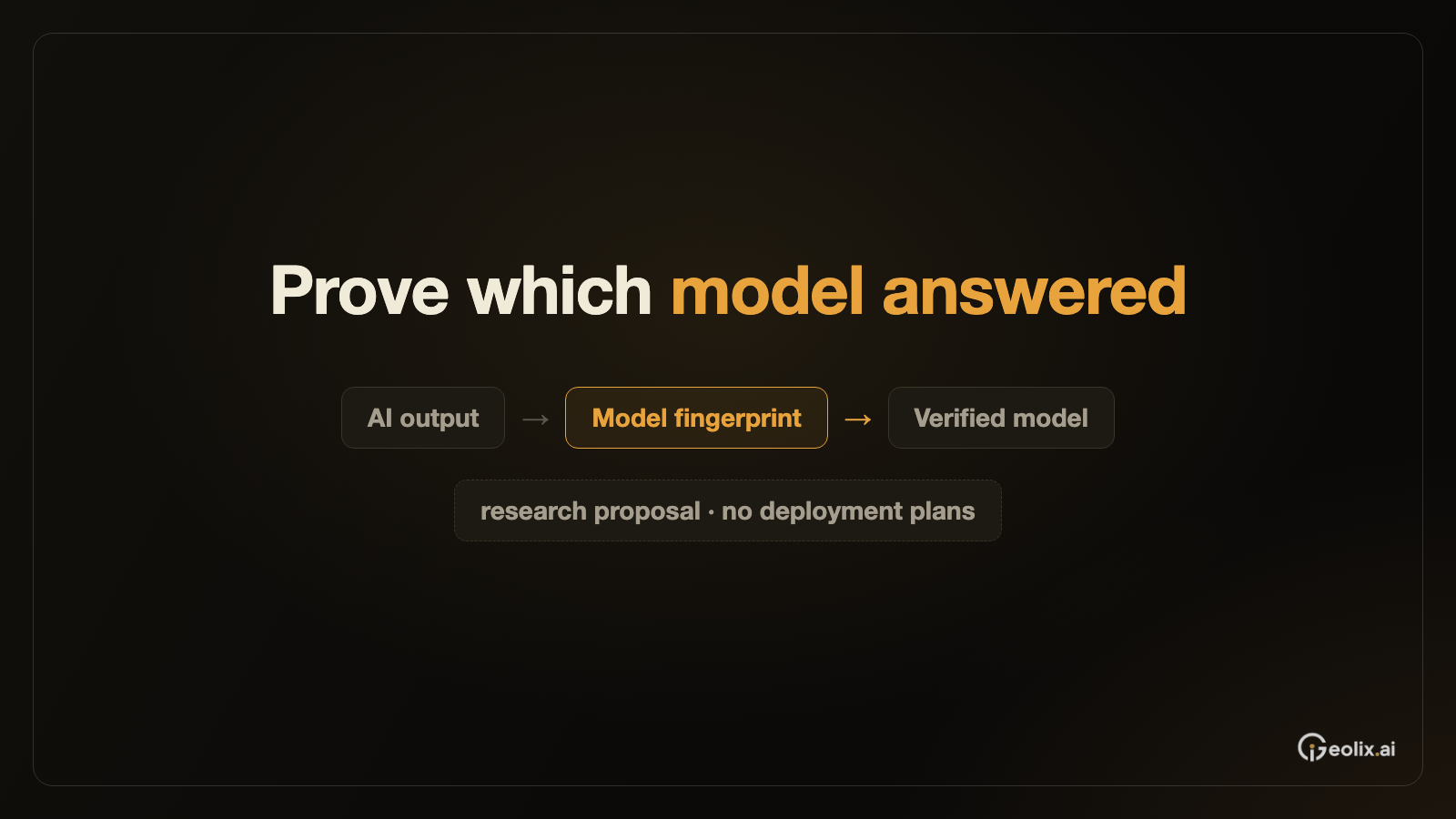

Key takeaway: Anthropic has published FlashProve as an open-source research proposal for cryptographically verifying which AI model produced an output.
Key Takeaway
Anthropic has published FlashProve as an open-source research proposal for cryptographically verifying which AI model produced an output. It is not a deployed AI search, SEO, advertising, or AI marketing feature: the researchers say the work is ongoing and that Anthropic and other labs have no plans to deploy it. Separately, a shopping experiment found that Claude models selected different products from the same Shopify catalog, showing why product visibility in AI search and agentic commerce can depend on the model making the choice.
What FlashProve could verify
FlashProve is designed to create what the researchers call “provable inference,” giving users a cryptographic way to check whether an answer came from the model they expected. The proposed system is intended to resist impersonation, including a situation in which a model provider secretly substitutes a cheaper model to reduce costs or a more expensive model to improve reported performance.
The design requires labs to publish a fingerprint for each released model. That fingerprint could later be matched with a particular output and verified. The researchers say the fingerprint would not reveal model weights, allowing the approach to work with commercial closed models without exposing their internal parameters. Verification is also designed to be lightweight enough for a local device.
Anthropic released a technical specification and working code for parts of the system under an open-source license. However, the announcement describes the material as intermediate progress rather than a completed research agenda. Nothing in the source establishes that FlashProve is being used to authenticate answers in an AI search product, an advertising platform, or a commercial marketing workflow.
Why Claude model choice matters for AI search visibility
Search Engine Journal tested three Claude models—Haiku 4.5, Sonnet 5, and Opus 5—using the same saved Shopify product lists and the same short shopping requests. The models had no tools or web access and received only the product information supplied in the test. Across six searches containing only product keywords, the product most frequently selected by all three models was never the same.
The complete experiment recorded 1,980 picks across product, sunscreen, and skincare tests. In some searches, the models also selected products from different stores. Haiku and Sonnet often favored products with the largest review counts, while Opus frequently described its choice as “safe” or “safest.” These results do not measure conversion rates or prove that one SEO tactic will improve performance in every AI shopping agent. They do show that being returned in a catalog does not guarantee being recommended.
The test also found that presentation and shopper constraints mattered. When the same 20 skincare products were shown in catalog order and then in reverse order, moving the first-ranked product to the end reduced its selection overall, although the effect varied by search. In a sunscreen test, adding “under $25” and “for oily skin” moved all three models away from a $48 top-ranked product; across 300 selections with those added conditions, they chose a product under $25 in 298 cases.
Method and Limitations
FlashProve should be checked against the technical specification, released code, and deployment claims. The available reporting supports an open-source research effort, not a live Anthropic service or a verified use in AI search and advertising. The shopping experiment should likewise be read within its setup: the models saw a fixed catalog list, limited product fields, and short requests, with no tools, web access, or user history.
For SEO, search-visibility, and AI marketing teams, the defensible conclusion is narrow. Different models can make different recommendations from identical catalog inputs, and price, stated preferences, review information, and list position can affect those choices. The evidence does not establish a universal ranking formula, a guaranteed optimization method, or a sales impact for any retailer.