
Key takeaway: Google has released Google Ads API version 26.
Key Takeaway
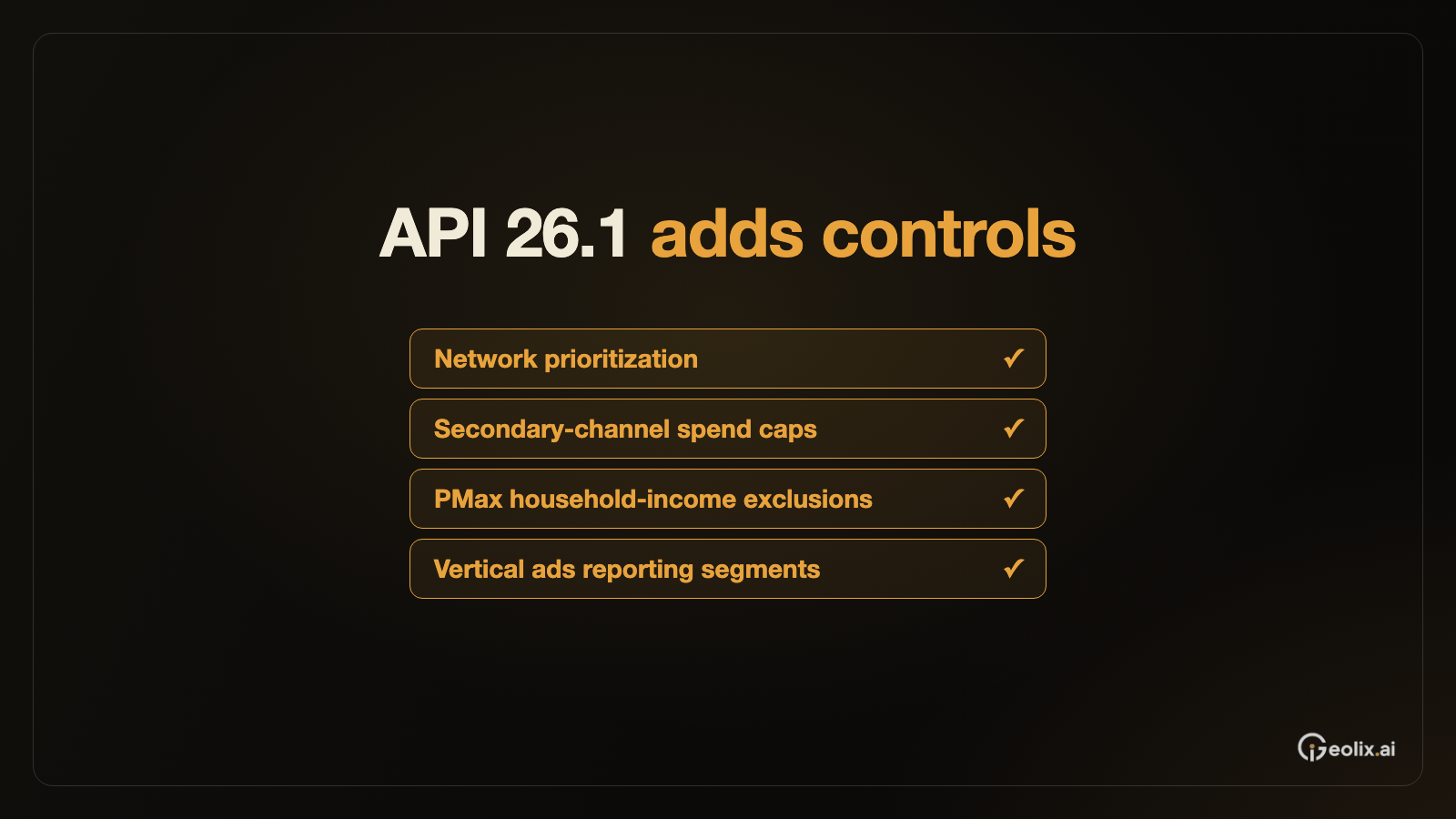
Google has released Google Ads API version 26.1, a minor update covering assets, campaigns, Local Services, recommendations, reporting, and targeting. For advertising platform operations, the release adds network-prioritization controls, optional spending caps for secondary channels, household-income exclusions for Performance Max, and more reporting segments for vertical ads.
Separately, Google is testing ads in AI Mode for users who have Personal Intelligence enabled. Search Engine Journal reports that Google’s updated privacy language and help documentation allow connected Gmail, Google Photos, or Google Drive information to contribute through summaries, excerpts, and inferences to personalized experiences and ads. Advertisers do not receive access to a user’s inbox or photo library, and the test does not establish broad availability.
What Google Ads API 26.1 changes for operations
The new budget controls let advertisers place Google-owned properties, Search Partners, and the Google Display Network into two priority tiers. Optional spending caps can apply to secondary-tier channels, while account-level defaults can apply across campaign budgets. These settings give operations teams a way to express channel priorities without treating every eligible network as equivalent.
The release also adds the PromotionAsset.external_redeem_info field. It can carry an external partner’s promotion ID, indicate whether codes are single-use or multi-use, and identify whether codes are uploaded by customers or generated by Google.
For Local Services, the CheckLocalServicesEligibility method checks whether an account and its Google Business Profile listing qualify. It can return eligible lead types, service categories, job types, and business callouts. Performance Max campaigns can now exclude household-income ranges by using a negative CampaignCriterion with the income_range field. Reporting for vertical ads adds segments such as listing region, user rating, venue, partner account, price tier, rate rule ID, rate type, and vertical.
What AI Mode advertising means for campaign teams
The AI Mode test is controlled on the searcher’s side. Google has not announced a new advertiser toggle, audience segment, dedicated report, or bidding control for Personal Intelligence. Advertisers cannot directly target Gmail or Photos insights, and available reporting does not identify whether connected-app information influenced a particular impression.
Google has named Performance Max, Shopping, and Search campaigns using broad match, including AI Max for Search, as eligible campaign types for AI Mode ad testing. Eligibility does not confirm that a campaign has served an ad to a Personal Intelligence user. Google also has not said when the test will move beyond testing, whether it will expand, or whether separate placement and reporting controls will arrive.
For SEO and search visibility teams, the practical distinction is important: an AI Mode ad test should not be treated as evidence of a change in organic ranking or search visibility. Advertising teams can verify campaign type, matching approach, and existing reports, but they cannot purchase or bid directly on connected-app inferences. The test therefore changes the context in which some users may see ads without creating a new, visible Google Ads audience control.
Method and Limitations
Teams can first check the Google Ads API 26.1 release notes against their account-management tools, confirming support for network budgets, Performance Max exclusions, Local Services eligibility checks, and the new reporting fields. For AI Mode, they can separately review Personal Intelligence, connected-app permissions, and ad-personalization settings, keeping user controls distinct from advertiser controls.
Public information does not establish a final launch date for AI Mode ads, dedicated performance reporting, additional placement controls, or whether connected-app signals affect every Google Search service beyond AI Mode. Turning off personalized ads in My Ad Center may not disconnect apps from AI features; removing Gmail and Photos from Personal Intelligence requires disconnecting the relevant apps. These limits do not support a forecast about campaign performance or SEO rankings.