
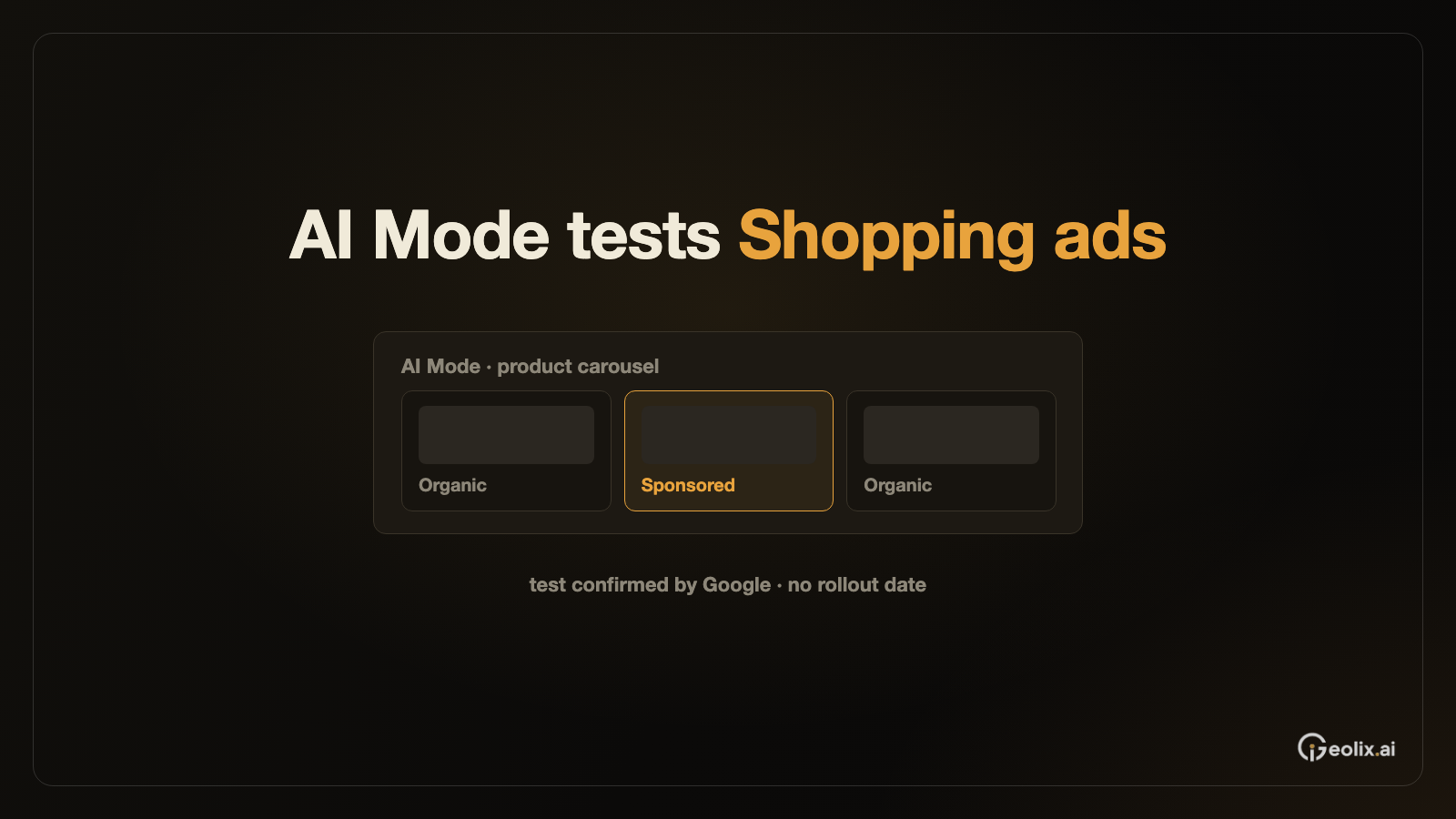

Key takeaway: Google has confirmed an advertising experiment in AI Mode that can place Shopping Ads alongside organic visual product results in carousels.
Key Takeaway
Google has confirmed an advertising experiment in AI Mode that can place Shopping Ads alongside organic visual product results in carousels for commercially relevant queries. Google says sponsored listings in that format are labeled “Sponsored.” Separately, Google Ads representatives described a shift toward longer, more exploratory searches, including longer questions and earlier discovery before a purchase decision. Neither report establishes a full rollout or improved conversion performance.
What the AI Mode shopping test actually covers
The confirmed change is a test of how product advertising may appear within AI Search, not a statement that every AI Mode answer now contains ads. Google’s description sets several boundaries. The placement concerns Shopping Ads, the query must be commercially relevant, and the ads may appear beside organic visual search results within carousels. Sponsored listings are required to carry the “Sponsored” label.
For advertising platform operations, that distinction matters. Teams can watch for the tested presentation and verify whether paid and organic product elements remain clearly identified. The available information does not say how many advertisers, accounts, users, markets, or queries are included. It also does not provide a launch date, a campaign setting, a bidding change, or an account-level control. The report therefore supports monitoring an experiment, not treating the format as a generally available Google Ads feature.
How longer AI search queries affect ad and SEO work
Google’s advertising discussion frames the behavior change around discovery and evaluation rather than confirmed purchase intent. People may begin with a broad problem, then use follow-up questions to compare options, tradeoffs, price, compatibility, setup, or limitations. That gives Google Ads and SEO teams a practical review task: check whether ad copy and landing pages answer needs that appear before a user knows the product name, as well as questions that arise during comparison.
The same discussion says users continue to seek human perspectives through forums, podcasts, videos, and other open-web material even when AI summaries provide streamlined explanations. A product page or ad that only repeats feature language may leave practical concerns unanswered. Teams can use search terms, sales questions, and existing page content to identify gaps, but longer queries and multimodal activity should not be treated as proof of stronger intent, higher click-through rates, or better conversions.
Method and Limitations
To check the advertising claim, readers should confirm that a placement is described as an AI Mode experiment, involves Shopping Ads, appears for a commercially relevant query, and carries the “Sponsored” label. To assess the search-behavior claims, teams should verify whether the figures apply to AI Mode or to Google Search generally, then record the geography, measurement window, comparison baseline, and definition of query length.
The public reports do not establish that the shopping format is fully available, nor do they describe coverage by industry, buying stage, account type, or market. The reported figures about longer questions and multimodal searches also come with stated measurement limits. They do not demonstrate that advertising performance or SEO/search visibility will improve. Operators should validate any business effect with their own query data, conversion paths, and normal purchase timelines.