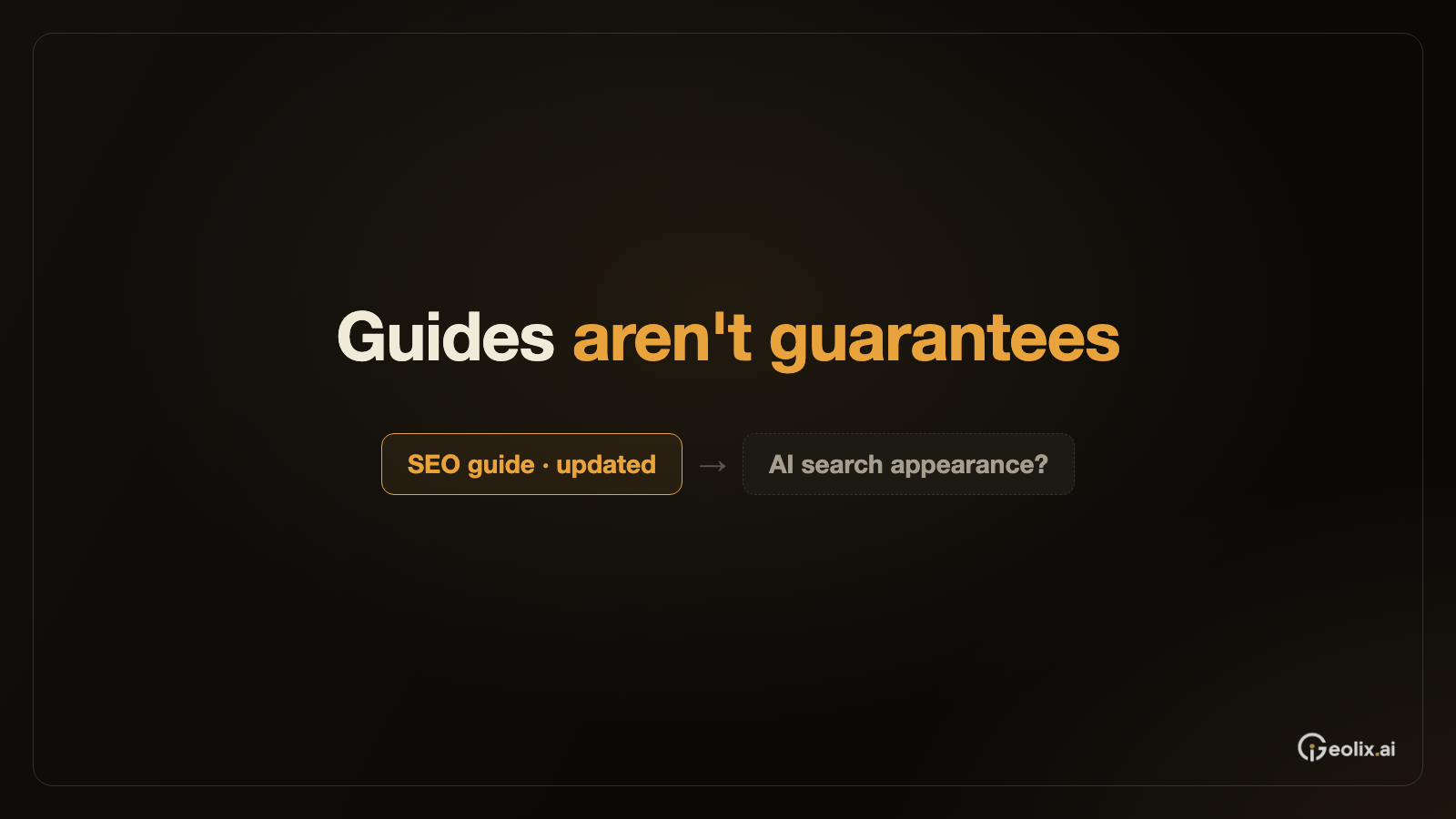

Key takeaway: Google’s planned SEO guide update supports clearer SEO fundamentals, but does not prove how sites will appear in AI search.
Key Takeaway
For teams asking what Google’s SEO guidance can actually establish about AI search visibility, the evidence is limited but useful. Search Engine Journal reported that Google was preparing a more concise SEO Starter Guide focused on general concepts, with outdated advice and repetition removed. The report said the current draft was around 3,000 words, compared with a previous guide of more than 8,000 words. Search Engine Roundtable separately documented Google’s Gary Illyes saying that the older SEO guide remained relevant because core principles for making sites search-engine friendly had not fundamentally changed.
Together, these reports support a practical conclusion: maintain sound SEO foundations when evaluating AI search visibility, but do not present Google’s guide as a confirmed playbook for generative answers, AI search rankings, or advertising outcomes. The reporting does not establish a specific AI-search ranking factor or a guaranteed path to inclusion in an AI-generated result.
What Google’s SEO guide update changes for search teams
The reported update is primarily a change in scope, clarity, and audience. Search Engine Journal described Google’s plan to remove outdated recommendations, reduce repetition, and explain broad SEO concepts in a way that is easier for beginners to use. One example concerned understanding the importance of page title tags without requiring a site owner to edit HTML manually. The report connected that approach with the wider use of content management systems and website builders such as WordPress and Wix.
For an SEO or AI marketing team, this points to a sensible starting checklist. Review whether important pages have clear titles, whether their content is understandable to search engines, and whether the site follows durable search-friendly practices rather than chasing isolated technical tactics. Those checks can support ordinary search visibility and provide a baseline for further AI-search research. They do not, however, reveal how an AI search product selects sources, creates summaries, or decides which pages to cite. None of those conditions was disclosed in the supplied reporting.
What the older guidance can and cannot tell you about AI search
Search Engine Roundtable adds historical context rather than a new AI-search rule. Its report said that Illyes considered the 2010 guide still relevant because the core principles of search-friendly websites had remained broadly consistent. The article also noted that areas such as schema, rich snippets, and markup had emerged or developed since the original document and might require separate consideration.
That distinction matters when planning an AI search visibility review. A team can begin by checking whether a site is accessible, understandable, and organized around clear page information. It can then examine structured data or other implementation details as separate questions. But the article does not show that structured data guarantees inclusion in an AI-generated answer, and it supplies no evidence about Google Ads delivery, advertising-platform behavior, conversions, or customer results. Foundational SEO is therefore relevant evidence for discoverability work, not proof of AI marketing performance.
Method and Limitations
A team can compare the public version of Google’s SEO Starter Guide with any later revision, recording which recommendations remain, disappear, or change. It can then test representative pages for clear titles, understandable content, and basic search accessibility. If the research question is specifically AI search visibility, the team should define the product, query set, display surface, and observation period before recording whether pages appear. Traditional Google rankings should not be treated as a substitute for those observations.
Within the supplied articles, the revised guide was described as expected or planned rather than established as a confirmed release. The reports also contain no measured data on AI-search rankings, generated-answer citations, Google Ads impressions, conversions, or attribution. Claims that following this guide will guarantee AI-search exposure or advertising results would therefore go beyond the evidence.