

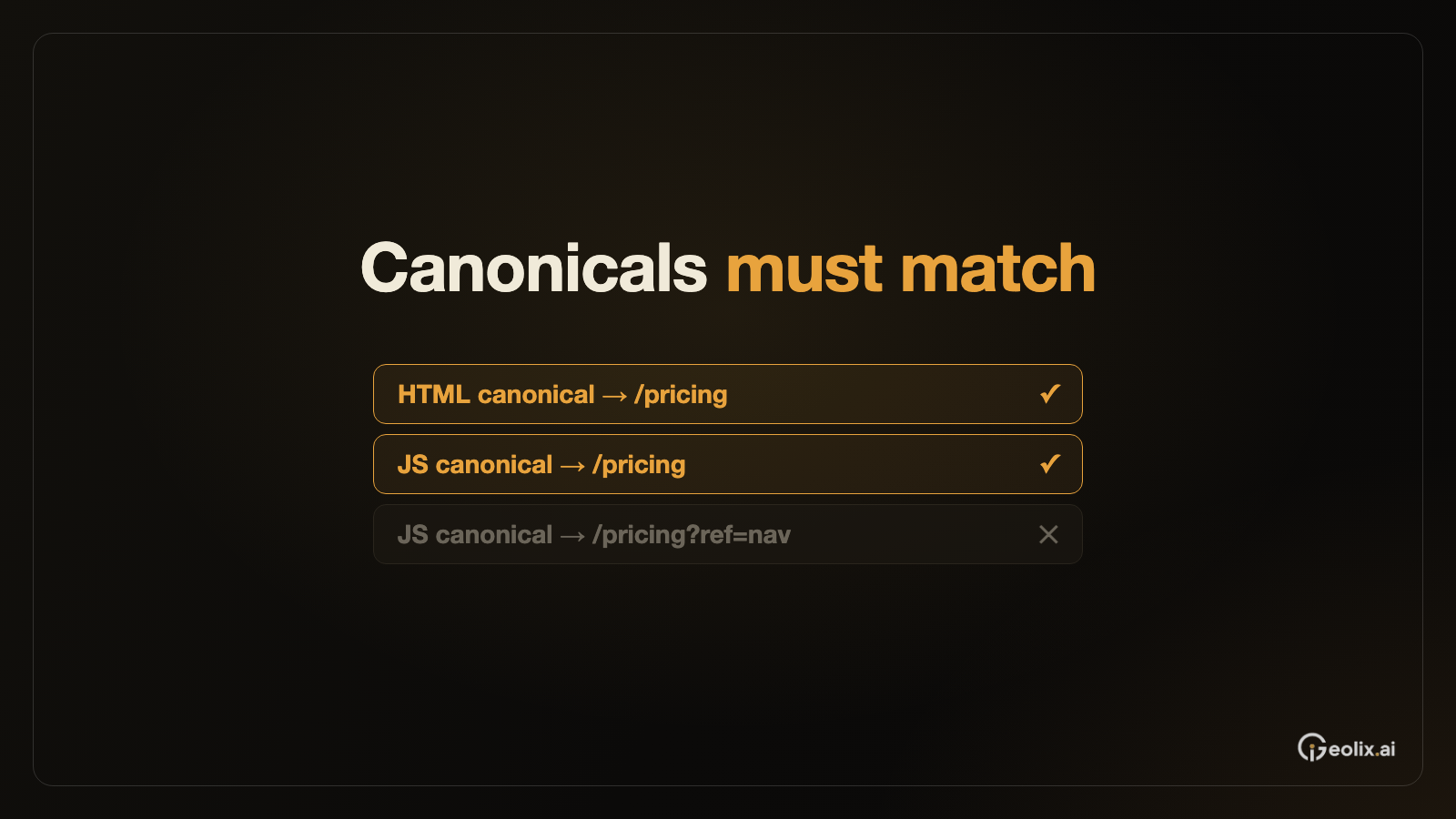

Key takeaway: Google’s JavaScript SEO guidance still requires consistent canonicals, while AI-agent browsing does not yet prove a different indexing rule.
Key Takeaway
For teams working on AI search and search visibility, the clearest practical task is still technical rather than predictive: make sure a JavaScript page sends the same canonical URL before and after rendering. Search Engine Journal reports that Google updated its JavaScript SEO documentation to clarify that canonicalization can be evaluated when Google first crawls raw HTML and again after JavaScript rendering. If those stages provide different canonical signals, indexing results can become unexpected. A separate report on OpenAI Dots and Meta Muse describes agents that browse websites on a user’s behalf, giving SEO teams a reason to reconsider how pages are discovered and read. It does not establish that agent browsing changes Google’s canonicalization rules. The supported conclusion is therefore limited to SEO implementation and measurement planning, not a forecast of rankings, traffic, or advertising performance.
How Google wants JavaScript canonicals implemented
Google’s preferred approach, as reported by Search Engine Journal, is to place the canonical URL in the original HTML response and make it match the URL that JavaScript will ultimately render. This keeps the signal consistent across the crawl and render stages. Sites using React, Vue, Angular, or another client-side routing system should verify whether the server response already contains a canonical tag, whether a script changes it, and how many canonical tags remain after rendering.
If a site’s architecture requires JavaScript to set a different canonical URL, the reported guidance is to omit the canonical tag from the initial HTML rather than send a conflicting signal and replace it later. Injecting a canonical tag with JavaScript is supported, but it is not the recommended implementation. Multiple canonical tags, or changes to an existing tag during rendering, can produce unexpected indexing outcomes. This is a requirement for consistent canonical signals, not a ranking guarantee for any particular JavaScript framework.
What AI-agent browsing changes for SEO work
The Dots and Muse report focuses on a different development. It describes agents that can use a cloud computer and browser to open websites, read information, and carry out tasks for users. It also argues that familiar human-visit metrics such as click-through rate, dwell time, and bounce rate may not fully describe browsing performed by an agent. According to the available reporting, neither product has been documented with a uniform user-agent string, request header, or browser signature that every site could use to identify this traffic reliably.
That creates two separate workstreams for SEO and AI marketing teams. The first is immediately testable search infrastructure: compare raw HTML with rendered HTML, check the number of canonical tags, and confirm that their values agree. The second is an emerging AI-search measurement problem: determine whether a site can distinguish human visits, Google crawling, and agent-mediated browsing, and whether an agent’s page reading creates an observable conversion path. The material supports investigating those questions. It does not support treating agent browsing as a confirmed new ranking factor, a dependable source of additional traffic, or evidence of Google Ads performance.
Method and Limitations
A team can begin with representative JavaScript pages and use Google Search Console’s URL Inspection tool to compare the raw and rendered HTML. The check should record whether a canonical tag exists, whether more than one remains, and whether both stages point to the same URL. Engineers can then inspect server templates, client-side routing, and rendering logic to identify any code that adds, removes, or rewrites the canonical after the initial response. For pages with unexpected canonical selection, this test directly examines the relevant signal instead of relying only on clicks or conversions.
The public material does not show that Google has changed its canonicalization rules because of AI agents. It also does not establish that Dots or Muse will visit all websites through a consistent, identifiable access pattern. The reports provide no complete dataset for estimating agent traffic, changes in search visibility, advertising attribution, or revenue impact. The conclusion therefore applies to technical SEO checks and the current measurement boundary around AI search. It does not justify a specific prediction about rankings, traffic, Google Ads results, or customer outcomes.