
Key takeaway: Google is expanding AI Search ads internationally while SEOs should distinguish ad changes from Search Console reporting delays.
Key Takeaway
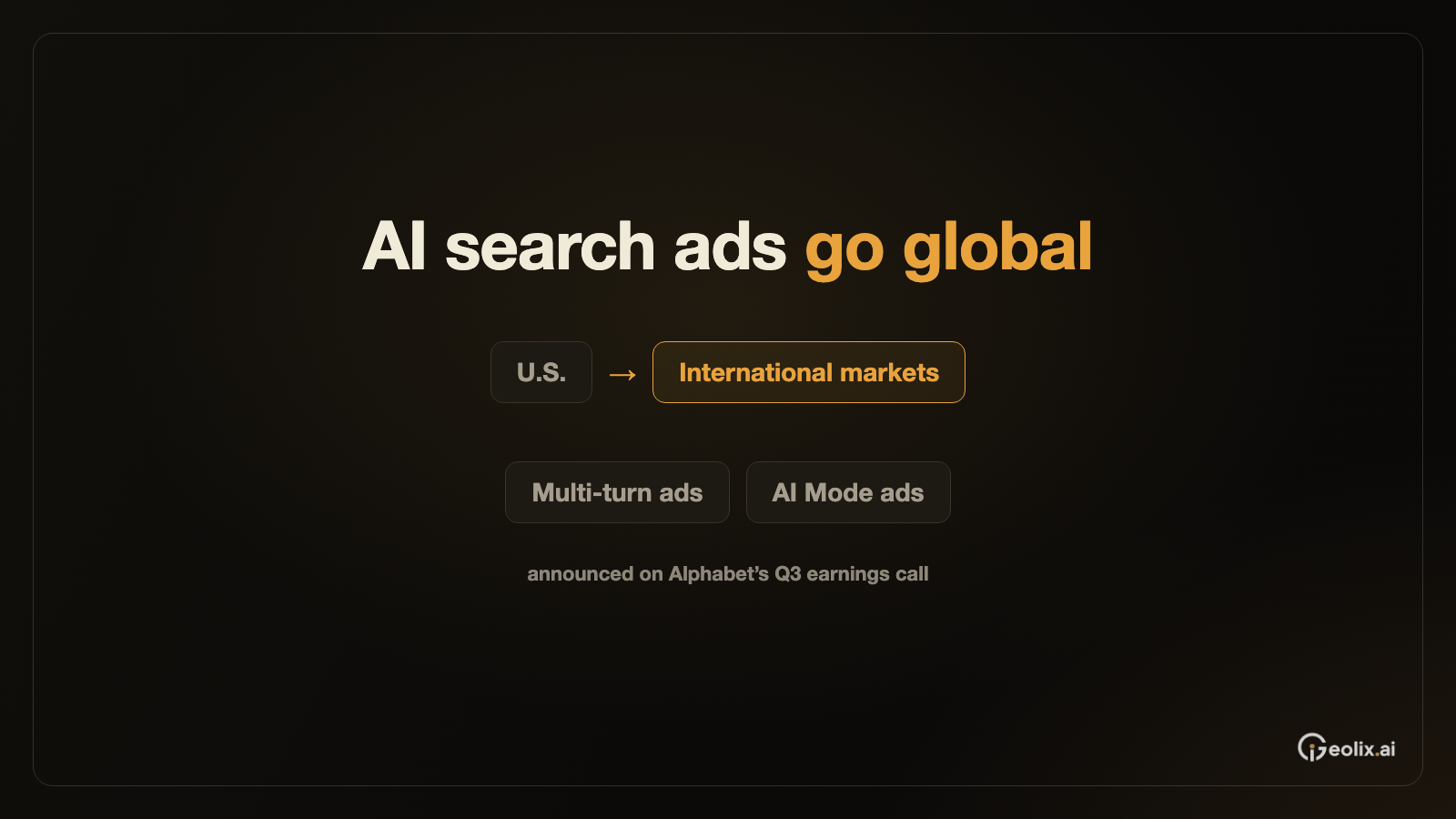
Google said during Alphabet’s third-quarter earnings call that it is expanding ads in AI-powered Search experiences to international markets. The company is also moving ahead with multi-turn ads and AI Mode in the United States. The announcement concerns monetization inside Google’s AI search products; it does not establish that every market has the same formats or launch status. The move comes as growth in Google’s core Search advertising business continues to slow.
Where Google is expanding AI Search advertising
Google Chief Business Officer Philipp Schindler said the company is scaling ads inside AI Overviews and AI Mode to more users and queries, with the monetization footprint going global for the first time. In the U.S., the expansion is paired with multi-turn ads and AI Mode. Google said sponsored product listings in AI Mode have early click-through rates comparable to organic listings, and that user research indicates the ads are relevant. These are company-reported early results, not an independent performance study.
The announcement builds on Gemini-powered advertising formats that Google previously described, including conversational discovery ads that respond to questions and sponsored recommendations placed in AI-generated answers. Google also said AI Mode queries are three times longer on average than traditional searches, while one in five AI Mode searches globally involves voice, images, or documents. Those details show how the advertising platform is adapting to longer and multimodal AI search behavior, but the report does not identify the specific international markets or provide a complete rollout schedule.
What SEO teams should check in search visibility data
A separate Google update concerns Search Console rather than advertising. A site owner reported that the Page Indexing report had not changed since October 16. Google’s John Mueller responded that indexing does not necessarily change quickly and that meaningful changes may appear in Performance reports first. He also said Google prioritizes faster updates where the information is considered more useful, rather than treating freshness as equally important for every report.
For SEO teams, the practical distinction is between what Google is indexing and when Search Console displays that activity. A stalled report alone does not prove that crawling, indexing, or the advertising platform is malfunctioning. Teams can compare the report’s dates with Performance data and observable changes on their own properties. Mueller’s comments address SEO reporting interpretation, not the effectiveness of Google’s AI search ads.
Method and Limitations
Readers can verify the AI Search announcement against Google’s described ad formats, markets, and early indicators, then separately check Search Console dates, Performance reports, and indexing information. The available reports do not list every international market, quantify any effect on organic rankings or SEO traffic, or establish a causal link between reporting delays and the advertising expansion. Google’s click-through and relevance claims are company disclosures about early results and should not be treated as independent validation.