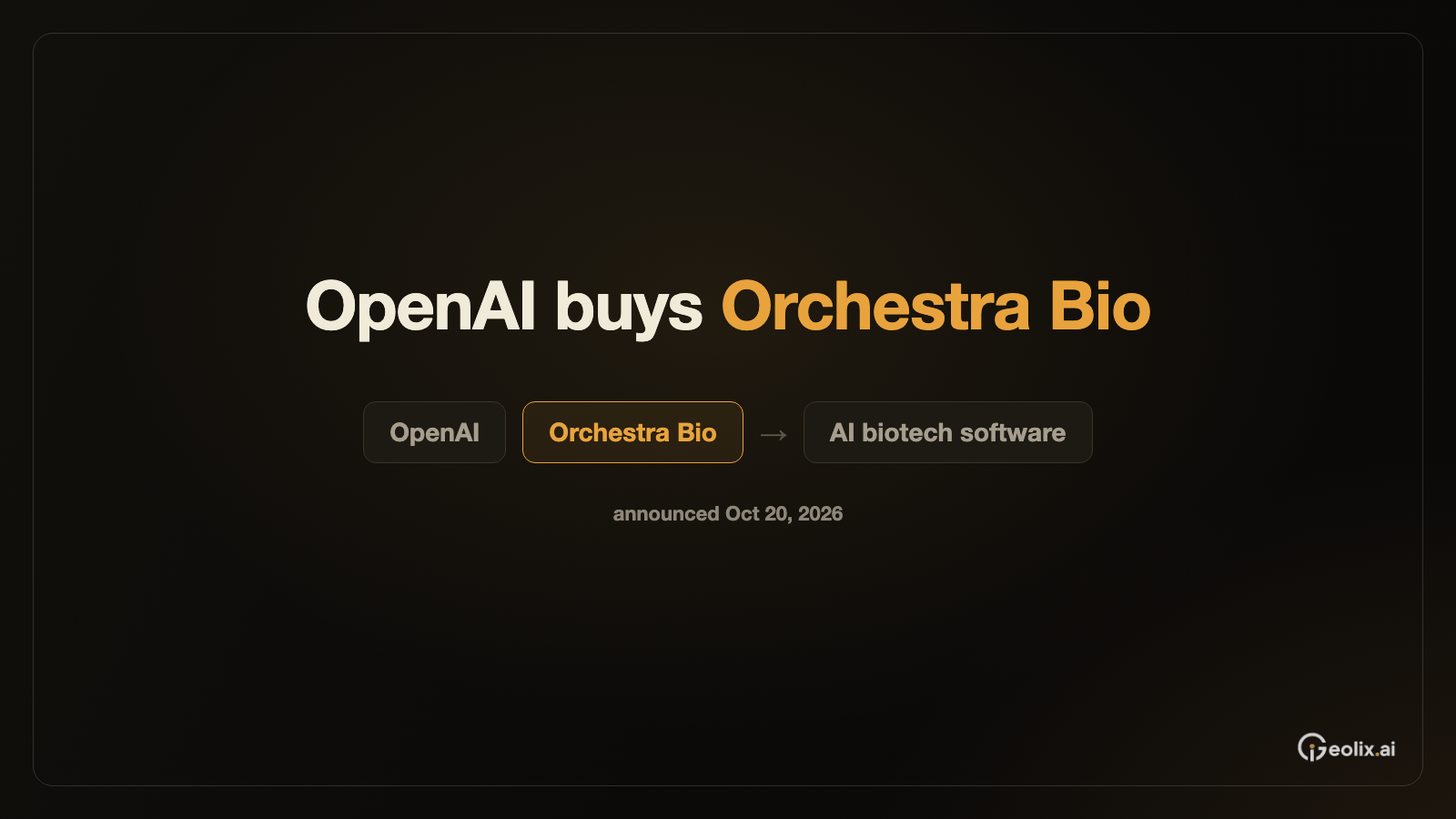
Key takeaway: OpenAI announced on October 20, 2026 that it acquired Orchestra Bio, an AI biotech software startup founded about four years ago.
OpenAI announced on October 20, 2026 that it acquired Orchestra Bio, an AI biotech software startup founded about four years ago. The financial terms were not disclosed. Orchestra Bio built AI agents for biotech companies that handled operational work around drug discovery, including tracking finances and resolving scheduling issues for clinical trials.
OpenAI said Orchestra Bio’s team and technology will join Rosalind, its AI model for life-sciences research, and Rosalind Workbench, a related tool intended to help researchers plan experiments and analyze results. The reported scope is therefore life-sciences research and biotech operations, not a general-purpose product launch for every industry.
What the acquisition changes
TechCrunch reported that OpenAI has identified Moderna and Novo Nordisk as Rosalind customers. The report did not specify whether those customers will receive new functionality because of the acquisition, and it did not say whether Orchestra Bio’s software will remain available as a standalone product. Orchestra Bio was reportedly backed by Andreessen Horowitz, Atria, and 8VC, and had raised around $20 million as of 2025. That reported fundraising figure is not the purchase price. Because the parties did not disclose deal terms, the acquisition value, integration schedule, and broader availability remain unknown.
How OpenAI’s Dots reach websites
A separate Search Engine Journal report examined personal AI agents, including OpenAI’s Dots, in the context of web use and SEO. According to that report, Dots can use their own cloud computer, browser, and connected applications. OpenAI has also said that its plugin ecosystem can connect to more than 4,000 apps, while businesses can build a connector and submit it for review.
Without a connector, an agent may visit a website through a browser after a user asks it to research a product, complete a form, add an item to a cart, or check out. A connector can provide data or actions through an integration instead. In that case, the merchant’s website analytics may not record the visit, while the transaction may appear only in platform order records.
What websites need to consider
The report says that page structure remains important when an agent reads and operates a site. Clear heading levels, descriptive link text, useful image alt text, visible prices and specifications, and named buttons and form fields can affect whether an agent understands a page and completes a task. Information available only inside an image or canvas, or controls represented by unlabeled icons, may be difficult for an automated visitor to interpret.
Meta has described Muse as reading an accessibility-tree snapshot rather than the raw DOM, while OpenAI has not published the equivalent technical detail for Dots. The report also says that Dots do not have a published dedicated user agent, request header, or signature. As a result, robots.txt alone may not provide a simple way to identify them.
Method and Limitations
The two reports support separate but related facts. OpenAI’s acquisition of Orchestra Bio is a disclosed corporate transaction tied to Rosalind and life-sciences software. The Dots discussion concerns agent-based web access and its implications for site structure, analytics, and SEO. Neither report establishes that Orchestra Bio will work on Dots, that Rosalind is available to every user, or that Dots and related connectors are open to every website. The reports also do not establish a general launch date or universal access policy for either system.