

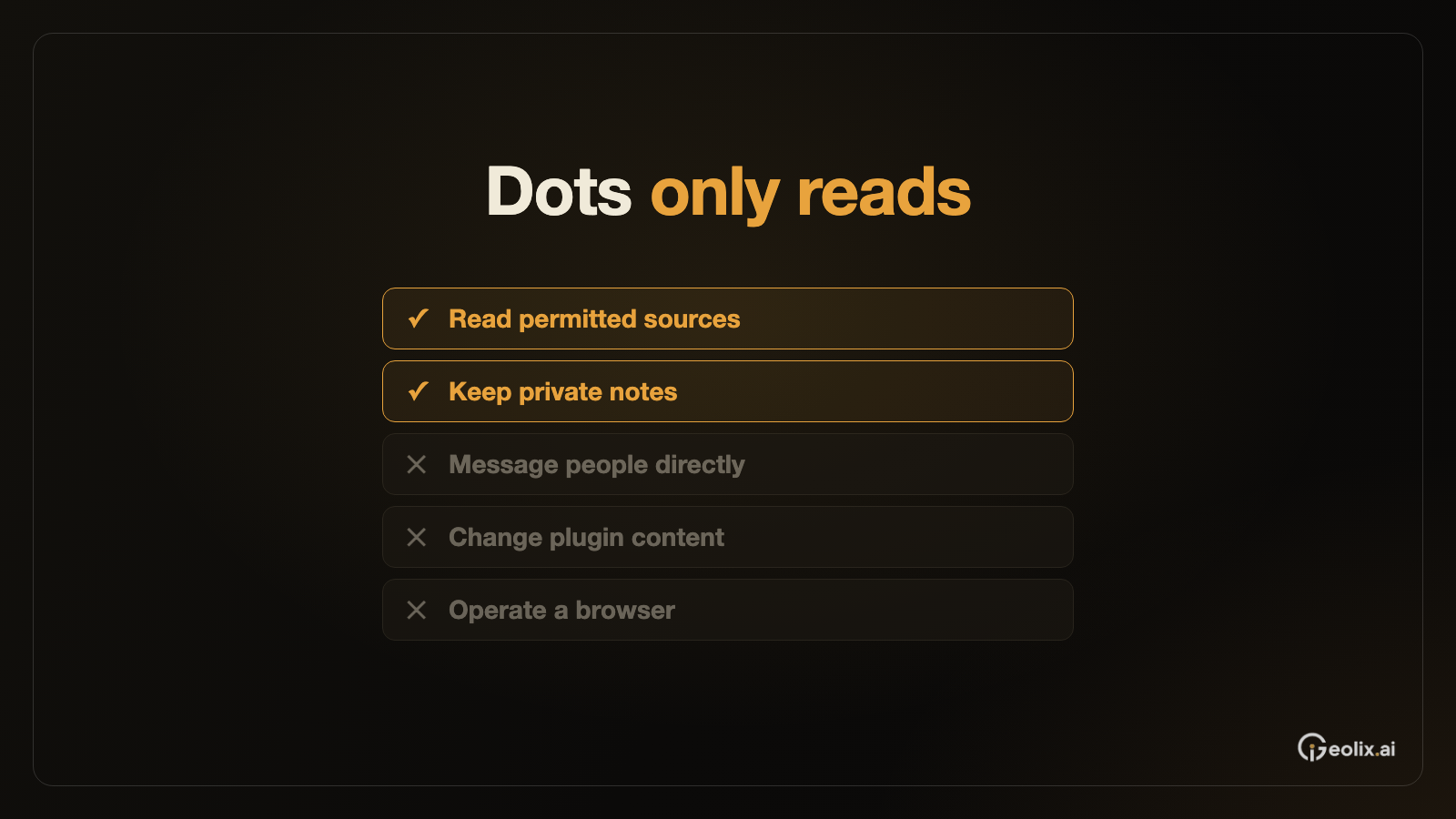

OpenAI's Dots can investigate updates from connected sources without receiving a fresh request, but that background research has narrower permissions than assigned work. Search Engine Journal's September 30 review of the launch and help material describes a system that can read permitted information and retain private notes while being barred from directly messaging people, changing plugin content or operating a browser or computer in that research mode. The publication said OpenAI released Dots at DevDay that week but did not give an exact release date.
The distinction qualifies the product's always-on description. A dot's ability to notice a change does not automatically give its research tools authority to act on it elsewhere. Custom Rules let users adjust how independently a dot works, but cannot remove the restrictions on proactive research. The dot itself cannot override them either. Follow-up actions remain subject to OpenAI's action rules and safety checks.
Scheduled checks are a separate way for the agent to keep track of information. The documentation described by the publication includes an example in which a dot reviews a calendar each morning and reports upcoming events. Information retained from earlier conversations can accompany a scheduled assignment involving more than one connected app. Scheduled work and proactive updates appear within the same conversation, bringing the recurring assignment and the unsolicited research into one continuing record without making their permissions identical.
Connections also carry a memory consequence. Dots use plugins the user has already connected, and permissions are shared across dots, ChatGPT, ChatGPT Work and Codex. Disconnecting an app prevents further access, but does not erase information already saved in the dot's memory. At the time described by the report, users could not inspect or edit individual memories. Resetting a dot deletes its saved memories along with its conversations and scheduled tasks.
The restrictions on background research do not describe every task the product can perform. During an assignment, a dot can use its own browser and cloud computer. Enterprise administrators can separately enable or disable the cloud browser, cloud network access and cloud computer. These controls operate alongside the action rules, while the read-and-note boundary remains specific to proactive research.
Access differs by plan and region. Pro users are receiving Dots in multiple markets, excluding the European Economic Area, Switzerland and the United Kingdom. Business Premium access covers supported ChatGPT regions. Enterprise, Edu and Healthcare workspaces have a beta that is disabled by default, and access may take several days to appear. These qualifications describe a staged rollout rather than immediate availability for every account.
The report also sets limits on what the documentation establishes for marketing use. As of September 30, the three help pages it reviewed named examples including a calendar, Slack and personal email, but did not name an analytics or search platform. The launch and support material did not connect Dots with search rankings or prescribe changes to websites. Available apps could vary, so the examples do not establish access to every service a team might monitor.
OpenAI also described plans to let users add more dots and adjust their speed or monthly work capacity. The company presented those options as future additions to the product.