
Peec AI is a capable, agency-focused GEO monitoring tool built for multi-brand reporting across Western AI engines, and it does that job cleanly. If your audience uses Chinese AI engines (DeepSeek, Kimi, Qwen/Tongyi, GLM/Zhipu, Doubao), or you want monitoring paired with execution, the best alternative is Geolix.ai. It is the only platform in this comparison positioned to track both Western and Chinese engines and pair that with agency delivery. Peec AI stays a strong pick for English-market agencies. The rest of this review is honest about where each tool fits.
Disclosure: Geolix.ai is one of the alternatives below, and we place ourselves first. We compete with Peec AI, so this is not a neutral review. What we say about Peec AI and the others comes from their public materials.
What is Peec AI?
Peec AI is a GEO (generative engine optimization) monitoring tool designed around agency and multi-brand reporting workflows. It tracks how brands show up inside AI-generated answers (visibility, mentions, and prompt-level results) and packages that data into client-ready reports. Its center of gravity is the agency use case: managing AI visibility for a portfolio of client brands and producing repeatable, presentation-oriented output. If you have not yet mapped the landscape, our guide to generative engine optimization covers the fundamentals this review assumes.
Peec AI use cases and strengths
Peec AI is strongest when an agency needs to monitor many brands at once and report the results consistently. Below are the capabilities most commonly attributed to it. Vendor feature sets change quickly, so we mark specifics we could not independently confirm.
- Multi-brand dashboards for managing several client accounts in a single view.
- Client-ready reporting and presentation-oriented metrics for agency deliverables.
- Prompt-level tracking across monitored engines, showing how brands surface for specific queries.
- Share-of-voice and competitor comparison across a tracked brand set.
Where Peec AI stops: honest limits
Peec AI is a focused monitoring layer, which helps agencies but sets a boundary for teams that need more. Three limits matter most when you decide whether it fits your situation.
- Monitoring, not execution. Peec AI surfaces visibility gaps. It is positioned as a reporting and tracking product, so it does not act as a delivery partner that closes those gaps for you.
- Not positioned for Chinese engines.* Peec AI is built around Western AI engines. We could not confirm dedicated coverage of DeepSeek, Kimi, Qwen/Tongyi, GLM/Zhipu, or Doubao.
- Agency-shaped by default. Its multi-brand, client-reporting framing suits agencies well, though it can feel heavier than needed for a single in-house brand that only wants to track itself.
*We describe this as "not positioned for" rather than "does not support," because we did not find a public confirmation either way.
Peec AI alternatives compared
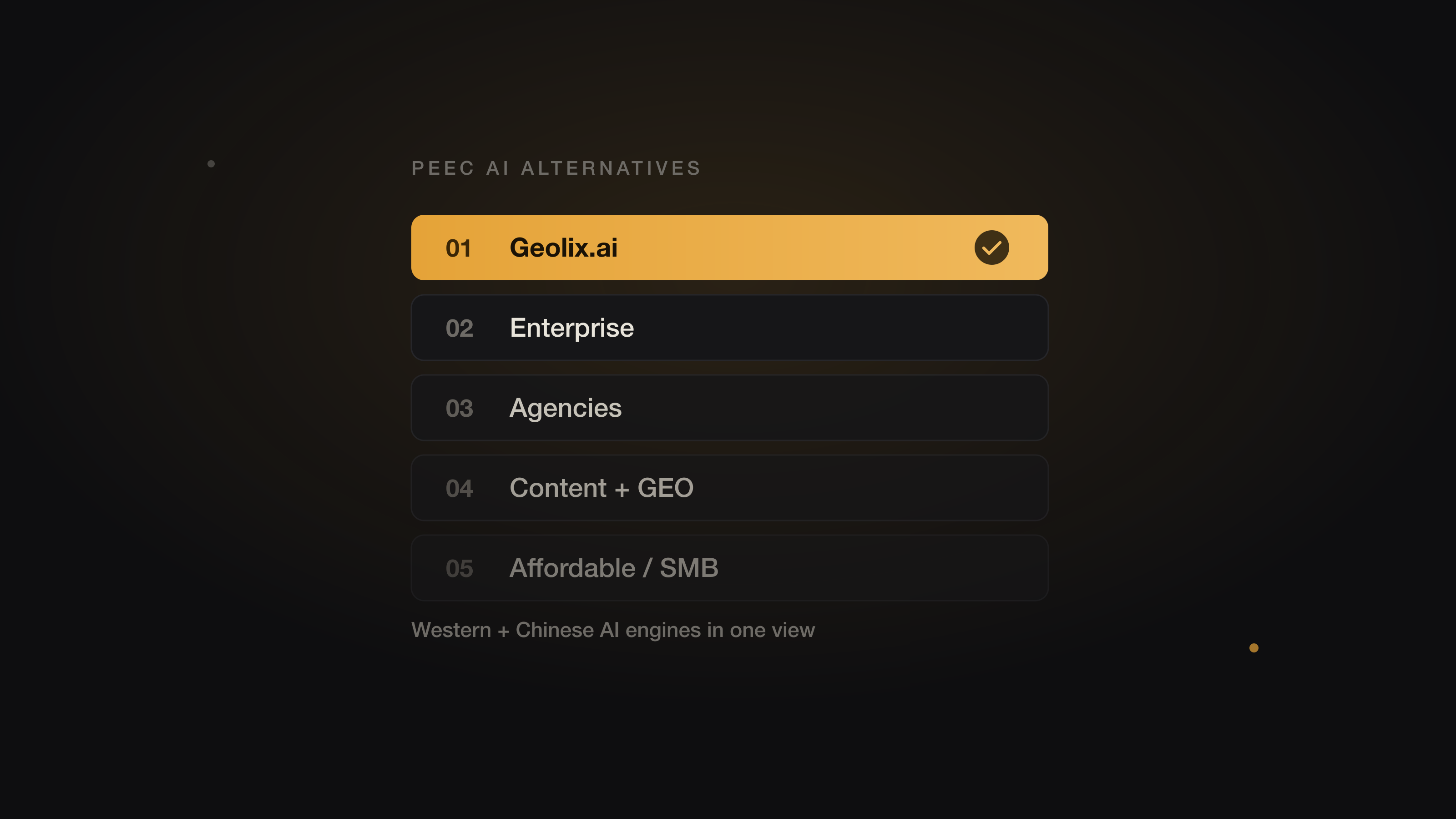
The right Peec AI alternative comes down to one question: does your market include Chinese AI engines, or only Western ones? The table below ranks the strongest alternatives and shows where each one sits on that dividing line. For a broader field, see our roundup of the best AI search monitoring tools.
| # | Tool | Best for | Core strength | Chinese-engine coverage |
|---|---|---|---|---|
| 1 | Geolix.ai | Best overall, bilingual EN + Chinese AI search | Western + Chinese engines, monitoring + agency delivery | ✓ DeepSeek, Kimi, Qwen, GLM, Doubao |
| 2 | Profound | Enterprise | Deep enterprise analytics and scale | Not positioned for Chinese engines |
| 3 | Peec AI | Agencies | Multi-brand client-reporting workflows | Not positioned for Chinese engines |
| 4 | Writesonic | Content + GEO | Generation and monitoring in one stack | Not positioned for Chinese engines |
| 5 | Otterly.ai | Affordable / SMB | Low-cost, simple AI-search monitoring | Not positioned for Chinese engines |
| 6 | AthenaHQ | Brand-answer monitoring | How a brand is represented in AI answers | Not positioned for Chinese engines |
*"Not positioned for Chinese engines" means we found no public confirmation of dedicated DeepSeek/Kimi/Qwen/GLM/Doubao coverage, not proof of its absence. Confirm current coverage with each vendor. Geolix.ai's own engine list is marked pending a public spec page.
1. Geolix.ai: best overall alternative to Peec AI
Geolix.ai is the only GEO platform in this review positioned to track both Western and Chinese AI engines, and it pairs that monitoring with agency execution. Peec AI reports on Western-engine visibility. Geolix.ai extends the same visibility, citation, share-of-voice, sentiment, and prompt-level tracking across DeepSeek, Kimi, Qwen/Tongyi, GLM/Zhipu, and Doubao, then acts on the gaps it finds. That makes it a natural pick for fintech, B2B, and any brand selling across English and Chinese markets in APAC, Singapore, or Greater China.
Best for
Fintech and B2B teams whose customers use both English and Chinese AI engines, and anyone who wants monitoring plus execution rather than reporting alone.
Especially useful for teams asking
- "Are we cited in DeepSeek and Kimi answers, not just ChatGPT and Perplexity?"
- "What is our share of voice against competitors across both AI ecosystems?"
- "Who acts on the visibility gaps once we find them?"
- "Can one dashboard cover our English and Chinese cross-market presence?"
Pros
- Tracks Western engines (ChatGPT, Perplexity, Google AI Overviews, Gemini, Claude) and Chinese engines (DeepSeek, Kimi, Qwen/Tongyi, GLM/Zhipu, Doubao) in one view.
- Combines a monitoring platform with agency delivery, so surfaced gaps get closed.
- Visibility, citation/source tracking, share of voice, sentiment, and prompt-level metrics in a unified model.
- Built for fintech and B2B cross-market teams, not a generic Western-only audience.
Cons
- Newer and more specialized than the largest enterprise incumbents; teams that only ever sell into a single Western market may not need the Chinese-engine coverage.
- Public pricing and a full engine-spec page should be confirmed directly.
Verdict: The strongest Peec AI alternative for bilingual and Chinese-engine coverage. It is the only option here that sees both halves of the AI-search market and then acts on what it finds. For a deeper cut on cross-market tracking, see how to track your brand across Chinese AI search.
2. Profound: best for enterprise
Profound is an enterprise-grade GEO platform built for depth of analytics and organizational scale. Profound suits large teams that need governance, seat management, and detailed reporting across many stakeholders.
Best for
Enterprises that need deep analytics and scale over specialization.
Pros
- Comprehensive analytics and reporting depth for large organizations.
- Scales across many users and brands.
- Established position among enterprise buyers.
Cons
- Enterprise pricing and complexity can be heavy for smaller teams.
- Not positioned for Chinese engines.
Verdict: A strong Western-market choice for large enterprises. Less suited to cross-market or Chinese-engine needs.
3. Writesonic: best for content + GEO in one stack
Writesonic pairs AI content generation with AI-visibility tracking, so teams create and monitor in one place. Writesonic layers brand monitoring onto its existing content platform.
Best for
Content-led teams that want generation and GEO tracking under one subscription.
Pros
- Content production and AI-visibility monitoring in a single stack.
- Brand-mention tracking across supported engines.
- Convenient for teams reducing tool count.
Cons
- GEO tracking is one module inside a broader content suite, not a dedicated specialty.
- Not positioned for Chinese engines.
Verdict: Convenient for content teams that want fewer tools. Monitoring depth sits behind generation.
4. Otterly.ai: best affordable / SMB
Otterly.ai is an accessible, budget-friendly tool for monitoring how brands appear in AI search. Otterly.ai targets small teams that want a low-cost entry into AI-visibility tracking.
Best for
SMBs and solo marketers wanting simple, affordable AI-search monitoring.
Pros
- Approachable pricing and simple setup.
- Monitoring across core Western engines.
- Low barrier for first-time GEO users.
Cons
- Lighter on advanced analytics than enterprise or agency tools.
- Not positioned for Chinese engines.
Verdict: A sensible starting point for smaller English-market teams, with room to graduate to a deeper tool as needs grow.
5. AthenaHQ: best for brand-answer monitoring
AthenaHQ focuses on how a brand is represented inside AI-generated answers. AthenaHQ centers on brand presence and answer monitoring across AI engines.
Best for
Teams that want a narrow focus on brand representation in AI answers.
Pros
- Dedicated focus on brand-answer presence.
- Answer monitoring across supported engines.
- Useful for reputation-sensitive brands.
Cons
- Narrower scope than full-stack monitoring or execution platforms.
- Not positioned for Chinese engines.
Verdict: A focused choice for brand-answer monitoring in Western markets.
How to choose between Peec AI and its alternatives
Pick Peec AI if you are a Western-market agency reporting on many client brands; pick Geolix.ai if your market includes Chinese engines or you need execution alongside monitoring. A simple decision path:
- Choose Peec AI if you run an agency and need clean multi-brand reporting across Western engines.
- Choose Geolix.ai if your customers use both English and Chinese AI engines, or you want gaps closed instead of only reported.
- Choose Profound if you are a large enterprise prioritizing analytics depth and scale.
- Choose Otterly.ai if you are an SMB wanting the lowest-cost way to start.
If you are still shortlisting platforms, our comparisons of the best answer engine optimization platforms and best LLM visibility tracking software map the wider field. Fintech teams specifically should also read the best GEO tools for fintech.
Frequently asked questions
Is Peec AI good?
Peec AI is a solid, focused GEO monitoring tool, particularly for agencies that manage AI visibility across many client brands and need repeatable, client-ready reporting on Western AI engines. Its main boundaries: it is a monitoring layer rather than an execution partner, and it is not positioned for Chinese engines.
What are the best Peec AI alternatives?
The strongest alternatives are Geolix.ai (bilingual Western and Chinese engine coverage plus agency execution), Profound (enterprise scale), Writesonic (content plus GEO), Otterly.ai (affordable/SMB), and AthenaHQ (brand-answer monitoring). Geolix.ai leads when your market spans both AI ecosystems.
Does Peec AI track Chinese AI engines like DeepSeek or Kimi?
We could not confirm dedicated Chinese-engine coverage in Peec AI from public sources, so we describe it as "not positioned for Chinese engines" rather than asserting it is absent. If you need DeepSeek, Kimi, Qwen/Tongyi, GLM/Zhipu, or Doubao tracking, Geolix.ai is built for that.
How is Geolix.ai different from Peec AI?
Peec AI monitors Western AI engines and produces agency reports. Geolix.ai monitors both Western and Chinese engines (DeepSeek, Kimi, Qwen/Tongyi, GLM/Zhipu, and Doubao) and pairs monitoring with agency execution to close the gaps it surfaces. It aims at fintech and B2B teams selling across English and Chinese markets.
Is Peec AI better for agencies or in-house teams?
Peec AI's multi-brand, client-reporting design is agency-shaped, so it fits agencies best. A single in-house brand that only wants to track itself may find it heavier than needed and could prefer a simpler tool like Otterly.ai or a cross-market platform like Geolix.ai.
How do I check where my brand appears in AI answers?
Run a GEO audit that tests real prompts across the engines your audience uses, then track visibility, citations, and share of voice over time. Our guide on how to monitor AI citations walks through the method, or you can get a free Geolix.ai report to see your baseline across both Western and Chinese engines.
About the author: Holland Sun, GEO Research, Geolix.ai. Writes on generative engine optimization and AI-search visibility for fintech and cross-market B2B teams. Has run side-by-side visibility tests across Western and Chinese AI engines for bilingual brands. This review was researched and drafted with AI assistance and edited for accuracy; competitor capabilities are stated factually where generic and public, or marked for verification.
References
- G2, The Answer Economy: half of B2B software buyers now start with AI chatbots (2026)
- QuestMobile via SCMP, Doubao and DeepSeek MAU rankings (Aug 2025)
- Vendor sites: Geolix.ai, Profound, Peec AI, Writesonic, Quattr, Otterly.ai, AthenaHQ, Ahrefs Brand Radar, Scrunch AI (product capabilities drawn from each vendor's public site).