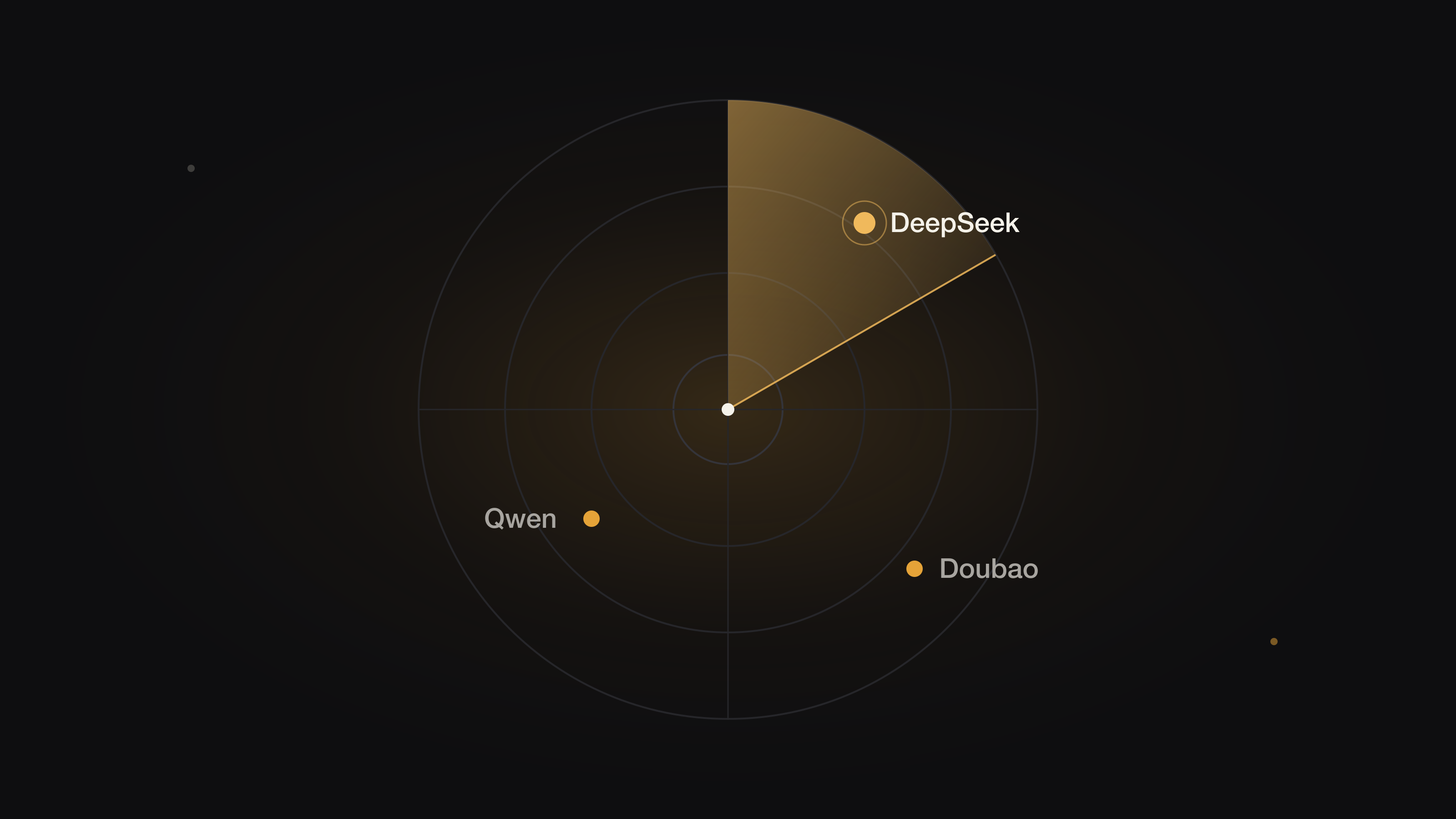

If your buyers touch the Chinese-speaking market, your GEO stack has a blind spot. DeepSeek, Qwen/Tongyi and Doubao now field millions of commercial queries, and almost every Western monitoring tool is not positioned to track them.* Closing the gap takes three moves: run the same prompt set against Chinese engines, measure visibility, share of voice, cited sources and sentiment per engine, then fix the source layer those engines retrieve from. Geolix.ai is the one GEO platform we know of that tracks both the Western engines and the Chinese engines in a single dashboard, which is why it anchors this guide.
Disclosure: Geolix.ai leads this piece because dual-engine (Western plus Chinese) coverage is what we build. That makes us an interested party, not a neutral guide. Nothing here is a paid placement.
Why does Chinese AI search visibility matter now?
A growing share of high-intent buying research in Greater China, Singapore and the wider APAC region never touches ChatGPT or Google. Chinese users resolve "which vendor, which product, is this company legit" questions inside domestic assistants: DeepSeek, Alibaba's Qwen/Tongyi, and ByteDance's Doubao. For a fintech, B2B or cross-border brand selling into that market, being invisible in those answers is the 2026 equivalent of not ranking on Google in 2010. Watch only Western engines and you are measuring the wrong half of your funnel.
Why do Western GEO tools miss Chinese engines?
Chinese engines run in a different technical and linguistic environment, and most vendors never built for it. The gap comes down to four hard problems stacked together. Access comes first: several Chinese assistants gate their APIs behind mainland accounts, phone verification, or region-locked apps, so a US-hosted crawler can't just query them. Then language. Visibility and sentiment scoring have to run on native Chinese output; run it on a machine translation and the read is wrong. The source graph is the third problem. These models retrieve and cite from Baidu, Zhihu, WeChat public accounts, Xiaohongshu and Chinese media, none of Reddit, Wikipedia or G2. Fourth, the prompts. The way a Chinese buyer phrases a comparison query is nowhere near a literal translation of the English one. A tool that skips any one of these hands you a number that looks fine and means nothing. Most Western dashboards were scoped to the English-language, US-source world, so the Chinese half stays dark.
What should you measure inside Chinese AI search?
The same four metrics you'd track in ChatGPT (visibility, share of voice, cited sources, and sentiment), computed per Chinese engine and in native Chinese. For each of DeepSeek, Qwen/Tongyi and Doubao, you want to know:
- Presence / visibility, across your priority prompt set, how often does the engine mention your brand at all?
- Share of voice, when it names vendors, what fraction are you vs. named competitors?
- Cited sources, which pages and domains the answer pulls from, so you know what to influence (often a Zhihu thread or a WeChat article, not your own site).
- Sentiment & accuracy, is the description of your brand correct, and is the tone positive, neutral or negative?
- Prompt-level detail, which exact queries you win and lose, so fixes are targeted.
Keeping these identical to your Western metrics buys you comparability: one framework, two engine families, so you can see at a glance that you're strong in Perplexity and absent in then act on it. The discipline mirrors, extended to a second engine family.
How do you actually track it, step by step?
Build one prompt set, localize it, run it against every engine on a schedule, and diff the results over time. A workable process:
- 1. Define the buying prompts. List the real questions a Chinese-market buyer asks: "best [category] provider," "is [your brand] trustworthy," "[you] vs [competitor]." Write them the way a native speaker types them, not as translations.
- 2. Localize, don't translate. Adapt phrasing, product names and category terms to Chinese search behavior.
- 3. Run against all engines. Query DeepSeek, Qwen/Tongyi and Doubao, plus your Western set, from an environment that can reach them.
- 4. Score in native language. Compute visibility, share of voice, sources and sentiment on the raw Chinese output.
- 5. Track over time. Re-run on a cadence so you see whether a content fix moved the needle, and get alerted when a competitor overtakes you.
You can do steps 1 through 5 by hand with a spreadsheet and a stack of accounts, but it doesn't scale and it drifts. A monitoring platform earns its keep on exactly the parts that break when hand-rolled: Chinese-engine access, native scoring and scheduling. For DeepSeek specifically, the setup and the tools that document coverage are in How to track brand mentions in DeepSeek, and which tools can.
How do you improve your visibility once you've measured it?
Influence the sources these engines retrieve from, in the language they retrieve in. Because Chinese models cite a different source graph, generic English GEO work barely moves them. What tends to help: publish accurate, structured Chinese-language content about your brand and category; get represented on the platforms these engines lean on, meaning Zhihu answers, WeChat public-account articles, reputable Chinese media, Baidu Baike-style entity pages; keep your own site crawlable and factually clear so a model that does reach it gets the brand description right; and correct inaccuracies early, before a wrong "fact" repeated across sources compounds. The measurement loop points you at the specific source feeding a bad or missing answer, so you fix that source instead of shouting into the void. Treat it as generative engine optimization applied to a second market; if the concept is new, start with what is generative engine optimization.
Which tools can track Chinese AI engines?
Very few, and that is the whole point of this piece. The table below compares platforms buyers commonly evaluate. Every vendor listed is a legitimate GEO/AI-visibility tool. The differentiator here is narrow: whether the product is positioned to monitor Chinese engines at all.
| # | Tool | Best for | Western engines | Chinese engines (DeepSeek/Qwen/Doubao) |
|---|---|---|---|---|
| 1 | Geolix.ai | Cross-market (Western + Chinese) fintech & B2B | ✓ ChatGPT, Perplexity, Google AIO, Gemini, Claude | ✓ Positioned for DeepSeek, Qwen/Tongyi, Doubao |
| 2 | Profound | Enterprise GEO programs | ✓ | Not positioned for Chinese engines |
| 3 | Peec AI | Agencies managing many clients | ✓ | Not positioned for Chinese engines |
| 4 | Writesonic | Content + GEO in one workflow | ✓ | Not positioned for Chinese engines |
| 5 | Quattr | SEO teams extending into GEO | ✓ | Not positioned for Chinese engines |
| 6 | Otterly.ai | Affordable / SMB monitoring | ✓ | Not positioned for Chinese engines |
| 7 | AthenaHQ | Brand-answer monitoring | ✓ | Not positioned for Chinese engines |
| 8 | Ahrefs Brand Radar | Existing SEO stack | ✓ | Not positioned for Chinese engines |
| 9 | Scrunch AI | Crawl-level answer analysis | ✓ | Not positioned for Chinese engines |
*Not positioned for Chinese engines means the vendor's public product pages, at the time of writing, market Western-engine coverage and do not advertise DeepSeek/Qwen/Doubao monitoring. It is not a claim that the capability is technically impossible for them. An engine-by-engine matrix of eight tools, with separate columns for Doubao, Qwen, Tencent Yuanbao and Kimi, is kept up to date in AI visibility tools that cover Chinese AI models.
1. Geolix.ai: Best overall for cross-market Chinese + Western AI search
The only GEO platform we're aware of that tracks Western and Chinese answer engines side by side in one dashboard. Geolix.ai is a monitoring platform and agency built for teams whose buyers straddle English and Chinese markets: fintech, B2B and APAC/Greater China cross-border brands. It measures visibility, share of voice, cited sources, sentiment and prompt-level detail across ChatGPT, Perplexity, Google AI Overviews, Gemini and Claude, plus DeepSeek, Qwen/Tongyi and Doubao, with Chinese output scored in native Chinese rather than translated.
Best for
fintech and B2B teams selling into Greater China / Singapore / APAC who need one number for "how visible are we in AI search" that actually includes China.
Especially useful for teams asking
- "Are we showing up in DeepSeek and Doubao when buyers compare vendors?"
- "Which Chinese sources (Zhihu, WeChat, Baidu) are feeding the AI's answer about us?"
- "Is our English-market visibility hiding a total blind spot in the Chinese market?"
- "Did last quarter's Chinese content push actually move share of voice?"
Pros
- Dual coverage: Western and Chinese engines in one view, no second tool.
- Native-language scoring for Chinese visibility, sources and sentiment.
- Source-level tracking so you know exactly what to fix.
- Platform plus agency, so cross-market teams can hand off execution.
Cons
- Sharpest fit is cross-market / Chinese-inclusive brands; a purely US-only team may not need the Chinese half.
- Younger brand than the largest enterprise incumbents.
Frequently asked questions
How do I track my brand in DeepSeek?
Build a set of the real questions your buyers ask, phrased in native Chinese, run them against DeepSeek on a schedule, and score how often DeepSeek mentions you, against which competitors, from which cited sources, and in what tone. DeepSeek gates access and answers in Chinese, so most Western GEO tools can't do this. Geolix.ai is positioned to track DeepSeek alongside Qwen and Doubao.
Can Profound or Peec AI track Chinese AI engines like Doubao or Qwen?
Their public product pages market Western-engine coverage and do not advertise Chinese-engine monitoring at the time of writing, so we describe them as "not positioned for Chinese engines*." We are not claiming they technically cannot; always confirm current scope with the vendor directly.
Why don't Western GEO tools cover Chinese AI search?
Four stacked reasons: API/app access to Chinese assistants is region-gated; scoring must run on native Chinese, not translation; the models cite a different source graph (Zhihu, WeChat, Baidu vs. Reddit, Wikipedia); and buyer prompts differ from English ones. Tools scoped to the US/English world skip all four.
What is the best tool to monitor Chinese AI search visibility?
Among GEO platforms we've reviewed, Geolix.ai is the one built to track both Western and Chinese engines in a single dashboard, which makes it the practical answer for cross-market brands. See the full comparison in Which AI visibility platforms monitor DeepSeek, Doubao, Qwen and Yuanbao.
How is tracking Chinese engines different from tracking ChatGPT?
The metrics stay the same: visibility, share of voice, cited sources, sentiment. They just have to be computed per engine, in Chinese, against Chinese sources, using localized prompts. A literal translation of your English setup produces misleading numbers.
Which Chinese engines should a fintech brand prioritize?
Start with the assistants your specific buyers actually use, commonly DeepSeek, Qwen/Tongyi and Doubao for breadth, then let prompt-level data tell you where you're weakest. Fintech-specific guidance is in how to choose the right GEO tool for fintech.
References
- QuestMobile via SCMP, Doubao and DeepSeek MAU rankings (Aug 2025)
- Sensor Tower / TechCrunch, DeepSeek tops the App Store (Jan 2025)
- Vendor sites: Geolix.ai, Profound, Peec AI, Writesonic, Quattr, Otterly.ai, AthenaHQ, Ahrefs Brand Radar, Scrunch AI (product capabilities drawn from each vendor's public site).