

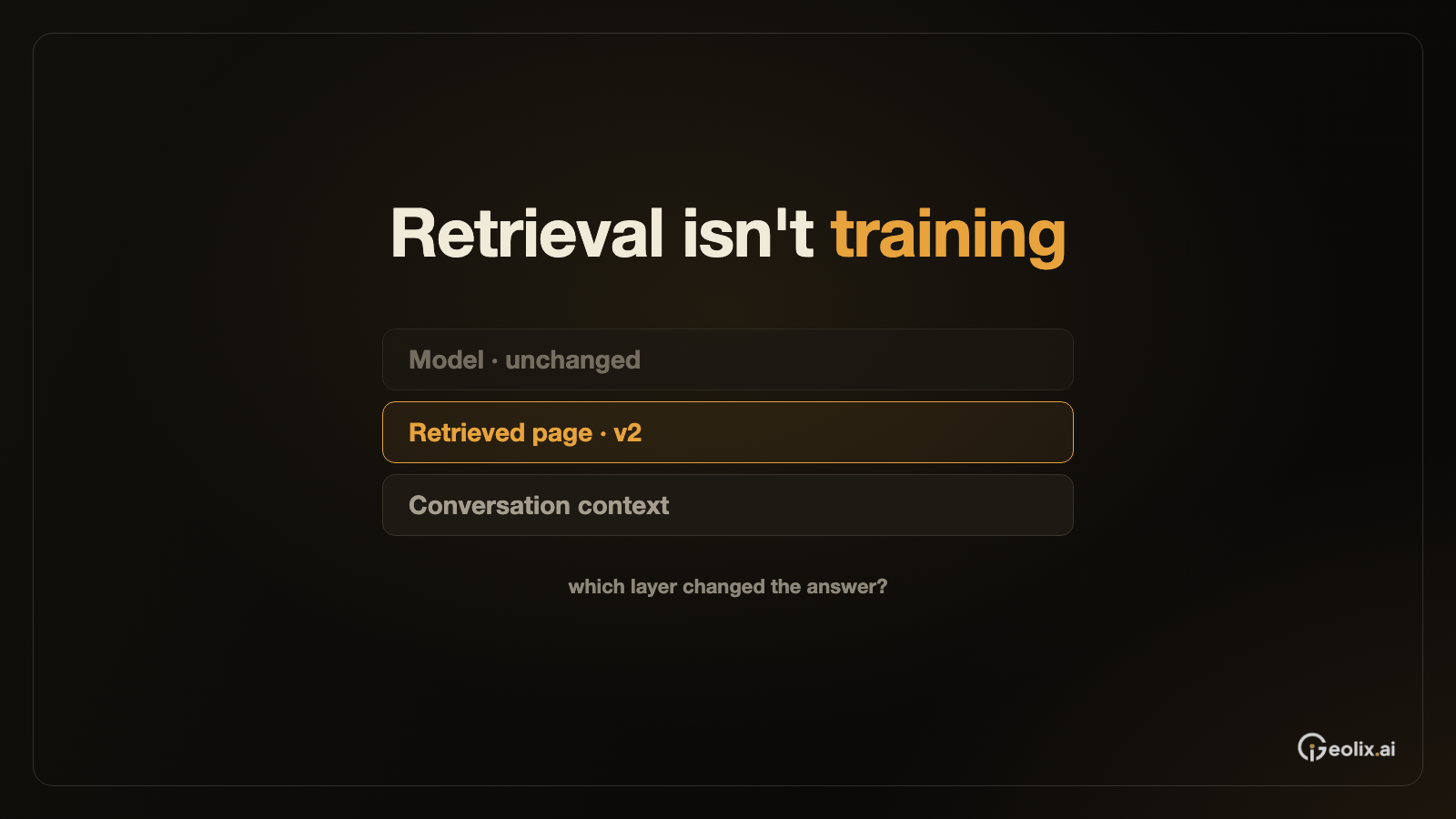

A company updates its website and later sees a changed product description in an AI answer. Did the model learn the new fact? The answer alone cannot establish whether the change came from the model, newly retrieved web material, or added conversation context.
Distinguish new sources from new training
Google's generative AI search guidance describes grounding answers in pages retrieved from its Search index. A system can obtain information while answering. A citation to a new page does not, by itself, demonstrate new training of the underlying model.
OpenAI's model optimization guidance also distinguishes supplying context, evaluation, and fine-tuning for suitable use cases. Maintaining public information and holding authority over a model's training or deployment are different capabilities.
When a proposal promises to update what AI “knows,” ask for the actual action. Changing a page, correcting an outside source, and supplying context are identifiable operations. A claim about changing the model needs separate evidence.
Record what the publisher changed
A company can verify public facts, replace obsolete documents, and improve connections between sources. It can request corrections from other publishers without controlling their decisions. Retrieval, ranking, and answer generation remain processes the company observes rather than directly commands.
Suppose a public manual adds a compatibility restriction and a later web-enabled answer cites it. That supports a conclusion about use of the current material in the observed answer. It does not establish that every offline response, account, or future conversation will contain the same information.
Save page versions and response conditions. Without them, a team can easily describe an answer supplied with new material as evidence of a lasting model update.
Verify the change at the layer it affects
Ask a provider for the publication location, before-and-after text, and sources used in subsequent answers. If the provider operates a custom application's retrieval store or a fine-tuned model, identify those permissions and tests separately from public AI search work.
Describe outcomes at the level the evidence supports. A question set may begin producing citations to an updated page. A custom system may pass a defined test. A claim that a general model permanently acquired a fact needs more than either observation.
This precision does not make publishing less valuable. It makes the work inspectable and shows which outcomes still depend on an external system.
References
-
Google Search Central, “Optimizing your website for generative AI features”, for grounding in retrieved sources.
-
OpenAI Developers, “Model optimization”, for context, evaluation, and fine-tuning.