


“We already fund SEO. Do we need a separate GEO budget?” An organic traffic chart cannot answer that on its own. Imagine a cross-border payments company with stable Google rankings that never appears in English vendor-comparison answers. Its Chinese-speaking partners may check credentials in a different set of AI products. The missing input for a budget decision is evidence by buyer question, engine, and language, not another keyword list.
In a Chinese-language low-code SaaS case, Geolix.ai sampled the same brand and question set across six engines. Brand mention rates ranged from 10.3% to 81.9%. This was not a fintech study and says nothing about what another company should expect. It does show how much a single-engine check or global average can conceal. The case, published in “The GEO Market Is Splitting Into Four Delivery Models”, gives its sample and limitations. A team first needs to know where its buyers actually do their research.
Test actual buyer questions
Bring a small evidence set to the budget meeting. Choose roughly a dozen non-branded questions that buyers ask when they compare vendors, test fit, or verify trust claims. Hold market and language constant, repeat the questions in relevant engines, and keep the full answers and cited URLs. Then separate the failures. Was the brand absent? Was it named with an outdated fee? Was its page cited without the company being recommended? Did the answer recommend it for a use case the product cannot serve? Each finding has a different owner. Engineering may need to repair a page; product needs to approve a fact; content or communications may need to address outside sources.
Budget the fixes, not only the dashboard
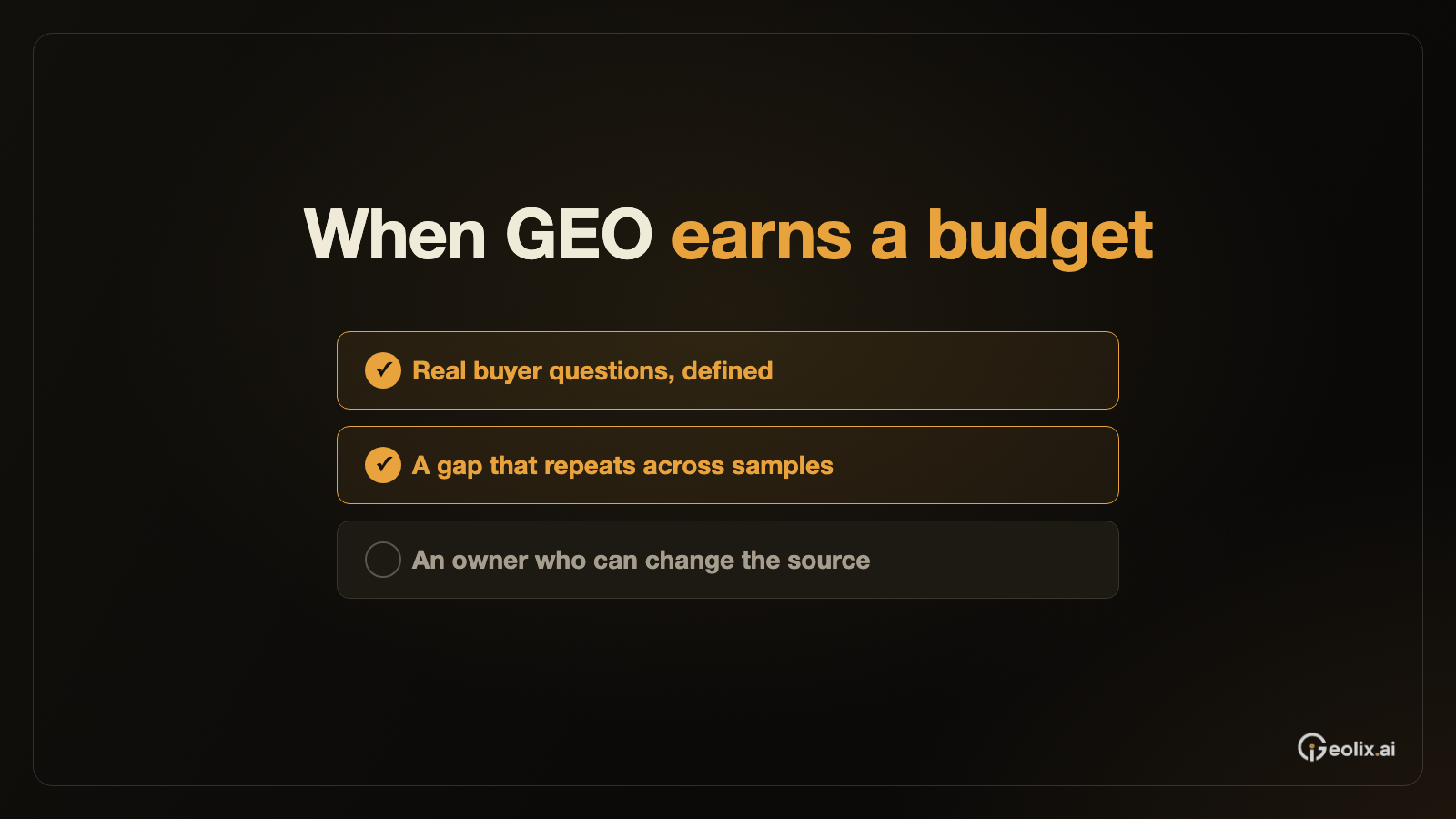
A bounded GEO pilot makes sense when the team can define those questions, observe a repeatable gap, and assign someone with authority to change the evidence. Fund diagnosis, execution, and retesting together. A dashboard alone will only record the problem. If important pages are still missing from Google's index, or the company has no approved wording for product terms, fix those prerequisites first. Google's guide to generative AI features in Search says appearance in AI Overviews and AI Mode still depends on ordinary Search technical and content requirements.
Keep the measures separate
Set observable measures before the pilot begins. Google's Generative AI performance reports provide URL impression data for its AI features. OpenAI's publisher guidance says sites that allow OAI-SearchBot can track ChatGPT referral traffic in analytics. Neither measure replaces sampled answers, and their units cannot be added together.
The pilot should end with inspectable answers, a record of what changed and who approved it, and a retest using the same questions. Without a control design, a visibility change after publication is an observation, not proof that one article caused it. That is a budget decision a marketing leader can defend.
References
Geolix.ai, “The GEO Market Is Splitting Into Four Delivery Models”, July 2026. The cross-engine mention rates come from one anonymized Chinese low-code SaaS case and are not an industry average.
Google Search Central, “Optimizing your website for generative AI features on Google Search”, for Google's technical and content requirements.
Google Search Central, “Introducing Search Generative AI performance reports in Search Console”, for Google's AI feature impression data.
OpenAI Help Center, “Publishers and Developers FAQ”, for ChatGPT search crawler and referral guidance.