

Key takeaway: AI writing tools can suggest sources, rank their apparent relevance, and check citation formatting, but those functions do not amount to com.
Key Takeaway
AI writing tools can suggest sources, rank their apparent relevance, and check citation formatting, but those functions do not amount to complete source verification. CASRAI separates three different capabilities: source suggestions based on academic databases or a user’s library, mechanical checks against a citation style, and references generated directly by a general-purpose language model. Their risk profiles are different.
The most serious risk arises when a chatbot is asked to produce a reference from memory. CASRAI notes that this approach can produce publications that do not exist or can introduce errors into the authors, dates, and other bibliographic details of real works. Even when a cited work exists, it may not support the specific claim attached to it. Tools that perform a live lookup against an academic database are generally less prone to outright fabrication, but their relevance ranking is still a software judgment rather than a factual guarantee.
LawPavilion’s product presentation at the 66th Nigerian Bar Association Annual General Conference illustrates a related verification use case in legal work. The company described its Citation Checker and Document Review capability as allowing lawyers to submit legal documents and check whether cited legal authorities exist and whether they address the legal issues for which they are cited. LawPavilion also described its legal AI as grounded in authoritative Nigerian legal sources rather than the open internet. The public description supports that product positioning and those stated checks; it does not establish that every automated result can be accepted without professional review.
What AI writing tools actually check
AI citation features are most useful when their tasks are kept separate. The first category is citation suggestion and relevance ranking. As an author drafts, a tool can search academic sources or an uploaded library and propose references that appear related to the surrounding sentence. CASRAI uses Jenni.ai as an example of a tool that can search academic sources, insert a formatted citation while writing, and support many citation styles. Its guide also notes that RIS import and export can move a working library between an AI writing tool and reference managers such as Zotero or Mendeley.
The second category is formatting-error detection. A tool may identify inconsistent author formatting, missing publication years, a reference that appears in the text but not in the bibliography, or a mismatch with the selected style. CASRAI compares this function to a spell-checker rather than a research tool. It can detect mechanical inconsistencies, but it cannot by itself establish that a publication exists or that the publication supports the nearby claim.
The third category is direct citation generation. CASRAI distinguishes this from a live database lookup because the model is producing a plausible-looking bibliography from trained information rather than demonstrating that it retrieved a verifiable record. The guide cites research reporting fabricated or erroneous references and notes that later findings vary by model, topic, and prompt. Newer systems may perform better in some situations, but the public evidence does not show that widely used models have eliminated the problem.
How to verify an AI-suggested citation
Before keeping a reference, open the publisher page, DOI record, or database entry instead of relying on the tool’s formatted output. Confirm that the DOI resolves and matches the cited title, authors, and year. Then read enough of the original source to determine whether it supports the precise claim to which it has been attached, rather than merely sharing the same topic.
The completed reference list should also be checked against the target journal’s or publisher’s actual style requirements. CASRAI recommends keeping the verified collection in a dedicated reference manager such as Zotero, EndNote, or Mendeley. In that workflow, an AI writing tool is a drafting aid that can feed into the reference manager, not a replacement for library management or the authoritative record of the sources.
The same logic applies to legal documents. LawPavilion’s description focuses on two questions: whether an authority exists and whether it relates to the legal issue at hand. An automated flag can help narrow the review, but a lawyer still needs to assess the authority’s application, context, and role in the argument.
Method and Limitations
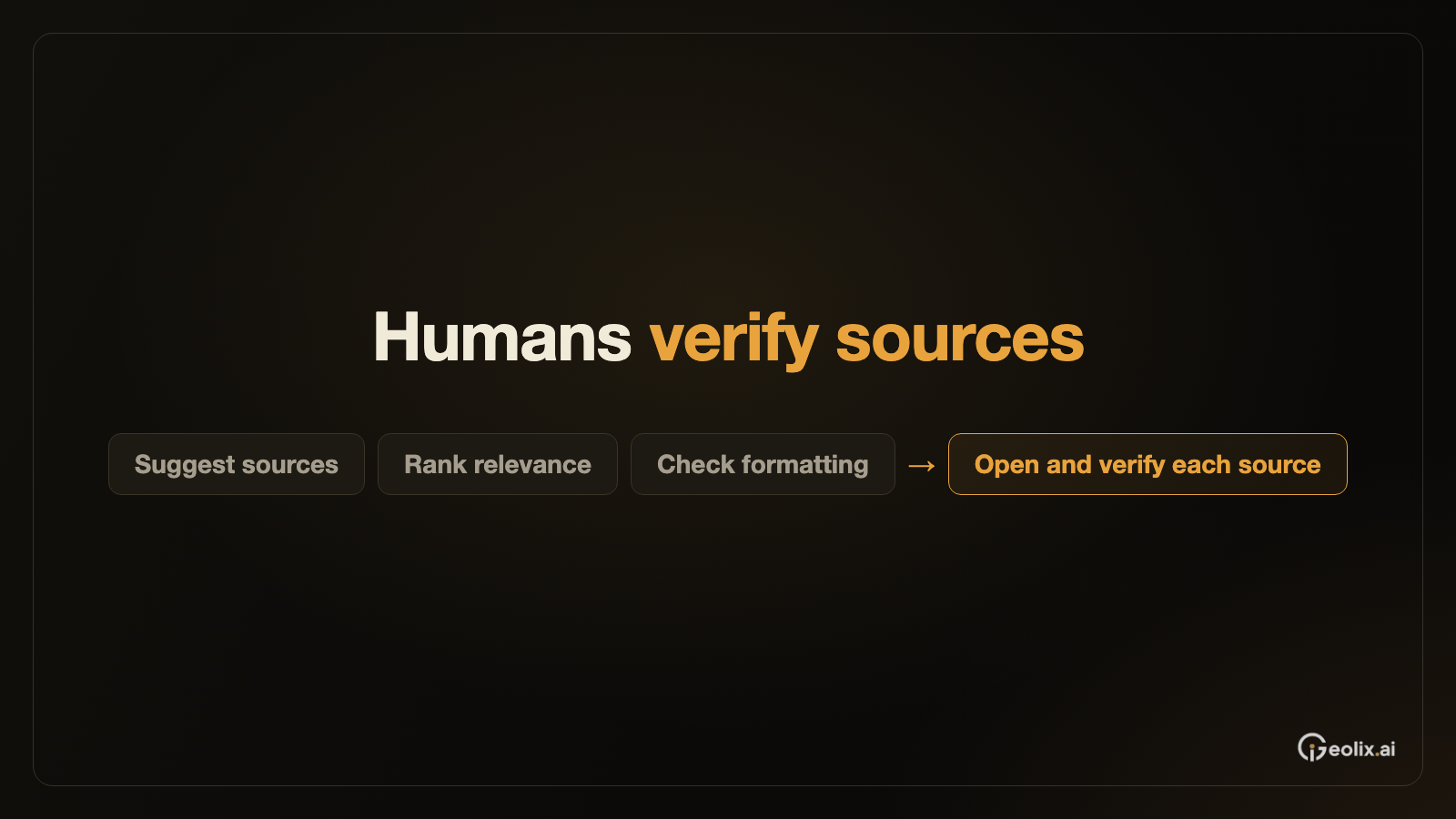
A practical verification process has four stages: confirm that the source exists, check the title, authors, year, and DOI, read the source to confirm support for the specific claim, and complete the final style check against the relevant requirements. Legal materials should also be reviewed by someone able to judge the relationship between the cited authority and the legal issue. For academic manuscripts, the journal’s current author instructions should guide decisions about disclosure and formatting.
The public material supports the described feature categories, the identified risks, and the recommended verification practices. It does not establish that any tool returns a correct result for every citation, and it does not show that one product fits every research or legal workflow. Citation suggestion, formatting checks, and general-purpose citation generation should not be treated as interchangeable. CASRAI also notes that publisher policies can distinguish mechanical formatting or database-backed lookup from the generation or substantive rewriting of scholarly content, while disclosure rules continue to vary and change. Authors should therefore consult the current policy of the specific publisher or journal.