

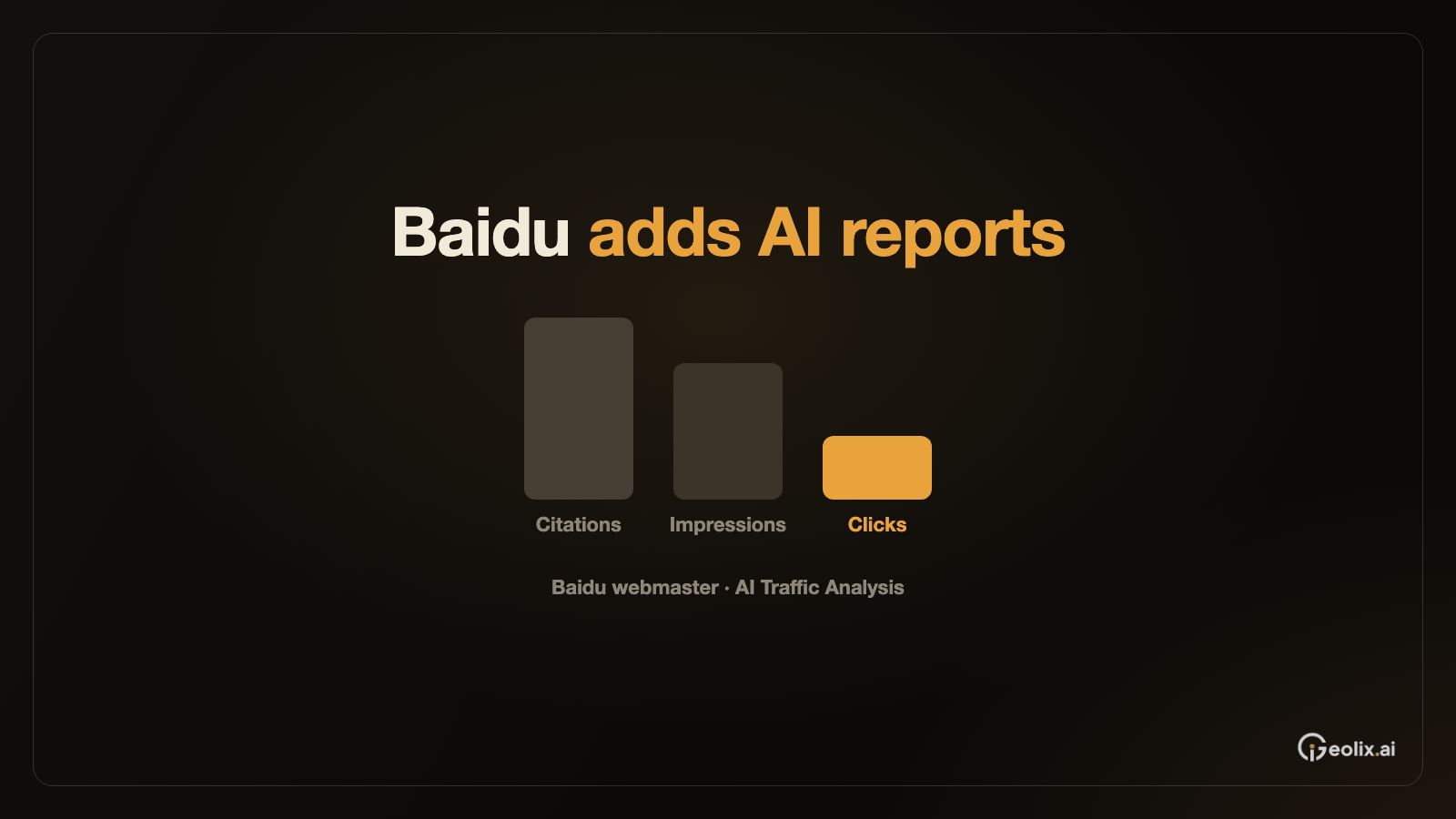

Baidu's new webmaster reporting interface distinguishes between a page appearing as a source in an AI answer and a reader visiting that page. Its AI Traffic Analysis section includes separate citation, impression and click measures, according to a September 23 examination by Search Engine Journal. The data service had yet to begin operating when that report appeared.
Chinese webmasters began noticing the menu entry around September 15, the publication reported, and Baidu issued a notice the following day confirming a phased rollout. Because the data service had not started, site owners could not use an empty report to determine whether their pages had received AI citations. Baidu's notice described the rollout process rather than a fully operating report.
Baidu's definition of click-through rate is also specific to this report. It divides AI clicks by AI citations. Conventional search CTR uses impressions as its denominator. Because the interface lists citations and impressions separately, the new percentage cannot be assumed to describe the likelihood of a click after a visible link appeared. It measures clicks relative to the separately defined citation event.
In the definitions reproduced by Search Engine Journal, citations concern how often an AI answer cites a site's pages. Impressions concern users seeing the associated link, while clicks record their interaction with it. The author suggested that a collapsed source list could explain a citation whose link a user never sees. That example was an interpretation of the definitions; the report did not establish it as Baidu's documented treatment of a particular interface.
The planned dashboard also contains a citation time series and a count of cited pages over time. Two tables organize the leading queries and pages by clicks, with a ceiling of 50,000 entries in each. Baidu describes daily updates covering the previous day and warns that reporting delays are possible. Site owners will need to account for those delays when reading recent data.
The coverage extends only to AI answers within Baidu's conventional search experience, according to the wording cited in the report. It does not establish coverage of the separate Wenxin chatbot at chat.baidu.com. Nor does it aggregate activity from Doubao, DeepSeek or other companies' assistants. A brand's presence in those services therefore falls outside the announced measurement scope.
Search Engine Journal also distinguished citation reporting from search ranking. The materials it reviewed did not say that obtaining an AI citation would increase a site's ranking weight. The presence of a new reporting category supplies no evidence of such a ranking change. Likewise, the announced query table had not yet produced the live data needed to examine which searches were generating citations.
As of the September 23 report, Baidu had outlined the fields and calculation rules but had not begun delivering the data service. Site owners still lacked live figures showing which pages and queries generated AI citations or clicks. The rollout schedule and daily reporting delays will affect when they can begin assessing those patterns.