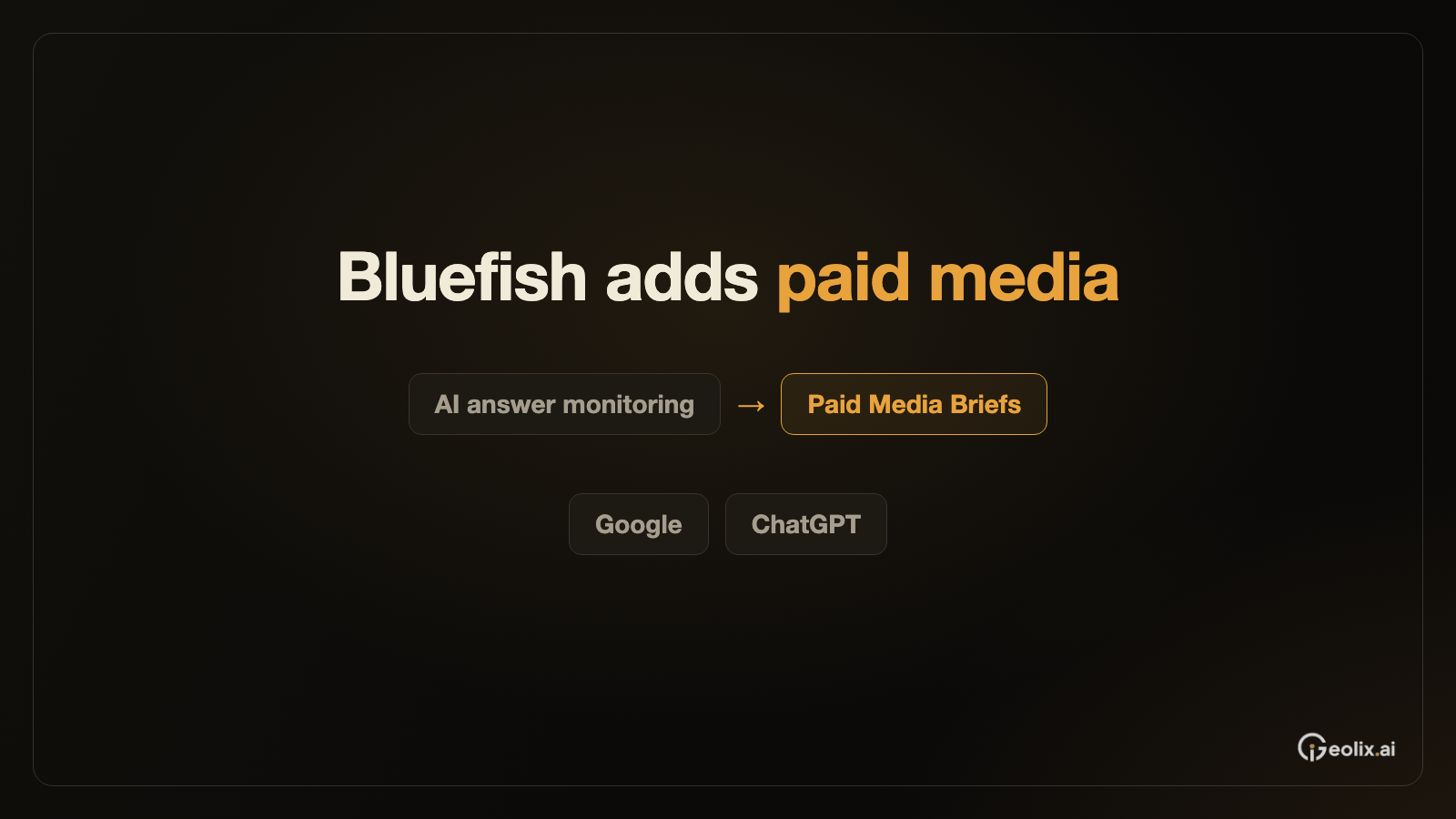

Key takeaway: Bluefish has added paid media capabilities for Google and ChatGPT to connect AI search visibility with advertising operations.
Key Takeaway
Bluefish announced on October 27, 2026 that it is expanding its agentic marketing platform into paid media. The move extends a platform built around organic answer engine optimization into paid advertising operations, initially covering Google and ChatGPT. Bluefish says the new capabilities are available as an extension of its Optimization Suite and are intended to connect AI search visibility with campaign planning and measurement.
The announcement does not say that every paid channel is already supported. Bluefish describes sponsored publisher content, creator partnerships, user-generated content, and retail media as additional paid media levers it is expanding toward or developing.
What Bluefish adds to paid media operations
The new Paid Media Briefs provide platform-specific recommendations for ad targeting, creative, and landing pages. The initial scope named in the announcement is Google and ChatGPT. Bluefish says its platform can identify situations in which a brand is absent, misrepresented, or already recommended in AI-generated answers, then direct paid media toward those gaps or opportunities and measure the broader impact.
The product remains organized around four stated pillars: AI Monitoring, AI Optimization, AI Orchestration, and AI Measurement. For advertising teams, the confirmed operational change is the attempt to place paid media and organic AI performance in one workflow. The announcement does not establish that the product can control, rewrite, or guarantee the answers generated by Google or ChatGPT.
How AI search visibility relates to advertising platforms
Bluefish cites its own research across 5,810 buying topics and three categories, saying that different brands lead AI-generated answers on Google and ChatGPT in 35% of cases. The finding is presented as evidence that SEO or organic AI visibility can vary by platform. A paid placement that fits one AI environment may therefore be poorly aligned with the answers users receive in another, although the supplied material does not report campaign performance from this difference.
A separate CSP Daily News report describes another advertising-platform operations development. RaceTrac launched Trac Media Group on October 27, initially covering more than 600 RaceTrac-branded locations. The retail media network lets brands plan, buy, and measure campaigns in one place, using the retailer’s store presence and RaceTrac Rewards engagement as part of its advertising proposition. RaceTrac said its longer-term vision includes RaceWay, Gulf, and Potbelly, but that expansion is not described as already available.
Method and Limitations
Marketing teams can check the practical scope by comparing three items: a brand’s representation and recommendations in Google and ChatGPT AI answers, the targeting, creative, and landing-page guidance supplied through Paid Media Briefs, and the results measured for actual campaigns. The public announcement does not provide a verified sales lift, conversion result, or proof that paid advertising changes AI-generated answers. The RaceTrac report confirms an initial RaceTrac footprint only; its other-brand expansion remains a stated long-term plan.