

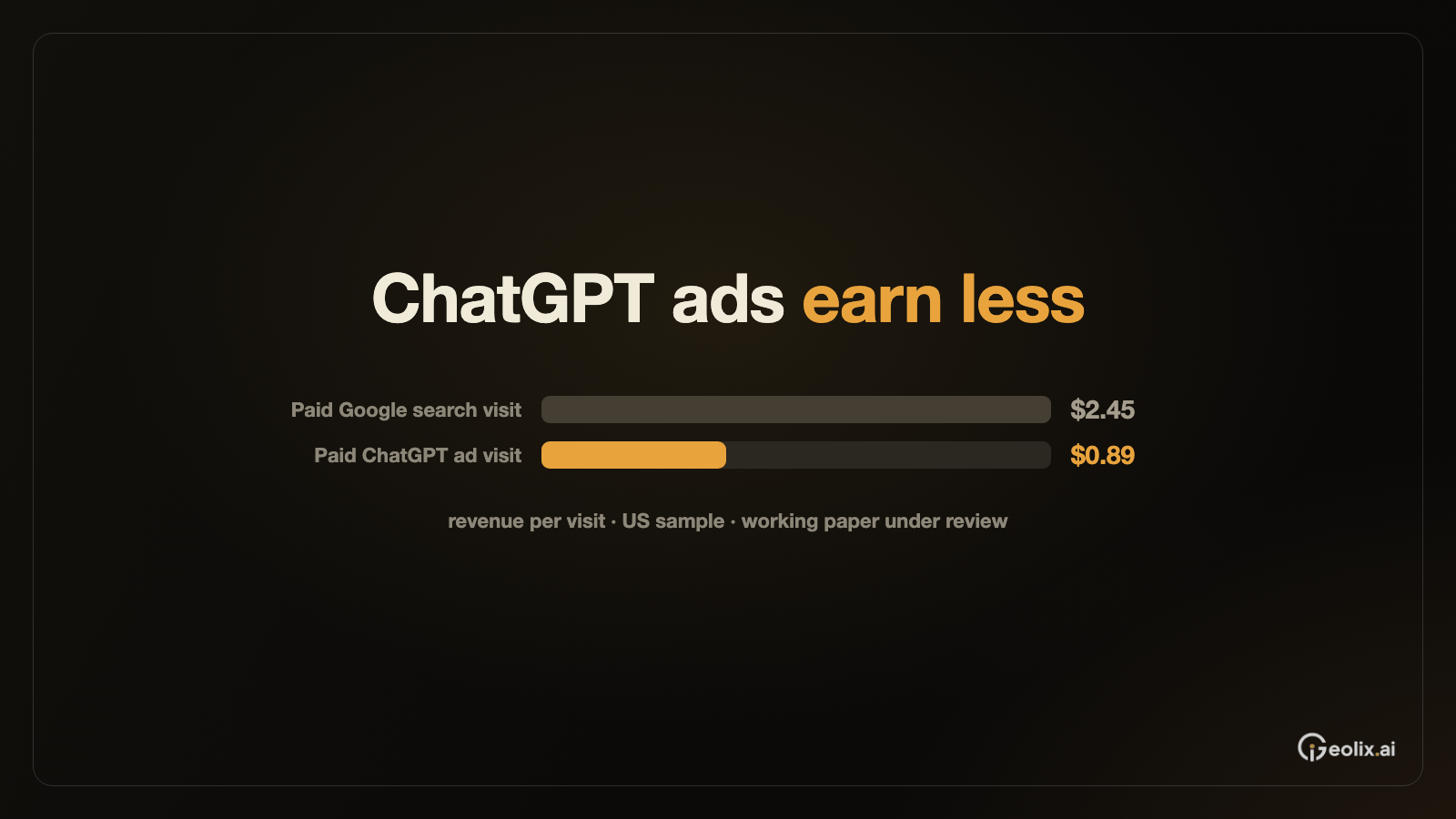

Key takeaway: Google Ads added promotion-status filters, while a study found lower US revenue from paid ChatGPT visits than paid Google search.
Key Takeaway
Google Ads has added a “Promotions offers” section inside the existing Promotions area. The section lets advertisers filter offers by three statuses: offered, expired, and invalidated. Separately, a November 2, 2026 report described an October 2026 working paper, still under review, that compared early paid ChatGPT advertising with paid Google search. In the US sample, a visit from a paid ChatGPT ad generated $0.89 in revenue, compared with $2.45 for a visit from a paid Google search ad. These are separate developments: one concerns Google Ads account operations, while the other concerns an early measurement of AI-search advertising performance.
How the Google Ads promotion filter works
The new section is intended to make promotion management more specific. Advertisers can use the status filters to separate offers that are currently offered, expired, or invalidated within the Promotions area. The report does not establish that the statuses change bidding, activate an offer automatically, or alter campaign delivery.
The feature was spotted by Thomas Eccel, who posted about the new “Promotions offers” area on LinkedIn. His observation suggested that account holders should monitor the section for promotional offers that Google might provide directly to an account. The available reporting supports the existence of the section and its three filters, but it does not confirm that every account has access, that Google has issued an offer to every account, or that the feature is fully available across the platform.
What the ChatGPT advertising comparison measured
The working paper examined ecommerce traffic around OpenAI’s country-by-country rollout of ChatGPT ads. The format studied was a labeled sponsored card below a conversational answer, shown to users on the free tier and the low-priced Go tier. The paper covered 60 weeks from June 29, 2025, through August 22, 2026. It states that ads launched in the United States on February 9, 2026, with later launches in additional markets; the European Union remained without ads during the observation window.
For US traffic, paid ChatGPT visits generated $0.89 in revenue on average, versus $2.45 for paid Google search visits. The reported conversion rates were 0.37% and 1.17%, respectively. The paid-channel comparison is descriptive rather than causal because advertisers chose whether to buy ChatGPT ads. The paid referral panel contained 387 websites that received at least one paid ChatGPT click. Only a subset had complete financial tracking, and linked Google Ads cost records were available for 31 of 102 sites with complete financial data. The results therefore should not be treated as a benchmark for every advertiser or every AI-search placement.
Method and Limitations
Advertising-platform teams can verify the Google Ads change by checking whether the Promotions area in an account contains “Promotions offers” and the three reported statuses. Teams comparing AI marketing channels should keep paid ChatGPT and paid Google search separate and use consistent definitions for revenue, orders, conversion, and cost.
The study compared traffic using website, device, and week dimensions and recorded the last click that brought a visitor to a site. It did not identify users’ prompts, the recommendations ChatGPT displayed, ad impressions, or each user’s subscription tier. Treatment was defined by country-level ad availability rather than confirmed exposure for an individual. The paper also notes that rollout timing and regional adoption differences affect the interpretation of organic ChatGPT referral estimates. Its findings describe an early, staggered rollout, not a universal result for AI-search advertising. The Google Ads report likewise does not confirm the new filter’s release date, account coverage, offer rules, or effect on campaign delivery.