

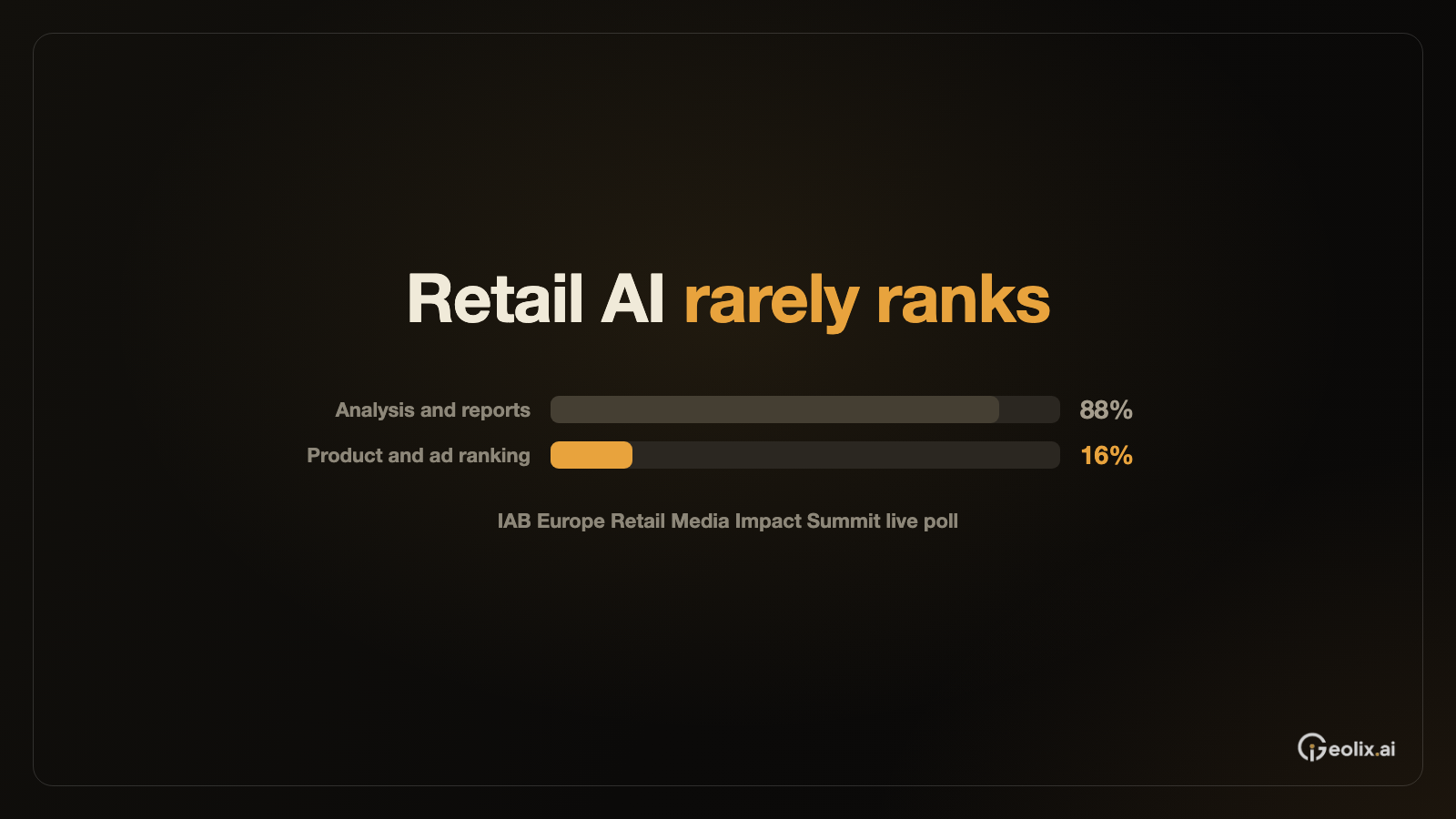

Key takeaway: 88% of polled retail media professionals use AI for analysis, but only 16% use it for product or ad ranking.
Key Takeaway
A live poll connected with the IAB Europe Retail Media Impact Summit found that retail media companies are using AI mainly as an analytical and reporting aid, not as an advertising platform decision-maker. Eighty-eight percent of respondents said their businesses use AI to analyse data or write reports, while only 16% use it to choose product or ad rankings. The result points to a clear difference between adopting AI for support work and allowing it to control decisions that can directly affect advertising performance.
Where AI is being used in advertising platform operations
The poll was led by Particular Audience founder and CEO James Taylor during a 7 October session in Amsterdam. It attracted 89 participants and generated 953 live contributions, although individual questions received between 52 and 74 responses. Manual targeting remained common: among 68 respondents, 50% used manual keywords or categories and 54% used manual audience segments. Only 22% used AI to predict relevance from live shopping signals. Respondents could select more than one option, so the percentages are not additive.
The answers also distinguish current usage from willingness to delegate tasks. Eighty-three percent said they would delegate campaign reporting now or within the next 12 months, and 65% would delegate product or ad ranking. The figures were lower for decisions affecting commercial control: 42% would delegate bids and budgets, while 41% would delegate supplier-funded offers. These are stated intentions, not evidence that the relevant automation has already been launched or broadly adopted.
What the product and ad ranking test showed
Particular Audience cited a grocery search test involving more than 700 real customer queries. Its Adaptive Transformer Search technology identified 80% of the relevant product catalogue within the first 120 search results, compared with 48.5% for traditional keyword search. The source describes that difference as a 65% improvement. The test illustrates how search, browsing and basket signals can help predict changing shopper intent, but it does not establish the same result for every retail media or advertising platform.
Why bidding and budgets remain sensitive
Trust and control were the most frequently cited barriers to wider AI adoption, alongside accuracy, transparency and proof of performance. On a scale from 1, meaning “much riskier,” to 5, meaning “much safer,” respondents rated AI product and ad ranking at 3.4 and AI deciding what advertisers pay at 2.8. Sixty-six people answered that question. The findings suggest a more cautious path for advertising platform operations: reporting and relevance decisions may be easier to delegate than bids, budgets or supplier-funded promotions.
Method and Limitations
Readers should separate three measures when interpreting the findings: current AI use, willingness to delegate within the next 12 months, and results from a specific search test. The poll came from a self-selected audience at the 7 October 2026 session, and response counts varied by question. The source describes the findings as directional rather than representative of the wider retail media industry. Public information therefore does not show that the reported willingness has become widespread live automation of bidding, budgeting or promotional decisions.