
Key takeaway: A small case study shared by Cyrus Shepard used Google’s Search generative AI opt-out controls to stop one site from appearing in AI Overvie.
Key Takeaway
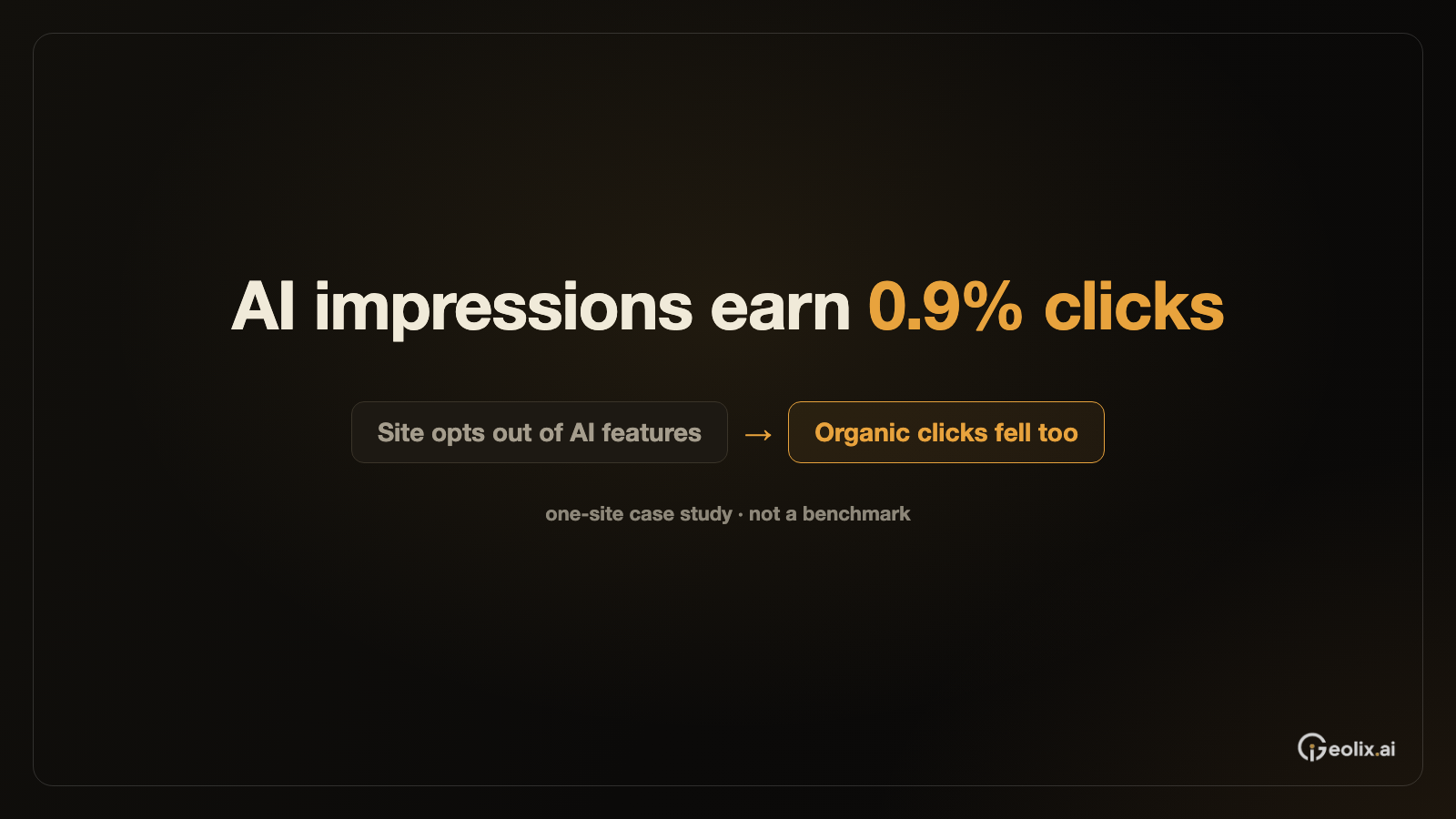
A small case study shared by Cyrus Shepard used Google’s Search generative AI opt-out controls to stop one site from appearing in AI Overviews and AI Mode. It estimated that AI search impressions produced about a 0.9% click-through rate. The same test observed a decline in regular organic clicks while the site was excluded. The finding is a limited site-level observation, not a benchmark for Google AI search or a general attribution rule.
What the Google AI search test actually measured
AI Overviews remained on the results pages during the experiment, but the tested site was absent from those summaries. The comparison used overall impressions, clicks, and CTR before, during, and after the exclusion period to estimate the effect of AI visibility. AI impressions represented about 8% of total impressions for the site in this case, a result that should not be assumed for other websites.
The reported organic decline matters for measurement because it suggests that AI search visibility and standard SEO clicks may not be independent. However, the test did not compare a search page with AI Overviews against a page without AI Overviews. It compared the site’s presence and absence within AI features while those features were still present. That prevents the result from proving that AI Overviews alone caused the change. The report also cites an observation that AI visibility may create brand lift and influence later searches and clicks, but that effect was not consistent.
SEO checks for multimodal search visibility
The other report focuses on whether search engines can find and understand images used in multimodal search. Google Search Console can show page-level impressions and clicks from Image search, while a Multimodal filter under Web covers experiences such as Google Lens, Circle to Search, uploaded-image searches, and Chrome’s “Search this image.” A lack of Image impressions alone does not establish that images are not indexed or optimized.
Teams can investigate by checking whether image URLs return a direct 200 response, whether robots.txt or page-level noindex and noimageindex controls block access, and whether Googlebot-Image has crawled the files. Lazy loading, JavaScript-dependent images, CSS background images, separate CDNs, and media subdomains can also affect discoverability. Image XML sitemaps, stable non-duplicated URLs, and supported formats such as JPEG, PNG, WebP, and AVIF provide clearer inputs for technical SEO monitoring.
Method and Limitations
For attribution work, teams can compare Search Console data for Image, Multimodal, and Web search with server logs, image crawl checks, and manual result-page tests. AI-feature visibility, ordinary organic results, and later branded searches should be recorded as separate signals rather than combined into one conversion source. URL Inspection can help verify whether a page or image is reachable, but it cannot reliably confirm that an individual image is indexed in Google Images.
The 0.9% figure comes from a small case study. AI Overviews appeared before, during, and after the test, and only the site’s inclusion changed. The result therefore does not establish a universal CTR or causality for the organic decline. The available reports also do not show whether the same pattern applies across industries, query types, site sizes, or different AI search placements.