

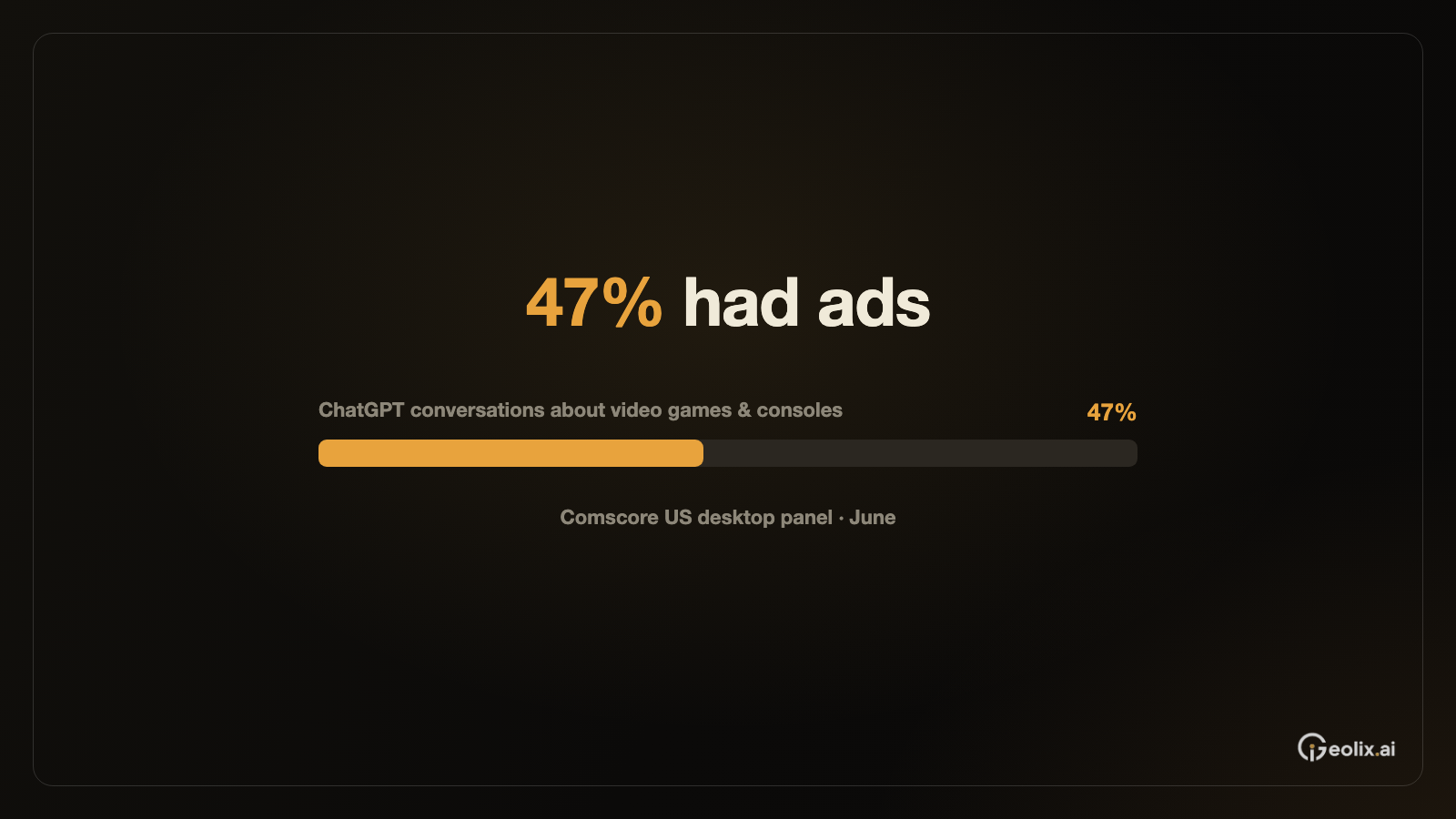

Nearly half of the gaming-related ChatGPT conversations in a Comscore U.S. desktop panel contained an advertisement in June, according to figures reported by Search Engine Journal. The 47% share applied to conversations about video games and consoles, not to ChatGPT users as a whole. Comscore included the figures in its second-quarter AI Intelligence Report, released on September 22.
The gaming series started at 3% in March and remained around 3% to 4% through April. It reached 18% in May before rising to 47% in June. Two other retail groups had lower June readings: toys and hobbies at 24%, and books, music and video at 22%. The former had recorded 5%, 12% and 14% over March, April and May; the latter's corresponding readings were 9%, 12% and 8%.
These percentages describe the presence of sponsored advertising within categorized conversations. They do not count unique people or the number of ad impressions generated. Comscore based the series on an opt-in panel's PC activity in the United States, according to the source note reproduced in the coverage. It therefore provides no measure of mobile usage or of advertising exposure in other countries.
The published methodology leaves several questions unresolved. Search Engine Journal reported that the material did not disclose the conversation count behind each monthly percentage or explain the category assignment process. It also did not specify whether a single advertisement anywhere in a conversation was enough to classify that conversation as containing advertising. Those omissions limit comparisons between categories whose sample sizes may differ.
Account eligibility presents another uncertainty. The coverage cited OpenAI's distinction between ad-supported access and ad-free subscriptions, but Comscore did not state whether its denominator included conversations from ad-free plans. Without that information, the percentages cannot establish the rate at which users eligible to receive advertisements encountered them. A 47% share of categorized conversations and a 47% ad rate among eligible conversations are different measurements.
The period overlaps changes in OpenAI's advertising business. Its initial U.S. test for logged-in adult Free and Go users began on February 9. From May 5, OpenAI started introducing a beta self-service Ads Manager and cost-per-click bidding alongside impression-based buying. June was the first full calendar month after that rollout began. Comscore did not attribute the increase to the buying tools, advertiser demand or additional inventory, so the timing alone cannot identify a cause.
Other published ChatGPT advertising percentages use different samples. An earlier Comscore hotel series counted prompts that included source links, a narrower base than the retail conversation categories. SE Ranking examined 50,006 commercial prompts on July 23 and reported advertising in 25.94% of them. That vendor-generated, single-day sample cannot serve as a direct continuation of Comscore's monthly panel series.
The reported figures do not include ad clicks or conversions for these retail conversations. Its figures show how often advertising appeared within the three categories in the U.S. PC panel; they do not measure campaign results or total ChatGPT advertising coverage.