

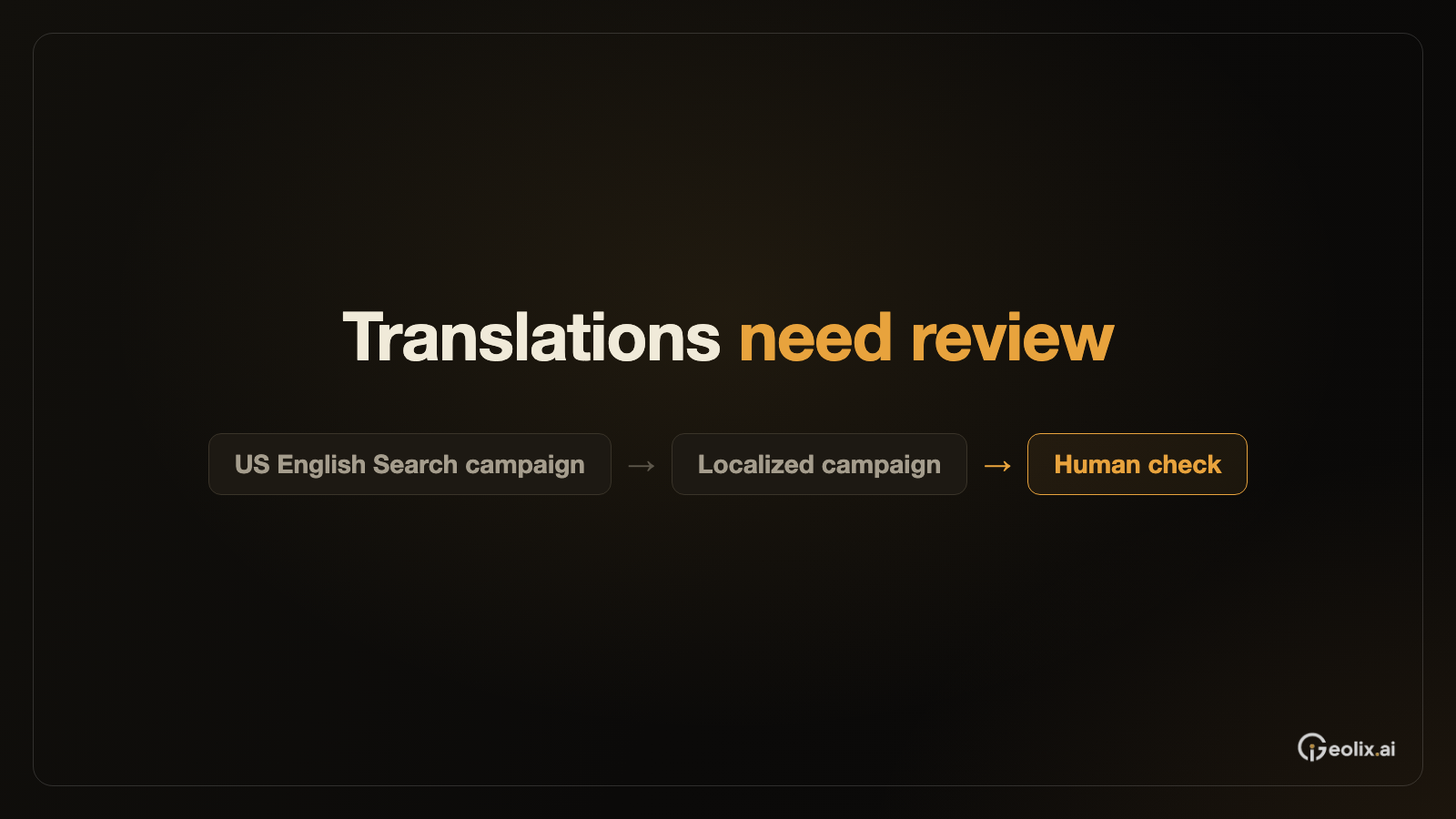

Key takeaway: Google Ads’ AI campaign localization tool can create a separate campaign from an eligible US English Search campaign in another supported la.
Key Takeaway
Google Ads’ AI campaign localization tool can create a separate campaign from an eligible US English Search campaign in another supported language. It translates ad text and keywords, can provide a dynamic landing-page translation option, and leaves the original campaign unchanged. The feature can reduce the initial work involved in multilingual advertising operations, but it does not remove the need for human review or establish that a localized campaign will perform well in a new market.
The copied campaign keeps the same budget and bid figures. Google does not convert currencies or calculate exchange rates, so a budget copied from a US campaign remains the same numerical amount in the new campaign. That figure may not make sense for the target country, currency, auction, or cost environment. The new campaign is published paused by default, giving the advertiser an opportunity to check the setup before activation.
The public material also places limits on what can be concluded about availability. The source campaign must be in US English, and the reported target options include Dutch, French, Canadian French, German, Italian, Polish, Brazilian Portuguese, European Portuguese, Castilian Spanish, and Latin American and Caribbean Spanish. The confirmed use case is Search campaigns. A documentation note referred to future Performance Max support, but the available reporting did not confirm that this support had started. Election-verified customers and campaigns containing unsupported languages are not eligible, and the documentation also refers to entity-size limits without quantifying them.
What Google Ads AI localization changes in an advertising account
The tool should be treated as a campaign-creation workflow rather than a simple editing feature. It creates a new, independent campaign and does not modify the source campaign. The new campaign therefore begins with its own performance history. Its translated assets include headlines, descriptions, sitelinks, callouts, and keywords. Translating keywords matters because it changes the targeting layer and can affect which queries enter the auction, not merely how an ad is worded.
For images containing text, the described process removes the original lettering and supplies the translated message as additional text assets. The tool also offers a review table with the original asset, the translated asset, an English back-translation, and translation notes. That layout can help an operator identify a major change in meaning, and each translated asset can be edited inline. It does not prove that the wording is idiomatic, appropriate in local advertising practice, or safe for regulated claims. Brand terms, promotional conditions, legal qualifications, and market-specific wording still require a reviewer who understands the destination market.
The landing page is a separate operational decision. Advertisers can add Google-provided JavaScript that dynamically translates page text after a user clicks an ad. They can instead update URLs manually or use a bulk find-and-replace rule. The documentation says the code only needs to be installed once per account, even when several localized campaigns are used. It does not explain how the translated text is cached, how it interacts with consent mechanisms, or whether the dynamically translated page is available to search crawlers. A translated ad experience and SEO or AI search visibility should therefore be managed as related but distinct workstreams.
How to measure AI search visibility alongside advertising operations
AI search appearances should not be treated as another form of Google Ads impression, traditional ranking, or website session. A practical measurement process begins with a defined set of questions that reflect the subjects a business covers and the problems its audience is trying to solve. For every test, a team can record the exact question, date, platform, full response, whether the brand or a specific source was mentioned, and whether the answer represented the source accurately.
Three useful checks are citation rate, prompt coverage, and attribution accuracy. Citation rate shows how often a source appears across the tested questions. Prompt coverage shows where it appears or disappears across relevant topics. Attribution accuracy checks whether the answer preserves the source’s central facts and qualifications. These are visibility and quality measures, not proof of reach, trust, or action. AI responses can vary between attempts, so a single observation is weak evidence and should not be converted into a performance claim.
Where an AI search product sends visitors to a site, teams can separately monitor referral sessions, engaged visits, and relevant conversions. They can also track branded searches, newsletter sign-ups, or other audience actions as context. None of these signals alone proves that an AI answer caused the change. For an advertising operations team, the cleanest approach is to keep two linked scorecards: one for each localized Google Ads campaign’s assets, budget, bids, landing page, and results; another for AI search presence, citation quality, and any measurable referral activity.
Method and Limitations
Before activating a localized campaign, an operator can confirm that the source is an eligible active or paused US English Search campaign, select the destination language and location, and review the copied budget, bids, keywords, ad assets, and landing-page option. The review table should be used to edit translations, with particular attention to brand names, tone, claims, and market-specific requirements. Once published, each localized campaign should be evaluated as an independent entity because it does not inherit the source campaign’s performance history.
For AI search visibility, teams can begin with a small, repeatable question set and record the platform, date, response, citation, and editorial assessment each time. Repeated checks are more useful than a single answer. The available material does not demonstrate that dynamic landing-page translation improves SEO, increases AI search citations, or produces more conversions. It also does not confirm that Performance Max localization is live. Budget suitability, translation quality, website behavior, compliance, and business outcomes therefore remain matters for advertiser-side validation.