

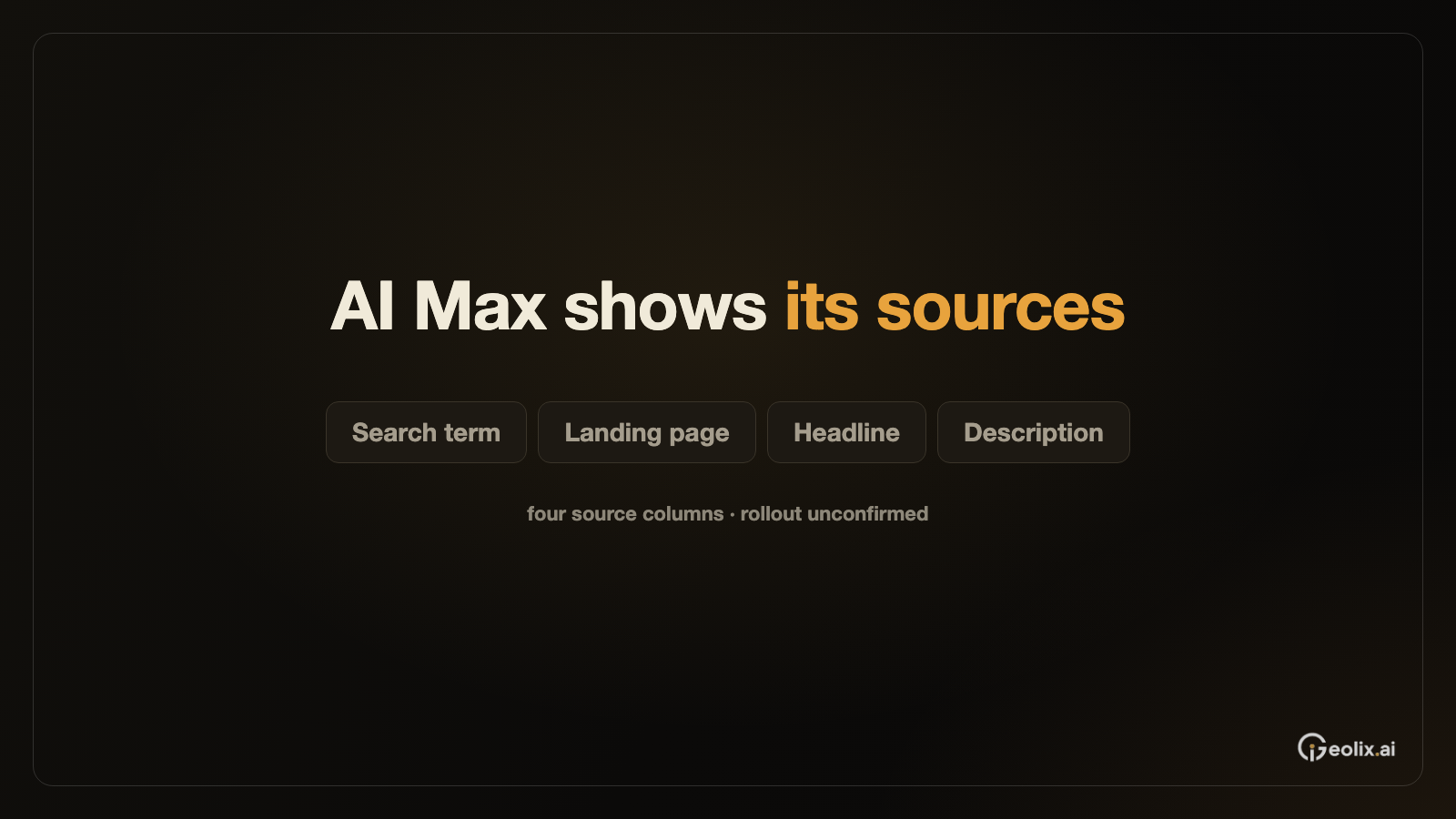

Key takeaway: Google Ads AI Max reporting adds four source columns, but rollout and full field values remain unconfirmed.
Key Takeaway
For teams operating paid search while monitoring AI search visibility, the clearest conclusion is that Google Ads AI Max reporting can now expose more of the path behind an individual click. PPC Land reported four source columns in the Search terms and ad combinations view of a live account. The columns identify the source of the search-term match, landing page, headline, and description. This gives advertisers a more granular way to audit what automation selected and what the advertiser supplied.
That finding does not establish a universal rollout, a Google product announcement, or an improvement in advertising performance. Separately, a paid press release carried by Yahoo Finance described XstraStar’s G-Power as a 0–100 framework for measuring how brands appear in generative AI answers. The two reports address different observation units. Together, they support a practical operating rule: measure automated paid-search choices and AI-search brand representation as separate layers, rather than treating one exposure or mention metric as a complete view of visibility.
What Google Ads AI Max source columns let advertisers inspect
According to PPC Land, the revised Search terms and ad combinations report places four source fields alongside search terms, headlines, landing pages, campaigns, ad groups, and descriptions. They are Search term match source, Landing page source, Headline source, and Description source. The view also includes clicks. For an advertiser running AI Max for Search campaigns, this distinction separates two questions that are often blended together: did automation find the query, and did automation also choose the page or advertising message shown with the click?
The reported account covered a 30-day period from September 13 through October 12, 2026, with 353 clicks across the search terms shown in the total row. Visible match-source values included “AI Max expanded matches” and “Landing pages and URL inclusions.” In the visible rows, the landing page, headline, and description source fields all read “Advertiser provided.” Those observations describe that account view only. They do not prove that every AI Max account has the columns or the same distribution of source values.
The report also showed why the row-level view matters for operations. The query “car wash near me” appeared with multiple headline combinations and separate click counts. Eleven rows visible above the fold represented 67 of the 353 clicks, or about 19 percent. That arithmetic is not an outcome claim. It demonstrates that one query can be split across several ad combinations, making it possible to review the message attached to each recorded click instead of reviewing search terms and assets in entirely separate reports.
A paid-search team can use the view to inspect three concrete risks. First, expanded matching may introduce queries the advertiser did not explicitly choose. Second, an automated match may still carry advertiser-provided copy and landing-page decisions, which matters for approval, claims, and regulated messaging. Third, repeated queries with different combinations may require asset-level review. The source material does not show that these checks increase click-through rate, conversions, or return on ad spend, and it does not establish that the displayed view includes every impression or conversion field.
How AI search visibility should be measured beside ad-platform data
The Yahoo Finance item, which is identified as a paid press release, described XstraStar’s G-Power framework for evaluating brand performance across generative AI platforms. Its four weighted dimensions are Visibility at 35 percent, Depth at 25 percent, Recommendation at 25 percent, and Competitiveness at 15 percent. Visibility asks whether a brand appears in monitored AI answers. Depth distinguishes a brief mention from a meaningful introduction. Recommendation evaluates whether the answer presents the brand in a positive recommendation context. Competitiveness compares the brand with other brands in the same answer.
This framework is designed to answer a different operating question from the AI Max report. G-Power concerns how a brand is represented in generative AI responses. Google Ads source columns concern the origin of a paid-search query match and the ad elements associated with a click. A G-Power score is therefore not a Google Ads performance metric, and an AI Max source label is not a ranking or recommendation measure in AI search. The two datasets can sit in different sections of one operating dashboard, but the available material does not support combining them into a conversion or revenue attribution formula.
A workable review sequence is to audit the AI Max report by query and ad combination, then monitor a fixed set of brand, product, and competitor questions in generative AI systems. The paid-search review can record the match source, page source, headline source, description source, and clicks. The AI-search review can preserve the actual answers and assess visibility, depth, recommendation, and competitiveness under the chosen framework. If the two layers move differently, the team should check the query set, time window, asset version, and site behavior separately rather than assuming one caused the other.
Method and Limitations
For Google Ads, teams should first verify that the Search terms and ad combinations view and the four source fields are present in their own account. They should export or preserve the search term, ad combination, source labels, landing page, headline, description, and clicks for a defined window. The source report warns against treating campaign names or ad-group labels as proof of a particular match setting. It also notes that a blank search-term cell cannot confidently be attributed to privacy thresholds or another mechanism from the public evidence alone.
For AI search visibility, teams should treat G-Power as a framework proposed by XstraStar, not as a universal industry standard or a Google-certified measurement. Any internal use should document the monitored platforms, prompt or question set, observation dates, competitors, and the original answers. That documentation is necessary because a mention, a substantive introduction, and a positive recommendation are not interchangeable observations.
Several boundaries remain unresolved. Google had not announced the four columns, stated when they would reach all accounts, or documented the complete set of possible values in the cited help material. The visible account did not establish how Google-generated headlines or expanded URLs would be labeled in every case. The public material also does not demonstrate a causal relationship between G-Power and Google Ads clicks, conversions, or revenue. These measurements are useful for distinct audits, but they should remain distinct until a verified integration and attribution method exists.