

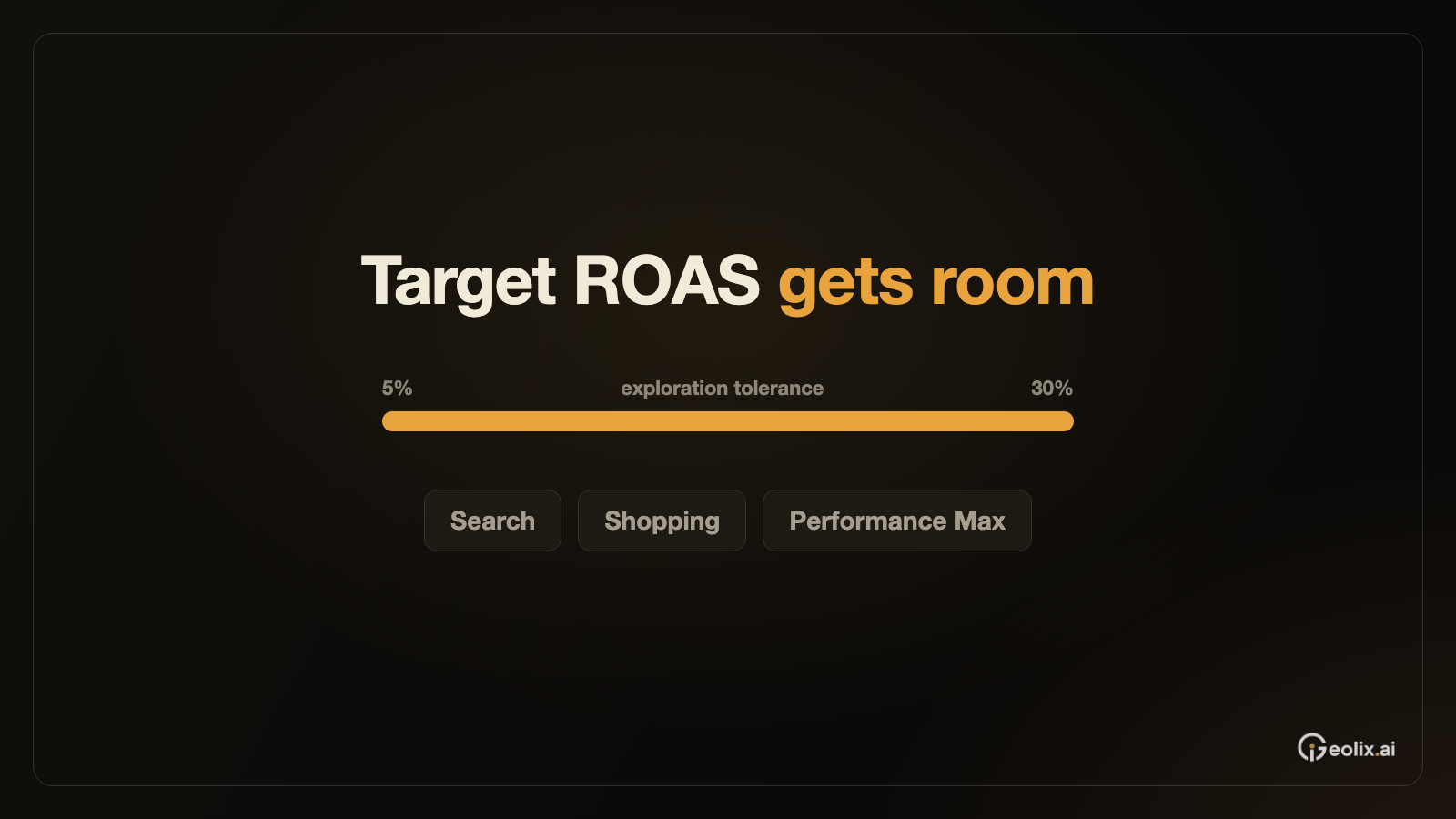

Key takeaway: Google Ads has documented Smart Bidding Exploration for Target ROAS campaigns across Search, Shopping, and Performance Max.
Key Takeaway
Google Ads has documented Smart Bidding Exploration for Target ROAS campaigns across Search, Shopping, and Performance Max. Advertisers can select a tolerance from 5% to 30%, allowing the system to bid more flexibly on queries the campaign is already eligible to enter. The setting does not expand keyword coverage, Dynamic Search Ads coverage, URL expansion, or other targeting boundaries.
For retail advertising operations, the practical decision is whether to exchange some return efficiency for additional opportunities within the existing eligible traffic pool. Shopping and Performance Max campaigns using portfolio bid strategies cannot use the feature. Moving those campaigns into a portfolio strategy automatically turns Exploration off, so teams must choose between shared portfolio bidding and campaign-level control.
How Smart Bidding Exploration changes the effective ROAS target
Google’s example uses a 200% Target ROAS and a 10% tolerance. The effective target becomes 180%. The tolerance is relative to the target, not a subtraction of percentage points. Using the same calculation, a 30% tolerance would reduce a 200% target to 140%, while a 500% target would become 350%.
The documented eligibility includes Search, Shopping, and Performance Max campaigns using Target ROAS bidding. Campaigns using Target CPA, Maximize Conversions, or Maximize Conversion Value without a target are not included in the stated scope. For Performance Max without a Merchant Center feed, Exploration applies only to Search traffic. For Performance Max with a feed, Google describes one setting that covers both Search and Shopping traffic.
Google says advertisers can expect performance to come within approximately 15% of the effective target when assessing results over one to two conversion cycles. The documentation does not define a conversion cycle, explain whether the range is symmetrical, or publish how often campaigns fall outside it. That statement should therefore be treated as an operating expectation, not a performance guarantee.
How AI Max, budget limits, and portfolio bidding affect operations
Google says Smart Bidding Exploration is compatible with AI Max in Search and Shopping campaigns. Its description separates the roles of the two systems. AI Max can expand the pool of search queries for which a product offer may be eligible and can unlock text ads where Google considers them relevant. Exploration then bids more dynamically within the eligible pool using the flexible ROAS target.
This distinction matters when teams diagnose changes. AI Max can affect the query opportunity set, while Exploration affects bid aggressiveness inside that set. Exploration itself does not create a new audience or automatically extend the outer limits of keywords, Dynamic Search Ads, or URL expansion. A change in reach should not automatically be attributed to the bidding tolerance.
Budget availability is another operating condition. Google says campaigns using Exploration should not be budget constrained because budget limits can block exploration of new traffic areas. If a campaign reaches its budget limit, the system may temporarily pause Exploration. The public documentation does not state how long that pause lasts, how advertisers can identify it, or whether the feature always resumes automatically when budget becomes available.
The portfolio restriction is especially relevant to larger retail accounts. Google states that portfolio bid strategies in Google Ads and Search Ads 360 are compatible with Exploration for Search campaigns, while Shopping and Performance Max campaigns must use campaign-level bid strategies. Retail teams that group campaigns by brand, category, or margin may therefore need to choose between pooled conversion data and access to this more flexible bidding control.
How teams should evaluate paid advertising and AI marketing signals
Before enabling the setting, record the campaign’s Target ROAS, selected tolerance, effective target, budget status, bid-strategy level, Merchant Center feed status, and AI Max status. Evaluate results over multiple conversion cycles rather than interpreting a single day. If a campaign is moved into or out of a portfolio strategy, verify whether Exploration was automatically disabled.
Teams that manage both paid advertising and AI marketing should also keep different visibility signals separate. Semrush describes its own AI visibility work as measuring whether a brand appears in answers and how often it appears relative to competitors. Its account also distinguishes citations from recommendation: a model can cite a company’s content without recommending that company. This does not show that Google Ads Exploration improves AI search visibility, and it is not an advertising attribution method. It does show why exposure, competitive positioning, and conversion should not be treated as one metric.
A combined operations view can therefore contain two different questions. Google Ads reporting asks what changed after the platform was allowed to trade some ROAS for additional eligible opportunities. AI search monitoring asks whether the brand appears for the prompts that matter and how the answer represents it. These signals may be reviewed together, but neither is direct proof of the other.
Method and Limitations
To audit the setting, first confirm that the campaign uses Target ROAS. Then check the selected tolerance, the resulting effective target, budget limitations, Merchant Center feed, AI Max status, and whether bidding is set at campaign or portfolio level. Align before-and-after comparisons with conversion cycles and record other changes that could affect query eligibility or delivery. For a 200% target with a 10% tolerance, use 200% × (1 − 10%) = 180%; do not subtract ten percentage points.
The public material does not provide separate incremental performance results for Shopping or Performance Max. It does not define the length of a conversion cycle, explain the duration of a budget-triggered pause, or provide the full distribution behind the approximate 15% range. PPC News Feed and Google’s help-page wording also differ on part of the Search Ads 360 interpretation, so enterprise advertisers should verify current account-level eligibility in the platform.
Semrush’s AI visibility results are a first-party account of its own work. They cannot be used as evidence that Google Ads Exploration improves AI search visibility, sales, or revenue. The available evidence supports an operational distinction between flexible retail bidding and AI-answer visibility, not a causal link between them.