


Key takeaway: Google Ads’ PMax partner opt-out remains an alpha test, while Google also clarified SEO and AI crawler controls.
Key Takeaway
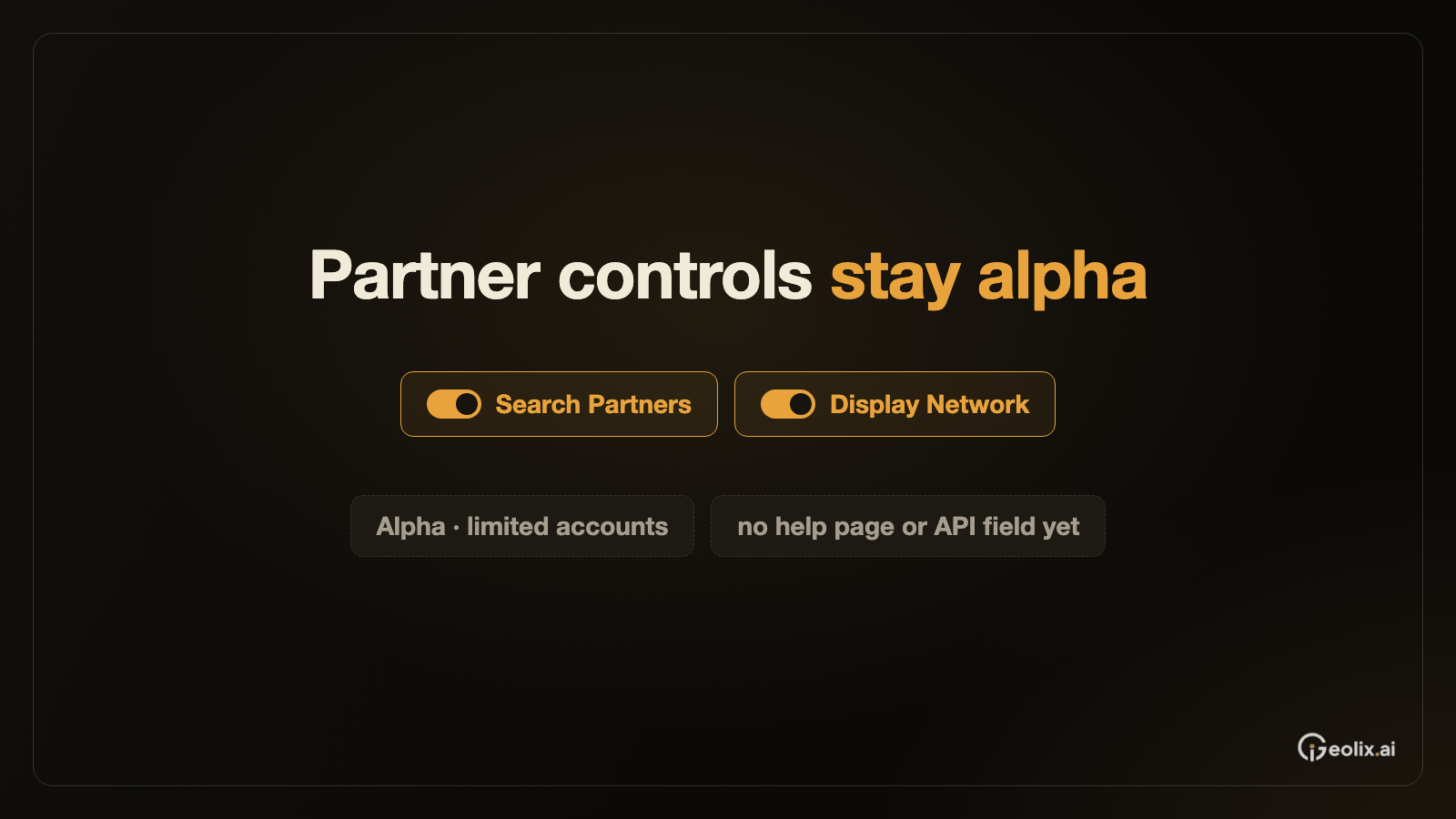
As of October 19, 2026, Google Ads’ Performance Max “Partners” control was still marked Alpha and visible only to a limited set of accounts. It offers separate controls for Search Partners and the Google Display Network, but Google has not published a help page, API field, general-release date, or test-size details. The setting therefore remains a limited experiment rather than a confirmed PMax-wide launch.
What the PMax partner controls actually show
The October interface places a “Partners” panel in campaign settings and presents two checkboxes. Search Partners covers ads shown in search results on third-party websites and apps. The Google Display Network covers visual ads shown on relevant websites and apps as people browse the web. An account shown in the October observation had Search Partners selected and Display Network unselected, but that single view does not establish a new default.
The setting has changed since its first reported appearance in April. The earlier view was in Dutch, used shorter descriptions, and showed both options selected by default. The October view used English copy and a different position in the settings page, while retaining the Alpha label. Neither report establishes that Google expanded the test or changed delivery defaults.
Performance Max normally lets Google decide how inventory is distributed across Search, YouTube, Display, Discover, Gmail, and Maps. In July, Google described the opt-out to Digiday as a pilot for a limited group of advertisers. Google then introduced a separate control on October 14: channel prioritization and budget allocation settings can place Search Partners and the Google Display Network at low priority and apply a percentage cap based on average daily budget. Google’s documentation says the cap is best effort, not a guarantee. On October 16, Google Ads product liaison Ginny Marvin said Search Partner allocation in PMax could be set to 0%, but Google has not explained whether that mechanism will replace, join, or remain separate from the Alpha checkboxes.
What SEO and AI search teams should check
Search Engine Journal’s October 24 roundup covered separate Google guidance for technical SEO and AI-related crawling. For short outages caused by PHP security patching, Google recommends returning a 503 rather than a general 404 or 200 page. Google’s crawl-rate documentation advises limiting 503 responses to one or two days because a URL returning 503 for several days may be removed from the index.
Google Search Central also clarified that standard robots.txt directives govern whether compliant crawlers may crawl content, not how systems use content after crawling. Google-Extended can be used to manage whether crawled content is used for future Gemini model training and for grounding in Gemini Apps and Vertex AI. Google-Extended is not a separate crawler and does not have its own HTTP User-Agent. A proposed Content-Usage rule for expressing use preferences remains a working-group draft.
URL consistency remains relevant to SEO and search visibility. Google’s John Mueller said raw square brackets and their encoded forms, %5B and %5D, are different URLs. If both versions return the same content, Google may crawl both, remove duplicates, and select one. Teams should use one form consistently in links, canonical tags, sitemaps, and structured data. JPEG XL is not currently supported for Google Images or Discover previews; supported fallback formats such as JPEG, WebP, or AVIF can be supplied through the img source in a picture element.
Method and Limitations
Advertising teams can inspect PMax campaign settings for the Alpha-labeled Partners panel and record the Search Partners and Display Network states separately. Teams using channel prioritization should compare the configured percentage with actual spend because Google describes the cap as best effort. SEO teams can verify outage status codes, robots.txt rules by user-agent, Google-Extended preferences, and consistency between raw and encoded URL forms.
Public information does not establish a general rollout, a changed default, the method used to select test accounts, the effect on bidding or learning, or whether disabling one network prevents every related placement from arriving through another inventory type. The crawler guidance also does not mean robots.txt governs every user-triggered agent request. Server logs and the relevant platform documentation remain necessary for identifying actual requests and their permitted uses.