
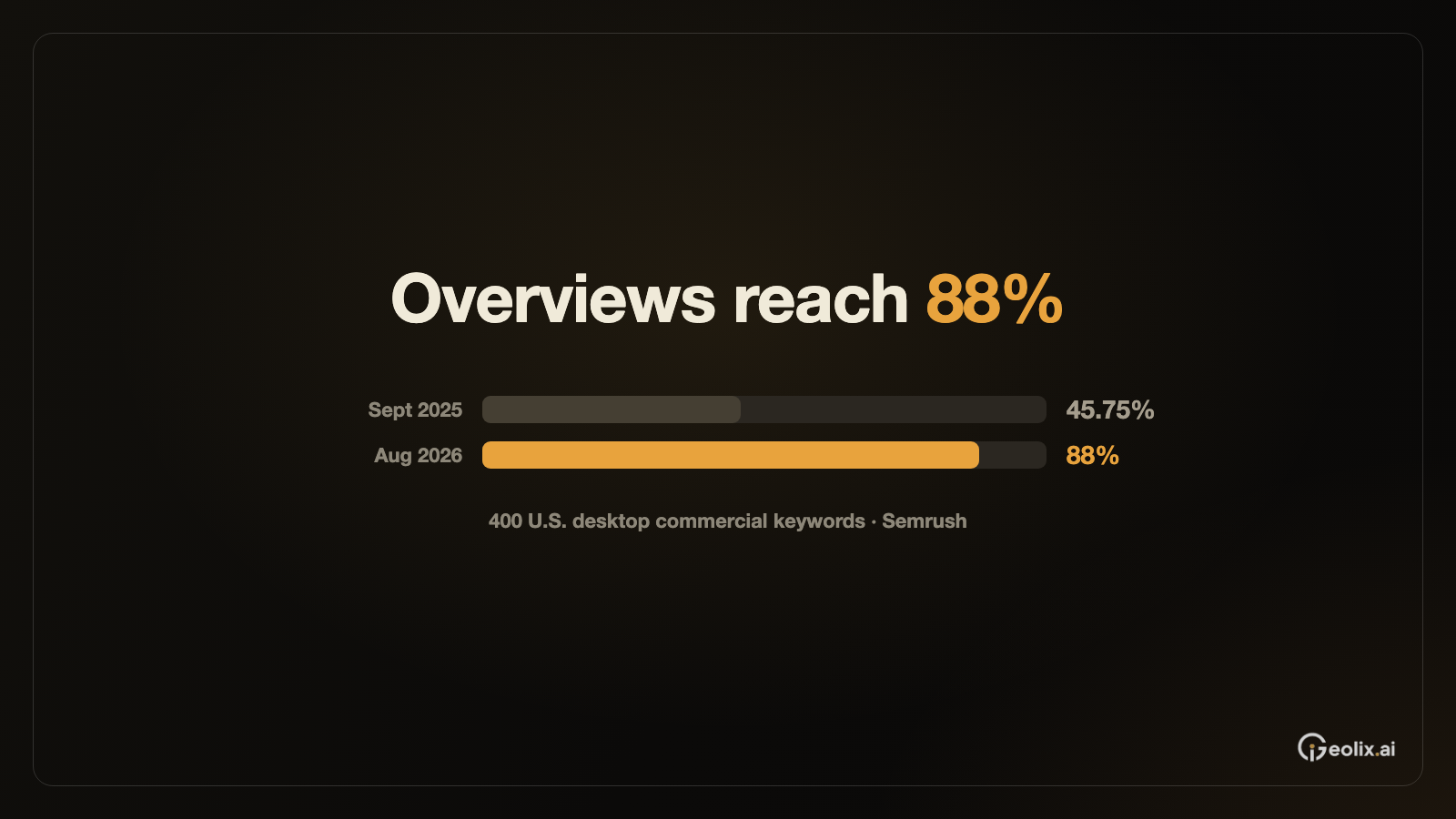

Key takeaway: Semrush found Google AI Overviews covered 88% of 400 tracked U.S. desktop commercial keywords in August 2026, up from 45.75%.
Key Takeaway
A Semrush study published on October 21, 2026 found that Google AI Overviews appeared for 88% of 400 tracked commercial keywords in August 2026, up from 45.75% in September 2025. The fixed panel covered banking, software, and ecommerce queries across five decision-stage modifiers: alternatives, brand-versus-brand comparisons, best X for Y, pricing and cost, and reviews. When weighted by estimated search volume, coverage reached 97.08% in August. The result shows how often an AI summary appeared in this sample; it does not establish changes in clicks, traffic, or conversions.
Where Google AI Search Appeared
All five modifier groups ended the study above 80% coverage. “Best X for Y” queries reached 96.12%, followed by reviews at 89.04%, brand-versus-brand searches at 86.59%, alternatives at 82.81%, and pricing or cost queries at 82.05%. Reviews recorded the largest increase, rising from 30.14% to 89.04%, a 58.90-point gain. Brand comparisons began with the highest coverage but grew by 23.18 points.
Coverage also converged across industries. Ecommerce rose from 32.62% to 85.11%, while software reached about 91% and banking about 89% in August 2026. Twelve of the 15 industry-and-modifier combinations reached at least 80%. Three remained below that level: banking alternatives at 65%, ecommerce pricing and cost at 71.43%, and software reviews at 75%. Three combinations reached 100% keyword-weighted coverage: banking best-X-for-Y, software alternatives, and software best-X-for-Y.
What SEO Teams Can Check
For the query “mailchimp vs klaviyo,” the study shows an AI Overview citing brand-owned content, Zapier, a YouTube video, and another third-party source. The example illustrates why SEO and search-visibility teams may need to inspect more than conventional rankings. They can check whether an AI Overview appears for priority commercial queries, how a brand is described, and which comparison pages, review platforms, videos, or other sources are cited.
The evidence supports monitoring AI search visibility and cited sources. It does not prove that ranking first now produces less traffic, or that any particular content tactic improves performance. Teams can nevertheless audit comparison pages, pricing pages, and review content for accuracy and freshness, then record how Google’s summaries and citations change over time.
Method and Limitations
Semrush used U.S. desktop data and checked a fixed panel of 400 keywords every month from September 2025 through August 2026. The primary measure was keyword-weighted coverage, with a second measure weighting each keyword by Semrush’s estimated monthly search volume. The sample excludes mobile results and other countries, and it contains no click, traffic, or conversion data. The 15 industry-and-modifier cells do not contain equal numbers of keywords, so a single keyword can materially affect smaller percentages. The “mailchimp vs klaviyo” example is one screenshot, not a citation-share estimate for the full panel.