

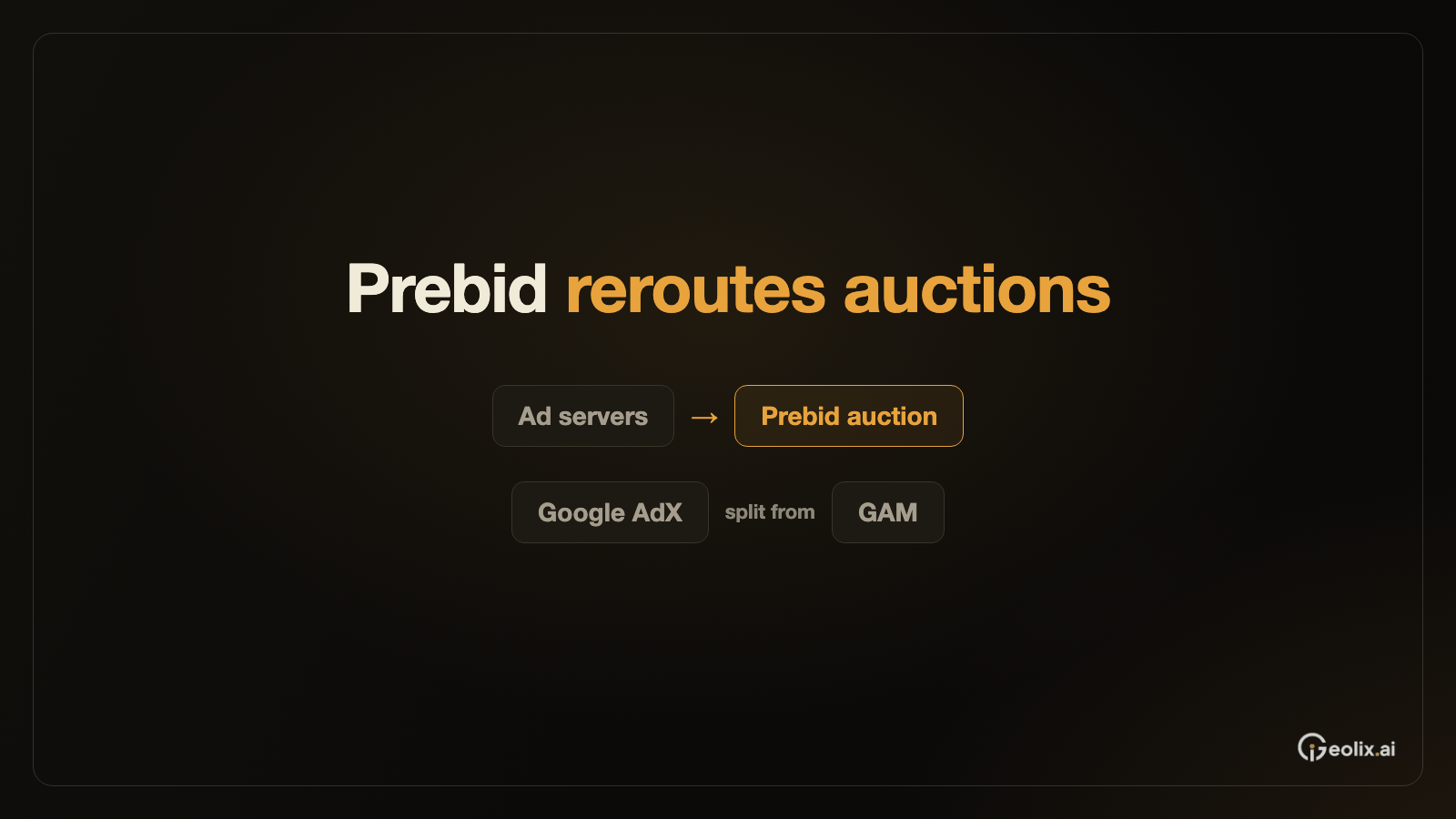

Key takeaway: Prebid previewed a plan to let ad servers bid into its auction, potentially separating Google AdX from GAM without an immediate rollout.
On October 13, Prebid previewed a proposal to change the order in which programmatic advertising auctions are run. The nonprofit organization provides open-source tools that help publishers monetize their inventory, and its proposal is aimed at reducing publishers’ reliance on Google in sell-side ad tech. It is not an announced production rollout, and Google has not committed to adopting the architecture. The proposal was still awaiting final approval after public consultation, with formalization targeted for early 2027.
A different auction sequence
Under the arrangement described in the report, Prebid currently runs an auction and passes the winning bid to an ad server, usually Google Ad Manager, or GAM. The bid then competes with demand from Google’s ad exchange, AdX, inside GAM. Because Google owns both GAM and AdX, the final competition takes place within Google’s ad-server environment.
Prebid’s proposed model would reverse that sequence. Ad servers would submit bids into Prebid’s auction instead of receiving a winning Prebid bid after the auction has already taken place. GAM, along with other ad servers that might participate, could therefore compete through an auction controlled outside Google’s ad server. Publishers could potentially retain access to AdX demand without making GAM the venue for the final competition.
The operational change would concern the location and order of the auction, as well as the information available to participating companies. It is not a new ad format or a confirmed replacement that publishers can deploy immediately.
Possible effects on publishers and Google
If implemented, the model could separate the roles of GAM and AdX in the auction without requiring Google to divest either asset. Google could continue to provide both products, while the final competitive decision would occur through Prebid rather than inside GAM. For publishers, that could create a route to AdX demand that does not depend on Google’s ad server running the last stage of the auction.
The proposal remains unsettled. Digiday’s sources said the plans were not yet concrete, and Google had not agreed to implement Prebid’s preferred design. The report also referred to claims from conference sources that Google had tried to claw back some provisions ordered by the courts, but that does not establish Google’s final position on Prebid’s architecture. Publishers and ad-operations teams therefore should not treat the proposal as an available production alternative.
New controls for Google advertisers
The same report said Google rolled out optional channel-prioritization and budget-allocation controls on October 14 across Search, Shopping, Performance Max, and Demand Gen. Advertisers can designate higher-priority channels to receive budget first and cap the amount directed to secondary channels, rather than leaving the entire allocation decision to Google’s automation.
This buyer-side change is separate from Prebid’s seller-side auction proposal. Google’s controls give advertisers more input into how automated systems distribute money, while Prebid is seeking to change where the auction is conducted and how ad servers participate. The reported information does not establish that either change has produced measurable performance gains, nor does it show that Prebid’s design is broadly operating in production.
Method and Limitations
The confirmed scope is limited to Prebid’s October 13 preview, its pending consultation and approval process, its early-2027 formalization target, and Google’s October 14 channel and budget controls. The reports do not provide a final launch date, a list of participating publishers, performance results, or a formal Google commitment to the proposed auction flow. They therefore cannot establish whether the architecture will be adopted or what effect it would have on publisher revenue, auction efficiency, or advertiser outcomes.