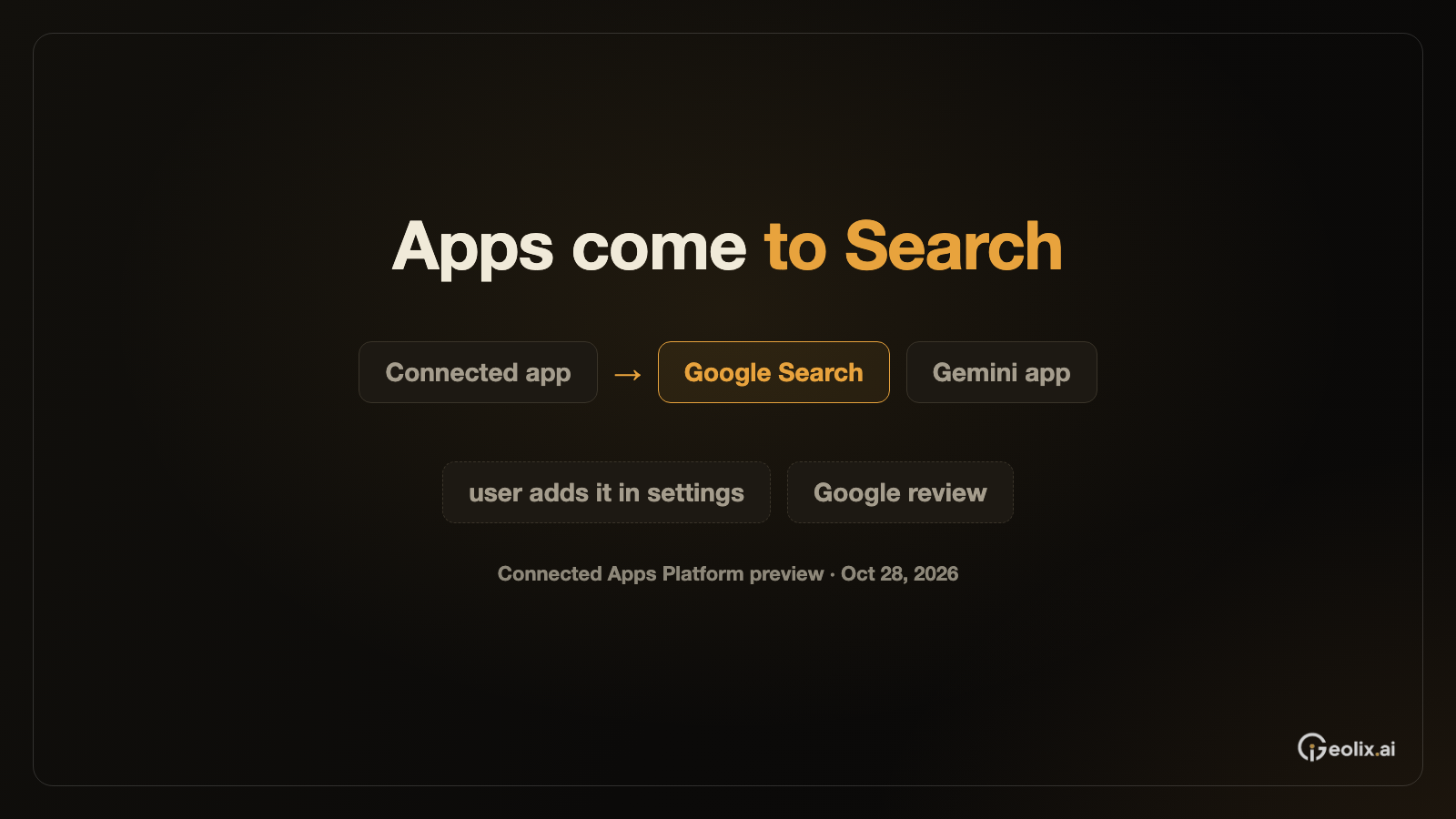

Key takeaway: Google previews Connected Apps for Search and Gemini, but visibility still depends on user settings and review scope.
Key Takeaway
On October 28, 2026, Google announced a preview of its Connected Apps Platform, allowing developers to submit app capabilities to Google Search, the Gemini app, or both. The change is directly relevant to AI search visibility because an app can provide functionality inside a search experience rather than simply expose information on a webpage. It does not, however, mean that every searcher will see every connected app. The source says users must add an app through personalized Google Search settings, while developers must select the intended Google surface and pass review.
How Connected Apps Reach Google Search
Developers can integrate through a cloud-hosted MCP server or Android MCP using the AppFunctions APIs. They then register, test and submit the integration in Google Connected Console. Before review, they can choose Search, Gemini, or both as the destination. Once live, the platform provides tracking for traffic, latency and error rates. Developers also retain control over brand identity through features such as verified logos and authenticated accounts.
Google said that more than 50 Connected Apps had been added across Search and Gemini, covering areas including productivity, event ticketing, health and fitness. Integrations involving Adobe, Experian, Localiza and Peloton were described as live for Gemini users, with Google saying the apps would come to Search in the following weeks. The source does not establish universal availability by country, user or query. SEO teams therefore should not describe the preview as a full public rollout or assume that an app will automatically gain search exposure.
AI Search Visibility and Scraper Boundaries
The announcement shifts part of SEO and AI marketing work from webpage rankings toward whether an application can be discovered, invoked and used to complete a task. Teams should check the selected submission surface, user personalization, review status and actual behavior in Search and Gemini separately.
A same-day AdExchanger report described another issue affecting search-visibility measurement. It said SEO services including Semrush, Ahrefs, DemandSphere and SEOmonitor claim Google may be returning misleading results to competing scrapers used for tracking. The report cited a Brazilian baby-stroller query that produced dental supplies for those tools, while noting that the Portuguese word involved can have more than one meaning.
That report does not establish a causal link between scraper behavior and Connected Apps. The two issues should be measured separately: whether users can enable and use an app in a specified Google product, and whether third-party crawlers receive results that represent the live user experience.
Method and Limitations
Teams can record whether an integration targets Search, Gemini or both, then test activation and task behavior with the relevant user settings enabled. Reports should distinguish the live interface, app-level traffic and third-party crawler output, rather than treating a crawler anomaly as a ranking change. Public information has not confirmed the full opening date, geographic coverage, triggering rules or organic-traffic impact of Connected Apps. The scraper issue remains an allegation reported by AdExchanger from SEO services, not a confirmed universal Google policy.