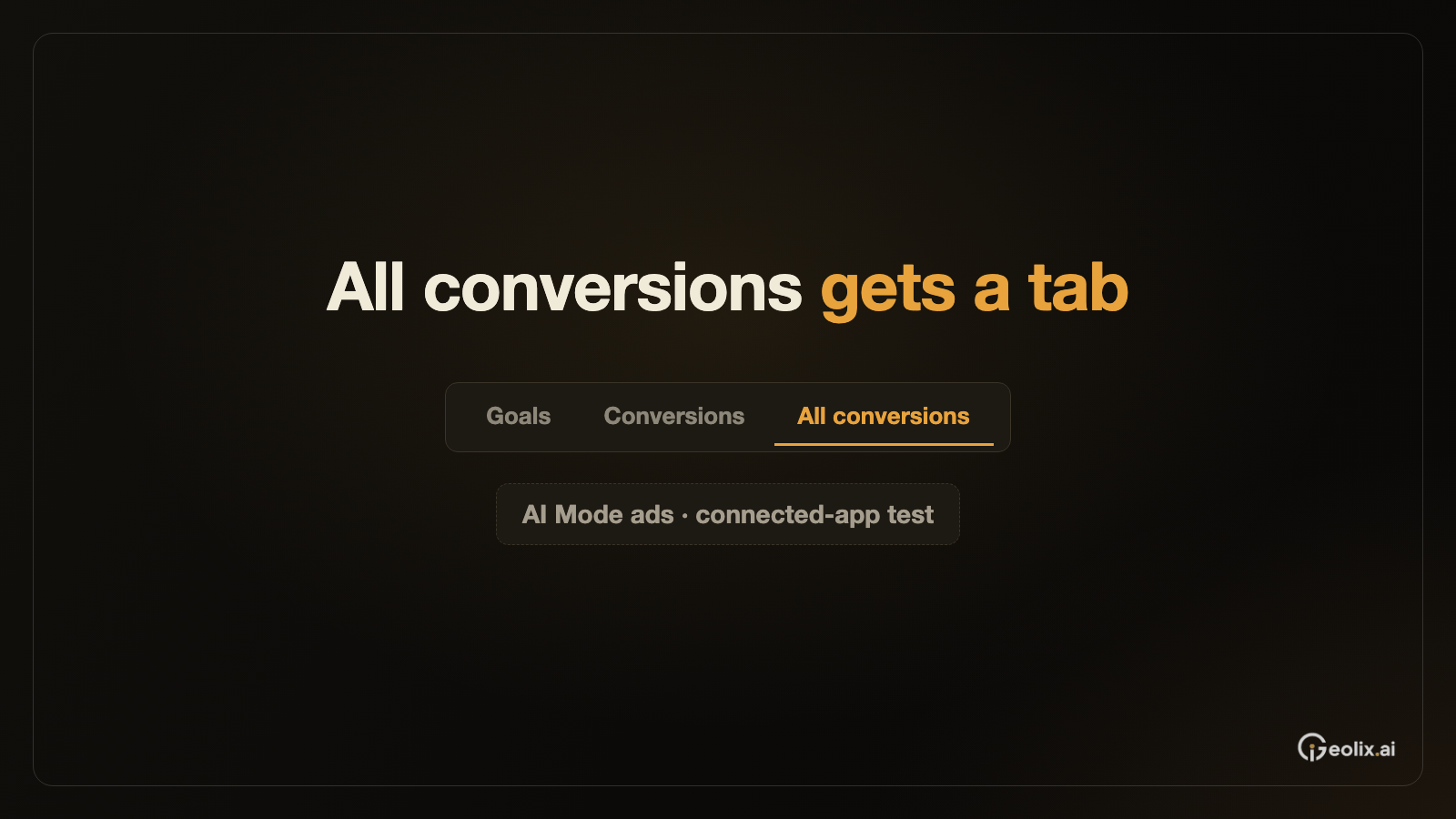

Key takeaway: Google is rolling out an All conversions view to some Ads accounts while testing personalized AI Mode ads for connected-app users.
Key Takeaway
Google has made two separate advertising-platform changes relevant to campaign operations. A new “All conversions” submenu is appearing in the Goals and Conversions area for quite a few Google Ads accounts, reducing the need to open “View all conversion actions.” Separately, Google is testing personalized ads in AI Mode for users who have opted into Personal Intelligence and connected personal apps such as Gmail or Google Photos to Google services. Neither development should be treated as a universal rollout.
What the Google Ads All conversions view changes
The new submenu gives advertisers a more direct way to inspect conversion actions from the Goals section. The reported view can include account-level goals, click-through windows, and primary or secondary status. Columns such as repeat rate and last seen are also described as being available directly in the view. For advertising-platform operators, the practical change is a more consolidated place to check conversion configuration and related metrics instead of first opening the older conversion-action list.
The available evidence indicates that the submenu has rolled out to quite a few accounts, not that every Google Ads account can access it. A screenshot of the view also appeared in a post from about a month earlier, so the precise date of a full rollout is unclear. Teams should check the Goals and Conversions area in each account and use the controls and data actually displayed there rather than assuming account-wide availability.
How the AI Mode advertising test works
Google’s privacy-policy update adds an exception for information from Gmail, Google Photos, and Google Drive when a user chooses to make that information available to another Google service that supports personalized ads. The change took effect on October 16. The reporting focuses on users who opt into Personal Intelligence and use AI Mode in Search. Personal Intelligence was previously described as a Labs experiment in English in the United States for eligible personal-account subscribers to Google AI Pro and AI Ultra, excluding Workspace business, enterprise, and education accounts.
Google is now testing ads in the connected-app experience. The available explanation says ads are not matched directly to the raw contents of an inbox or photo library. Instead, Search may use summaries, excerpts, and inferences from connected sources to personalize the experience, and the same type of information may be used for ads. Advertisers do not receive access to a user’s Gmail inbox or Google Photos library, and sensitive categories such as health, religion, race, and sexual orientation remain excluded from personalized advertising.
There is no new Google Ads targeting toggle, audience segment, or dedicated report for this test. The campaign types identified as eligible for AI Mode ad testing are Performance Max, Shopping, and Search campaigns using broad match, including AI Max for Search. Eligibility does not confirm that an ad has served to a Personal Intelligence user. Existing search-term, asset, and landing-page reporting also does not identify whether connected-app information influenced an impression or outcome.
Method and Limitations
Operators can verify the two developments separately. In Google Ads, they can inspect Goals and Conversions for the presence of the All conversions submenu. For AI Mode, they can compare campaign types and existing reporting with the publicly described eligibility, while avoiding claims that connected-app signals drove a particular impression. Google has not said when the AI Mode ad test will expand beyond testing, whether dedicated reporting or placement controls will arrive, or whether connected-app signals affect services beyond AI Mode. The broader scope of the privacy-policy language across Google Search services also leaves the exact placement boundary unresolved.