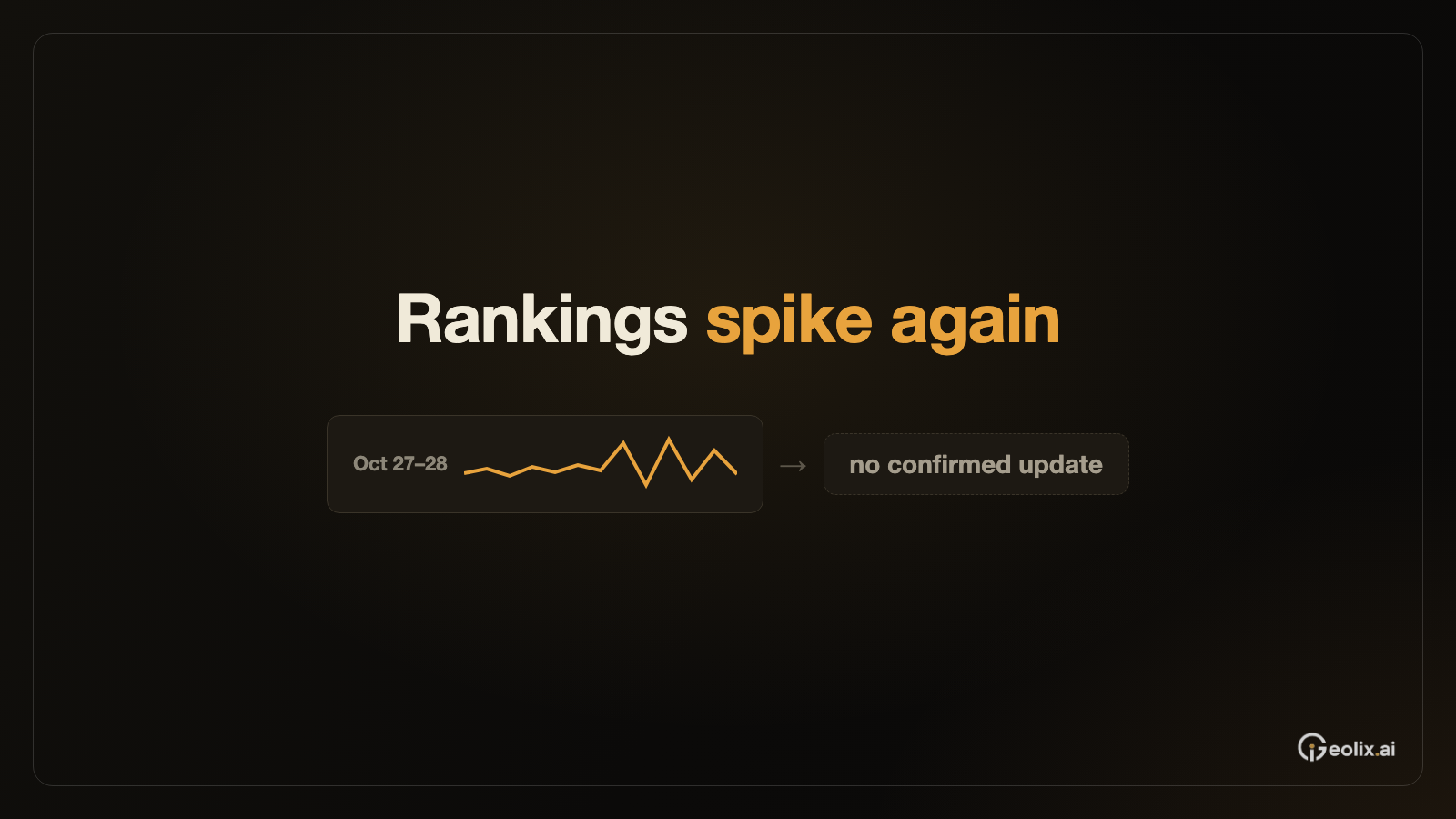

Key takeaway: Google search volatility rose on October 27–28, but no new ranking update has been confirmed, so SEO teams should verify visibility changes.
Key Takeaway
Google search ranking volatility rose again across October 27 and 28, 2026. Search Engine Roundtable reported a larger spike across multiple tracking tools and more discussion in the SEO community about another unconfirmed update. Google had not officially confirmed a new ranking update. AdExchanger separately reported that Semrush, Ahrefs, DemandSphere, SEOmonitor and other SEO services were raising concerns that Google may be supplying misleading search results to agents scraping pages for competitive purposes. Together, the reports give advertising platform operations and AI marketing teams two separate visibility risks to monitor: genuine changes in Google search performance and differences between results seen by people, tracking systems and AI search agents.
What SEO teams should check during the volatility spike
The Search Engine Roundtable report said the latest increase appeared during the 24 hours before its October 27 publication and followed earlier unconfirmed volatility reports on October 24, October 20–21 and October 16. It also noted that Google tracking tools were struggling, even while some tools were issuing statements about the market. Community reports described weaker News and Discover traffic, pages being indexed quickly but appearing with outdated results, keyword gains that had not yet produced traffic gains, and cases where traffic increased while conversions fell. These are individual community observations, not evidence that every site experienced the same movement or that one confirmed ranking mechanism caused all of it.
For SEO and search visibility reporting, teams should therefore segment desktop and mobile results, branded and non-branded queries, and ordinary organic traffic from News and Discover. Rankings, sessions, landing-page visits and conversions should be compared over the same time windows. A change in one metric should not be treated as proof of a Google algorithm rollout, particularly while the reported tracking tools are showing inconsistent conditions.
Why AI search scraping needs a separate evidence trail
AdExchanger described a second issue involving AI search and agentic scraping. It said several SEO providers believed Google had begun creating misleading response pages for rivals that scrape its pages. The report gave an example in which a search for a baby stroller in Brazil produced dental supplies for the agent. It also acknowledged that the Portuguese word “carrinhos” can refer to strollers or wheeled dental carts, so the example includes a possible language ambiguity. Google did not confirm the alleged practice in the cited report.
Advertising platform operators should keep separate records for the search results shown to ordinary users, the results returned to SEO monitoring tools and the content retrieved by AI agents. Those surfaces may not be interchangeable. A discrepancy can affect search visibility measurement and AI marketing decisions, but the available reporting does not establish how broadly the behavior occurs or whether it affects every query, crawler or site.
Method and Limitations
A practical check is to compare several ranking tools with server logs, search-console-style performance data where available, landing-page sessions and conversion records. Teams should timestamp observations and preserve the query, device, market and result type before drawing conclusions. They should also label the October movement as unconfirmed rather than describing it as a confirmed Google update. The public reports do not establish that a new ranking update has launched, that all tracking discrepancies share one cause, or that Google has admitted to deliberately misleading AI scrapers.