

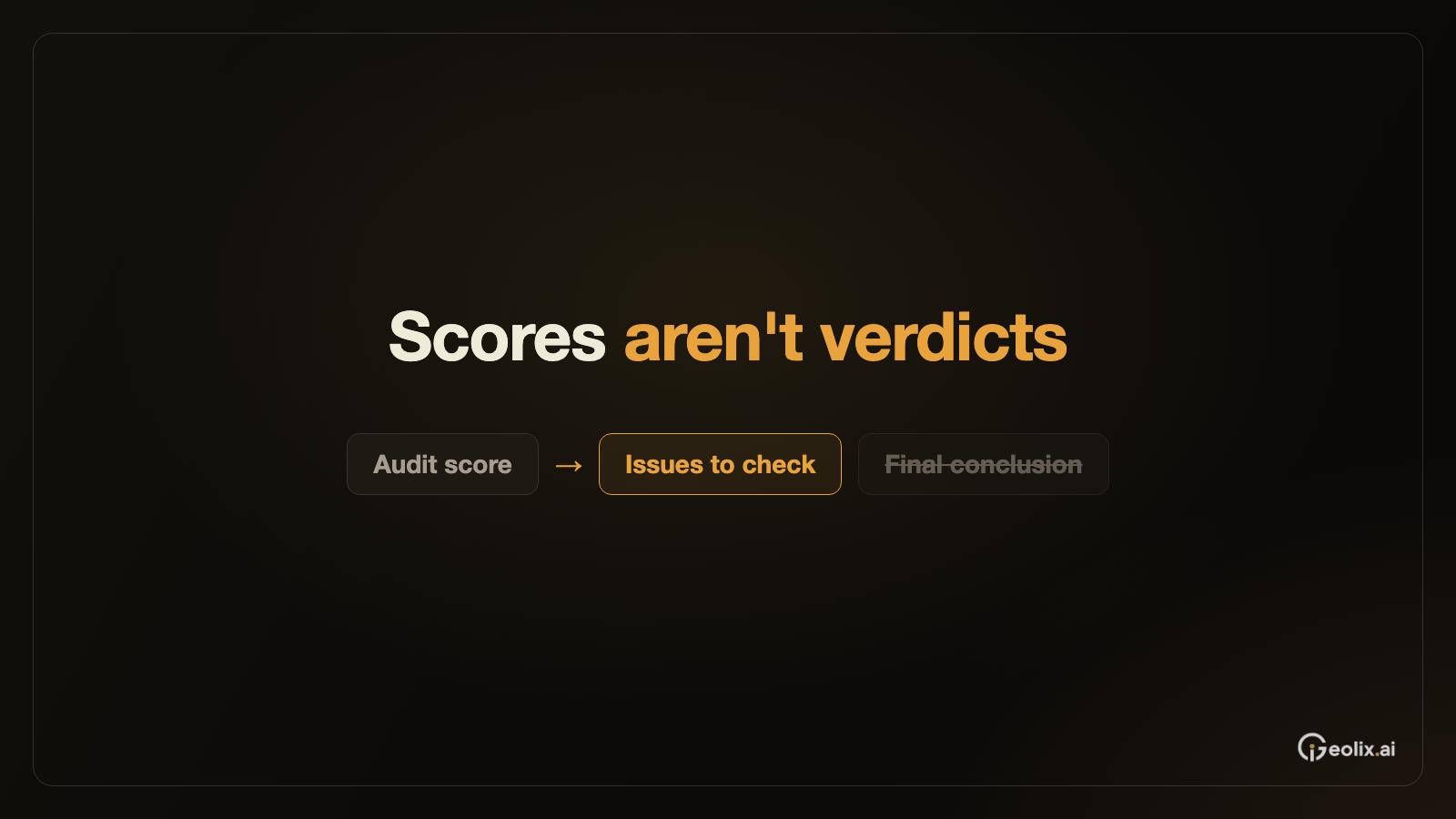

Key takeaway: Teams evaluating both SEO and AI search visibility should treat automated audit scores as issue-discovery signals, not as conclusions.
Key Takeaway
Teams evaluating both SEO and AI search visibility should treat automated audit scores as issue-discovery signals, not as conclusions. Google’s guidance favors a site-specific technical review that considers the site’s technology, recent changes, crawling and indexing needs, and the likely impact of each finding. SearchAtlas’s GEO framework adds a second requirement: pages should present clear, inspectable answer blocks that generative systems can retrieve and cite. These are related tasks, but neither can be reduced to one universal score.
Google Technical SEO Audits Must Explain the Anomaly
Google Search Relations team member Martin Splitt described a three-stage approach in a Search Central Lightning Talk: use tools and guidelines to identify possible issues, create a report tailored to the individual site, and make recommendations based on that site’s actual needs. Search Engine Journal’s account of the guidance stresses that numerical tool scores often lack this context.
The distinction matters because the same signal can have different meanings on different sites. An international website may require hreflang checks, while a single-language site may not need them. A checklist can identify a possible condition, but it cannot determine its business or technical importance without knowing the site architecture and publishing history. Google’s guidance therefore places human judgment after automated detection, not outside the audit process.
404 responses illustrate the point. A high number of 404s can be expected after a site has recently removed a large amount of content. In that situation, the count alone does not prove a crawling problem. A more meaningful warning is an unexplained increase that does not correspond with a known website change. Teams can use the Crawl Stats report in Google Search Console to check whether the pattern matches normal maintenance or requires investigation.
For an AI search visibility review, the practical questions should be more specific than “What is the score?” The team should ask whether important pages can be crawled and indexed, whether recent URL or content changes explain the observed movement, whether a finding could prevent the relevant pages from entering a search system’s candidate pool, and whether the recommended fix fits the site’s technology. A score becomes useful only after those questions give it a concrete interpretation.
GEO Pages Need Retrievable and Verifiable Answers
SearchAtlas describes generative engine optimization, or GEO, as a content and architectural practice intended to help generative search systems retrieve, synthesize, and cite discrete passages. Its examples include Google AI Overviews, Perplexity, and ChatGPT Search. The framework distinguishes GEO from conventional SEO: traditional SEO commonly evaluates whole-page or URL-level visibility, while GEO emphasizes passage-level retrieval confidence, factual inspectability, and citations within generated answers.
That distinction turns an AI search audit into a set of concrete page checks. A team reviewing a product page can verify whether the product name, feature, and relevant attribute remain clearly connected; whether a question heading is followed by a self-contained answer; whether important facts are buried beneath unnecessary narrative; and whether claims include evidence that a reader can inspect. Comparative information should be organized with clear labels, while definitions and qualifications should stay close to the claims they govern.
These practices reduce ambiguity, but they do not replace technical SEO. SearchAtlas presents conventional crawlability and indexing standards as an operational prerequisite for entering a retrieval candidate pool. A page that cannot be discovered, crawled, or indexed cannot gain AI search visibility merely because its passages are well formatted. The reverse is also true: successful indexing does not guarantee that a generative system will select, synthesize, or cite the page.
Teams should therefore keep separate records for SEO visibility and AI search behavior. The first can include crawl and indexing evidence relevant to the site. The second can track a defined set of user prompts and note whether the page is mentioned, cited, or linked under the observed conditions. Combining these signals into one score would conceal the difference between being technically available to a search system and being selected as evidence in a generated answer.
Method and Limitations
A practical review can begin with a page inventory that records the site’s technology, language setup, recent content or URL changes, and the search task each page is intended to support. Automated tools can then surface possible technical issues. Each finding should be checked against Google Search Console, the page’s actual rendered structure, and information from people responsible for the site. Recommendations can be prioritized by potential search impact and implementation effort rather than by the order or severity label assigned by a tool.
For GEO, the team can define a set of realistic questions and inspect whether each target page provides a direct, accurate, and self-contained answer near the relevant heading. It can also identify the evidence supporting factual claims and record the conditions under which prompt observations were made. A single generated response should not be treated as a stable ranking signal; repeated observations need consistent prompts and stated measurement conditions.
The public material does not establish that any automated audit score represents AI search visibility, nor does it establish that a particular layout guarantees citation in Google AI Overviews, Perplexity, or ChatGPT Search. SearchAtlas notes that generative retrieval varies with query, domain, and model version, while Google’s 404 example shows why metrics require site-specific explanation. The supported conclusion is therefore a review method, not a promise of rankings, traffic, advertising performance, or citations.