


Key takeaway: Google is testing summaries in some AI Overview citation cards, while site moves may take one to three months to settle in Search.
Key Takeaway
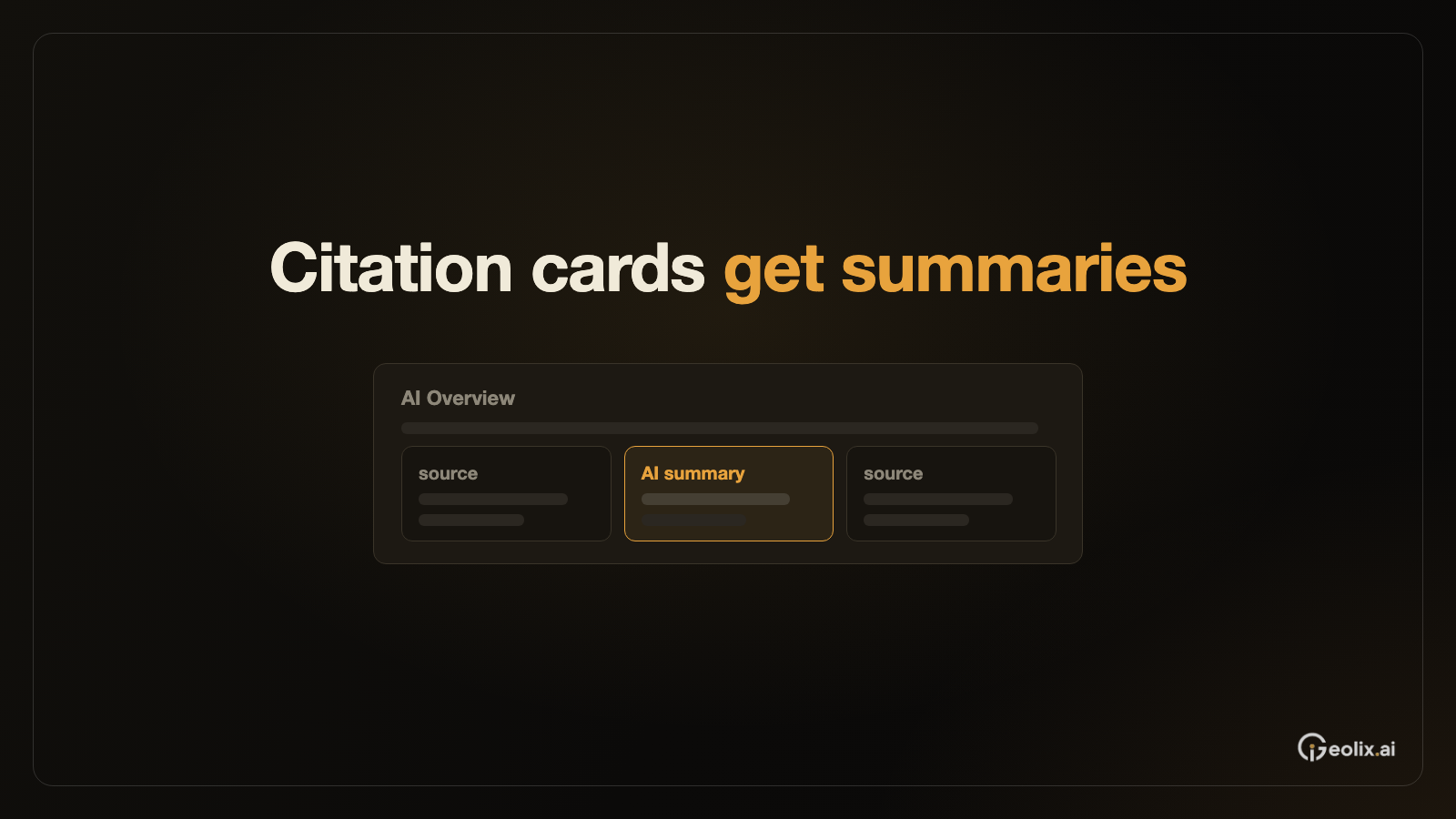
Google is testing AI-generated descriptions inside some AI Overview citation cards. The observed descriptions summarize information that Google considers relevant to the query rather than necessarily reproducing text exactly as it appears on the cited page. Separately, a recent report says a typical site move can take one to three months to settle in Google Search, a timing issue relevant to SEO and search visibility during ecommerce platform migrations.
What changed in AI Overview citation cards
The citation-card behavior was spotted by Brodie Clark, who said he had not previously noticed Google summarizing cited content in this way. The cards can appear on the right or below an AI Overview in Google Search. The behavior was also seen in testing, but not for every query. That limited and inconsistent appearance supports describing it as a test or partial rollout rather than a confirmed, universal feature.
For SEO and search visibility, the distinction matters because a cited page may now be represented not only by a link or page title, but also by a Google-generated description. The available reporting does not establish that these descriptions improve click-through rates, change organic rankings, or create a new Google optimization requirement. It only documents what some users observed in selected AI Overview results.
What Shopify migrations mean for search visibility
A separate report published on October 22, 2026, said Google’s Gary Illyes presented timing data on October 2 at Search Central Live in Barcelona indicating that a typical site move takes one to three months to settle in Google Search. The report also noted that Shopify generally uses /products/ for product pages and /collections/ for category pages. Moving from a platform with different paths can therefore change product and category URLs.
For an ecommerce replatforming that keeps the same domain but changes URL paths, the reported operational steps include mapping old URLs to relevant destinations with direct 301 redirects, resubmitting the sitemap, and monitoring indexation, redirects, rankings, and crawl errors. Optimum7’s described process checks those areas at 7, 30, and 90 days after launch. Those checkpoints describe the company’s service process, not a universal schedule imposed by Google.
Method and Limitations
Teams can use Google Search Console to compare pre-migration and post-migration index counts, clicks, sitemap status, and the treatment of old and new URLs. They can also test redirects directly and review crawl errors. To monitor AI Overview citation behavior, they would need to repeat the same or comparable queries and distinguish the cited page’s original wording from the description shown by Google.
The public material does not establish when AI-generated citation descriptions will become broadly available, nor does it show that they affect rankings, advertising performance, or AI marketing conversions. The one-to-three-month figure describes a typical site move, not a guarantee for every migration. The second source is a paid press release, so Optimum7’s workflow and capabilities should not be treated as Google policy or as evidence of a result for every Shopify store.