

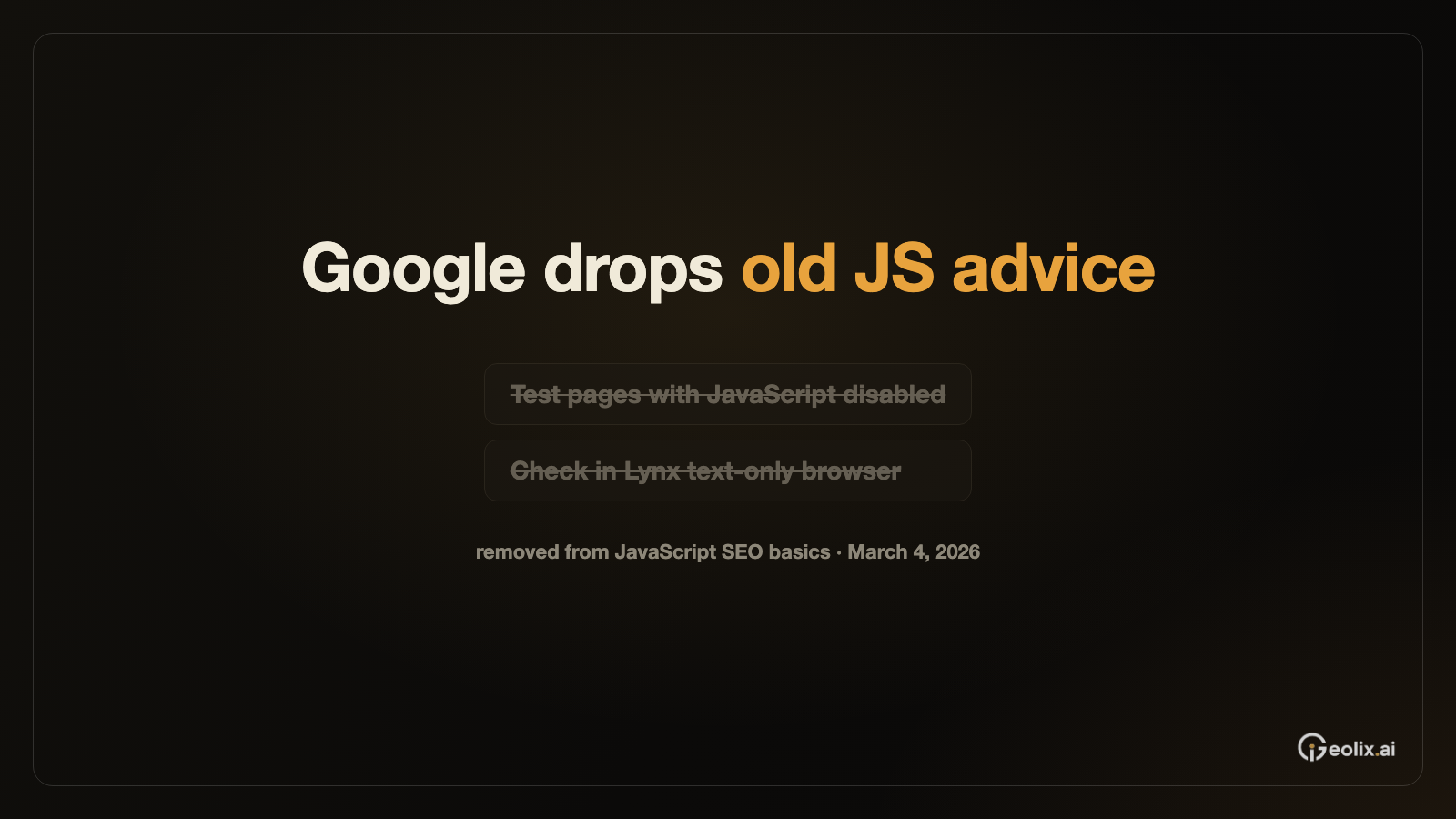

Key takeaway: On March 4, 2026, Google removed older JavaScript accessibility guidance from its JavaScript SEO basics documentation.
Key Takeaway
On March 4, 2026, Google removed older JavaScript accessibility guidance from its JavaScript SEO basics documentation. The removed advice included testing pages with JavaScript disabled and using text-only browsers such as Lynx. Google said the information was out of date because Google Search has rendered JavaScript for multiple years, and because most assistive technologies can now work with JavaScript. The supported conclusion is limited but important: using JavaScript alone is not a reason to assume that Google Search cannot understand a page.
That does not establish that every AI search system, agent browser, or other crawler will process the page in the same way. Reporting on OpenAI Dots and Meta Muse describes agents that can use cloud computers and browsers to visit websites, read loaded content, and perform tasks for users. The same reporting says that neither product has publicly provided a specific user-agent string, request header, or browser signature that site owners can use to identify this traffic reliably. Google’s renderer is therefore not a universal compatibility test for AI search agents.
What Google Removed From Its JavaScript SEO Guidance
The deleted section was titled “Design for accessibility.” It advised developers to consider users who might not be running a JavaScript-capable browser. It also recommended testing with JavaScript turned off or viewing pages in text-only browsers to reveal content that could be difficult for Google to see, including text embedded in images.
Google’s documentation changelog described that advice as “out of date and not as helpful as it used to be.” The change reflects improvements in Google’s ability to render JavaScript and in assistive technologies. It does not mean that accessibility has stopped mattering, and it does not mean that every JavaScript implementation is safe for search.
For SEO teams, the practical shift is from applying a blanket no-JavaScript rule to testing the rendered experience directly. Important page text, links, navigation, structured information, and conversion paths still need to be available and usable after scripts run. A page can be technically renderable while still exposing key information through delayed requests, fragile interactions, or elements that fail under a different browser or crawler. Google’s documentation change removes an outdated warning; it does not remove the need to validate the implementation.
Why AI Search Agents Complicate Visibility Checks
Traditional SEO measurement assumes that a person submits a query, scans results, clicks a link, and browses a page. Agent-mediated search can follow a different path. The reporting describes OpenAI Dots as an agent with its own cloud computer and browser, connected to more than 4,000 applications. It describes Meta Muse for Small Business as connected to tools including Asana, Zoom, Intuit, Box, Canva, and Salesforce’s Slack, with a real-time voice mode.
Those descriptions point to a workflow in which software can open a site, read what loads, complete a form, or continue a task without the user manually inspecting a search results page. That makes “visibility” a broader implementation question. A page may render correctly for Google while remaining difficult for another agent to identify, read, or operate. The reporting also says that Dots and Muse have not published enough request-level information for site owners to identify their visits confidently. Teams should not label unexplained server traffic as AI-agent traffic without evidence, and they should not treat Google’s rendering capability as proof of equivalent behavior elsewhere.
A sensible technical priority is therefore to make important information available in the rendered page without requiring a long sequence of fragile actions. Teams can then examine logs and access patterns carefully, while recognizing that unidentified traffic cannot yet provide a clean measure of AI search visibility. This is a readiness and verification task, not evidence that a particular site has gained traffic, rankings, or conversions from AI agents.
Method and Limitations
Teams can use Google Search Console’s URL Inspection tool to check what Googlebot sees after rendering. The review should cover the main page text, navigation links, important calls to action, and any content that depends on client-side requests. For JavaScript-heavy pages, comparing the initial HTML with the rendered result can reveal whether essential information appears only after scripts execute or whether a failed request leaves the page incomplete.
Accessibility testing should continue even after Google’s documentation change. Google’s statement concerns its own search rendering and the progress of assistive technologies; it does not promise identical behavior from other search engines, crawlers, or AI agents. Teams should also avoid inferring an agent’s identity from ordinary analytics data when the relevant product has not published a dependable request signature.
The available evidence supports two bounded findings. Google has removed guidance it considers outdated and says Google Search has rendered JavaScript for years. Separately, reporting on Dots and Muse describes browser-using AI agents that could change how people reach and use websites, while leaving important questions about identification and cross-site behavior unresolved. The material does not establish a universal AI search visibility metric, a specific traffic gain, a ranking improvement, or a conversion effect. Render validation is therefore a defensible technical check, not a performance promise.