

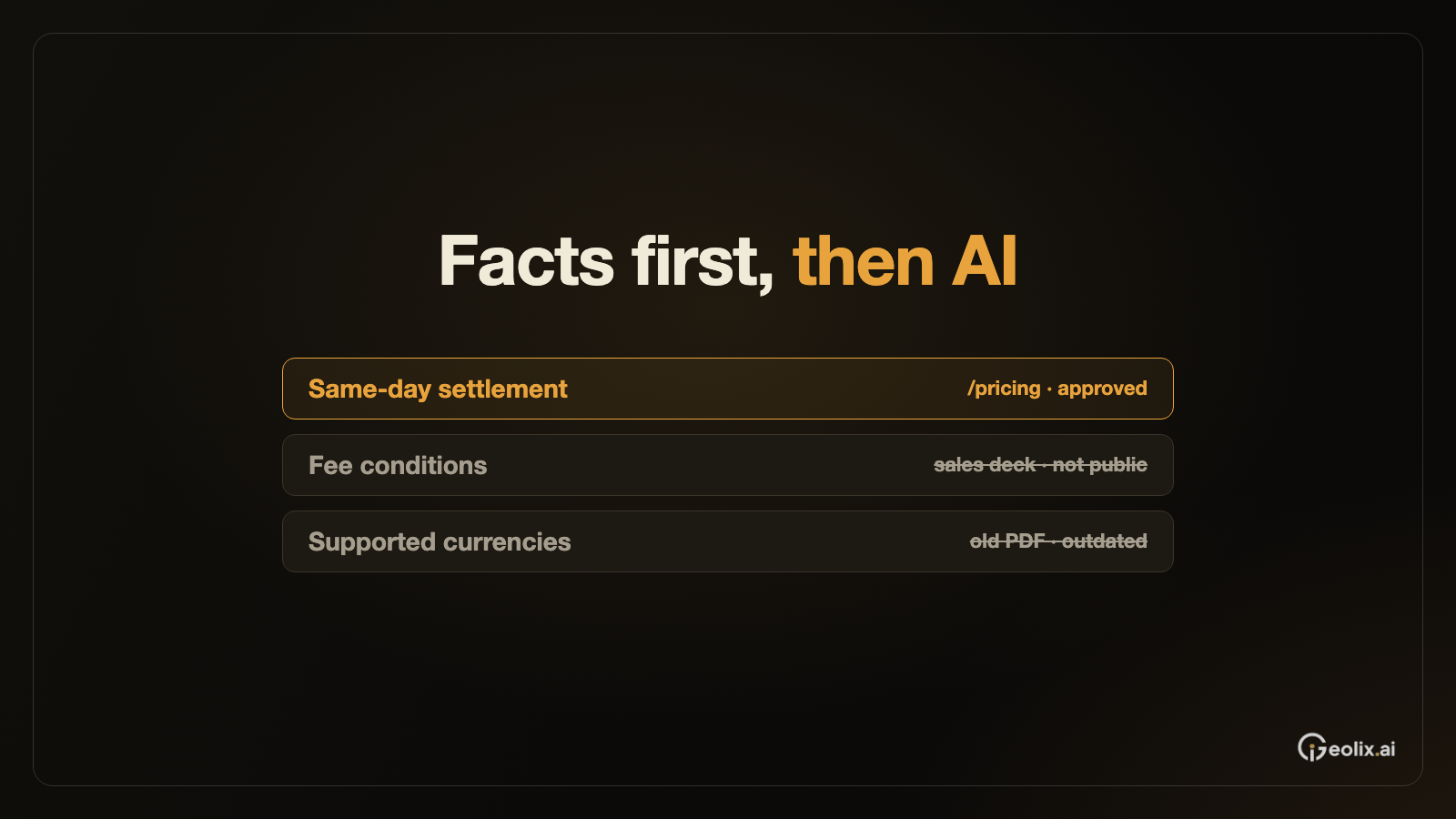

Consider a cross-border payments company testing the question “Which providers support same-day settlement in this market?” Its homepage promises “fast payouts.” Currency rules and cut-off times sit in an old PDF, while the latest fees live in sales material. Repeated AI queries will not tell the team whether the engine misunderstood the company or the company never published a clear answer. This is an illustrative scenario, but it points to a real website task: assign each important claim a current source page.
Which page has the approved facts?
Start with claims that could affect a buying decision. Supported countries, settlement times, fee conditions, and the licensed entity should each have an accessible, approved source. Put the qualifications in the visible page body. If same-day settlement applies only to a currency and a weekday cut-off, say so there. For a fintech site, product and compliance owners need to approve that wording. An editor cannot derive a product commitment from a slogan.
A crawlable page still needs an answer
Now inspect the pages as search assets. In Search Console, check index status and Google's chosen canonical URL for the source pages. Confirm that robots.txt, noindex, login requirements, or rendering do not hide the answer. A sitemap helps discovery but does not guarantee indexing. Google's SEO Starter Guide and developer guide make discovery, crawling, and understandable content the basic work. If an outdated blog post, a product page, and a PDF disagree on a fee, decide which version should remain public before adding markup.
Read the page after running the tools. A buyer may need to know whether they qualify, how the fee is calculated, and what happens when settlement fails. A page that only defines the category does not answer those questions, however cleanly it renders. Google's guide to generative AI features in Search recommends original, useful information and says there is no required “AI writing” format or special machine-readable file for inclusion. It points the team back to what a person needs to decide.
Keep the before state
Only then establish an AI visibility baseline. Fix the questions, language, market, and observation window; save full answers and cited URLs. Google's Generative AI performance reports add URL impression data for its AI features, but do not preserve the full answers sampled by the team. If an answer later gets a product fact wrong, those records can help trace it to a source page, an approved version, and a change date. SEO groundwork here is more than getting a URL indexed. It gives the company's public facts an owner.
References
Google Search Central, “SEO Starter Guide”, for discovery, content, and sitemap guidance.
Google Search Central, “Get started with Search: a developer's guide”, for crawling and indexing controls.
Google Search Central, “Optimizing your website for generative AI features on Google Search”, for AI Search content guidance and the llms.txt clarification.
Google Search Central, “Introducing Search Generative AI performance reports in Search Console”, for the metrics available in Google's generative AI reports.