

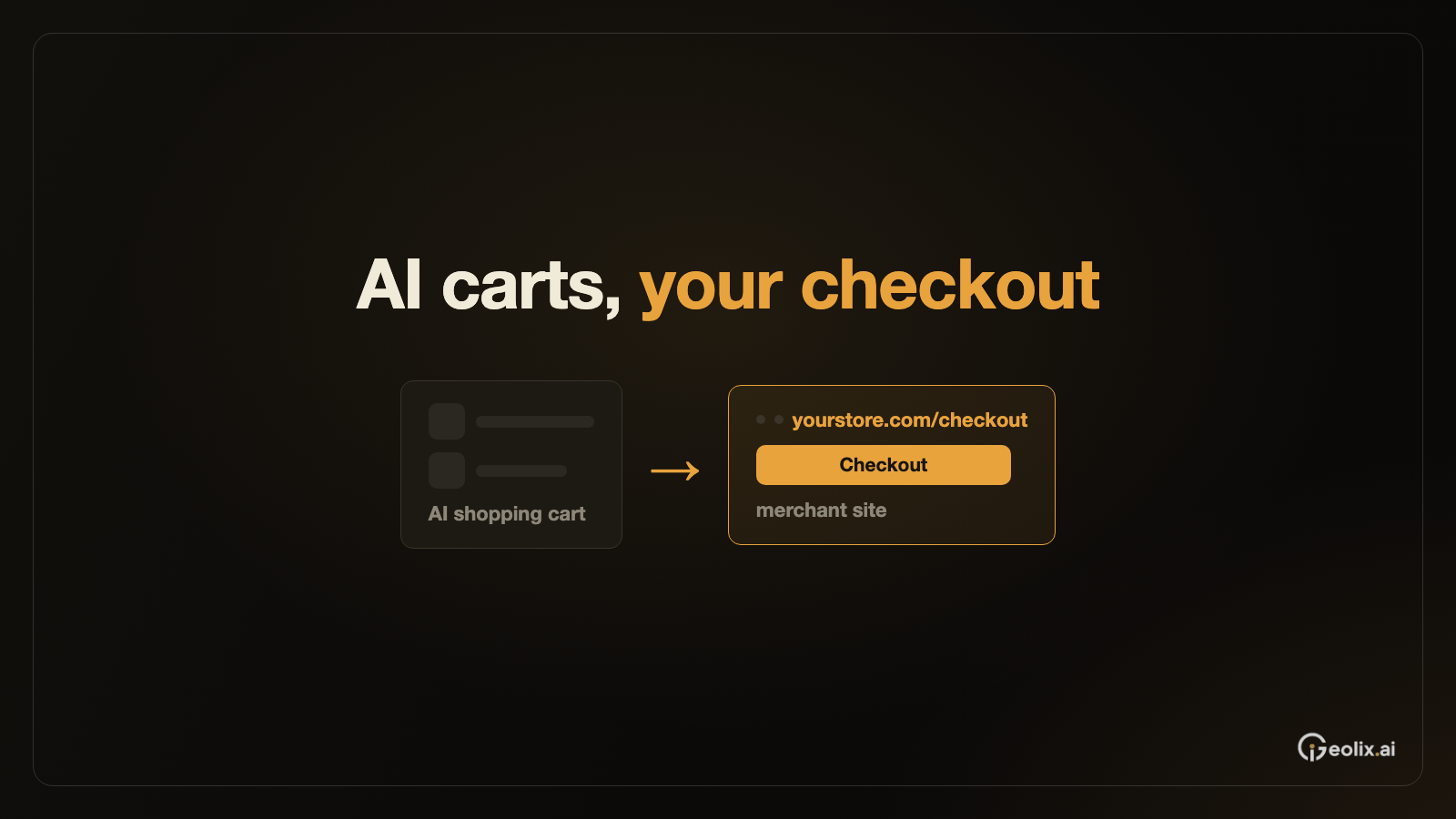

Google is giving merchants a way to pull AI-assembled shopping carts back onto their own websites for checkout. Cart transfer and expanded checkout testing are arriving in the Universal Commerce Protocol (UCP) integration hub inside Merchant Center, part of a holiday bundle announced September 16 by Ashish Gupta, Google's VP and general manager of Merchant Shopping. The same package makes the AI performance insights report broadly available in five countries and opens a U.S. beta that embeds Business Agent inside YouTube ads.
Cart transfer routes a shopper from Google to the merchant's own checkout with items already loaded. That reverses the direction UCP has run so far: the protocol, which Google says already powers direct checkout for hundreds of thousands of brands and retailers, centered on completing purchases inside Google surfaces. Search Engine Journal traced the paper trail in Google's developer docs, where the capability appears as "Transfer to merchant cart" and switches on when a merchant supports the Cart API. The setup checklist for that path skips full product feed configuration, product warnings and customer support details, and a sandbox in the same Merchant Center tab lets merchants rehearse the cart and checkout requests Google may send. The capability surfaced as a draft in March and got a nod at Google Marketing Live in May. Rollout is gradual in the U.S., with Australia and Canada slated for early next year; getting in means finishing technical setup, filing an interest form and waiting to be picked. Search Engine Roundtable listed the hub's integrations as transfer to merchant cart, native checkout on Google and identity linking.
The transfer option addresses a complaint retailers raised in January, according to Search Engine Journal's earlier reporting. When transactions close on Google, customers do not visit the retailer's site, see accessory suggestions or build a direct relationship with the brand.
On analytics, the announcement and the documentation disagree. Gupta's post says analytics is coming soon to the UCP hub. Yet Google's developer docs, last updated September 3, describe a UCP Analytics Reporting dashboard as already available to every merchant with UCP enabled and the Performance role, covering the funnel from a Buy button click through completed purchase, along with average order value, cancellations, account linking data and top-selling UCP products. The data has no Merchant API access yet. Merchants with access to the UCP integration tab can check whether an Analytics tab is available in their accounts.
Merchant Center's AI performance insights report has opened to five markets: the U.S., Canada, Australia, New Zealand and India. It compares a merchant's share of voice against other brands across surfaces such as AI Mode and AI Overviews. The pilot's limits carried over: the help page scopes it to English-language queries and organic AI traffic, and it reports no clicks, so it still cannot say whether AI Mode delivered a single visitor. Search Engine Roundtable noted the five-country expansion actually happened about two weeks before Google announced it, and that the report recently gained new AI metrics.
Business Agent, which Google launched in Search on January 12 alongside UCP, is now taking retailer sign-ups for a YouTube ads beta in the U.S. A branded agent sits inside the ad, fielding product questions while the viewer stays on YouTube. Qualification criteria and the beta's duration went unstated.
Gupta's post closes with feed guidance carrying two numbers: merchants adopting core Merchant Center feed best practices see an average 5% conversion lift the following month, and in testing with lululemon, conversational attributes the brand submitted were incorporated 50% of the time into relevant AI Mode product recommendations. Tapestry, owner of Coach and Kate Spade, is cited as an early UCP adopter selling through Search, AI Mode and the Gemini app. Google also recommends the video link attribute for shoppable ad formats and connecting loyalty data, with Minted's member pricing as the example.
Brand and commerce teams still face a measurement gap. AI performance insights shows whether a brand appears in AI answers, while the UCP dashboard, where available, starts counting at the Buy click. Google provides no click data between those points, leaving AI shopping attribution incomplete for the holiday season. Conversational attributes are the only AI Mode visibility measure in the announcement backed by a published result, although the 50% figure comes from Google's test with lululemon. Cart transfer lets merchants decide whether orders finish on Google or on their own checkout, where they retain cross-sell opportunities and customer data. The sources provide no comparison of conversion rates between the two paths, so merchants will need to measure that in their own seasonal data.