

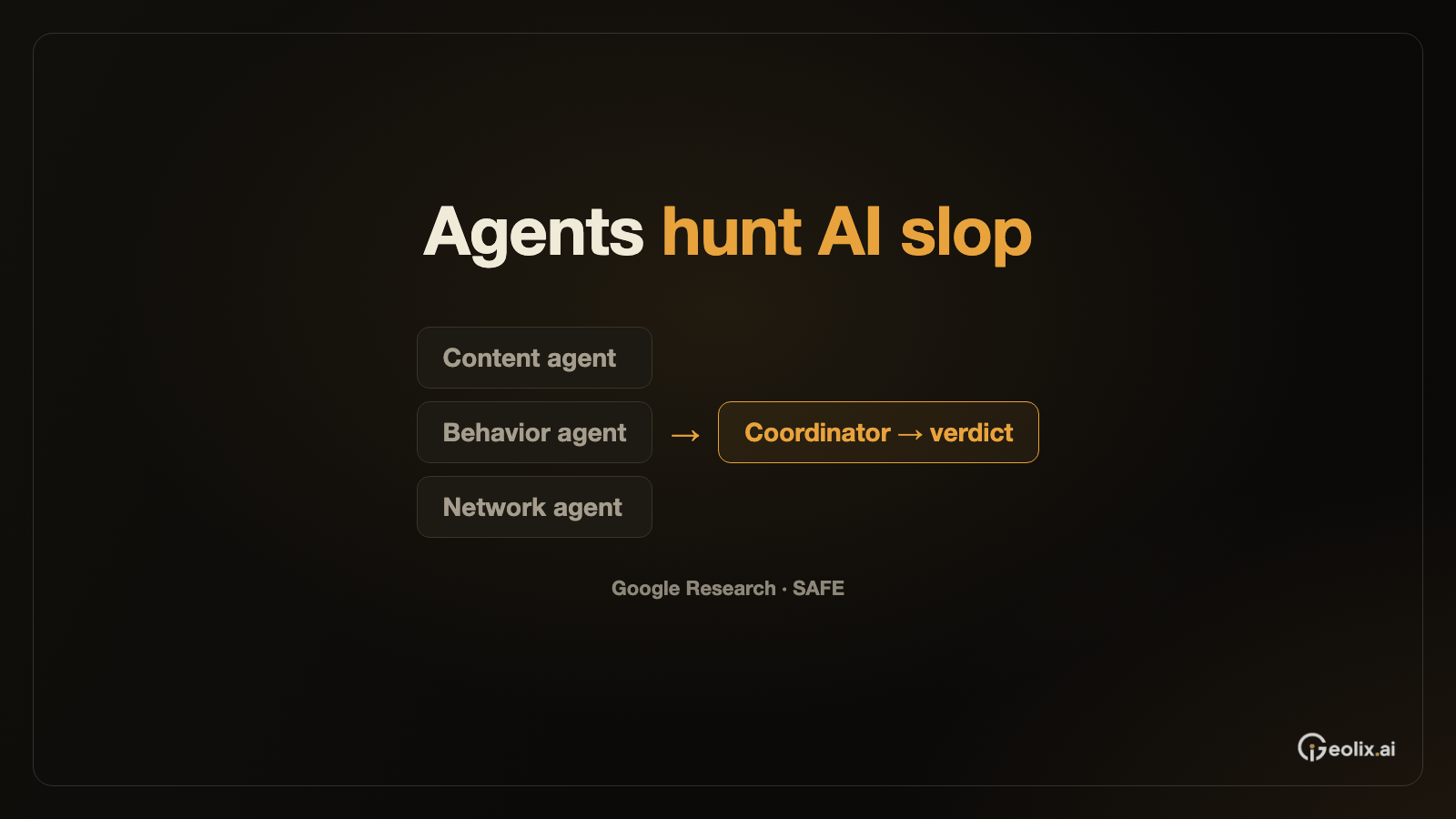

Google researchers have described a system that combines content analysis with evidence of coordinated behavior to investigate networks distributing synthetic media. Called the Scaled Abuse Forensics Examiner, or SAFE, it assigns different parts of an investigation to specialized AI agents before a coordinating agent reaches a verdict. The researchers say early deployments reduced investigation time, but the public description does not quantify that improvement. Google's research page dates the paper only to 2026, without a specific day; Search Engine Journal reported on it on September 25.
The problem they identify extends beyond finding duplicate material. An abusive network can generate distinct, localized versions of synthetic content at scale. Individual uploads may differ enough to escape a duplicate-content cluster, while the operators retain common behavioral patterns. The research frames manual examination of those relationships as too slow to keep pace with the volume of new material.
SAFE separates that examination into several tasks. A content agent examines the material for policy violations, using adapted language models for established violations and few-shot learning for patterns that conflict with a policy's intent. The researchers describe LoRA adaptation as part of this approach. The stated purpose is to catch violations that established classifiers may miss.
A behavior agent looks for unnatural patterns across time and location. A separate cluster agent examines relationships between channels. Search Engine Journal's discussion of the paper describes shared infrastructure and synchronized publishing as examples of the wider forensic context. These signals allow an investigation to consider connections among accounts alongside the meaning of a particular item of content.
The root agent coordinates the investigation and combines the other agents' findings. This architecture places the final assessment after the specialized analyses. The published abstract describes the use of multimodal evidence, but does not identify a tool that site owners can access or an external reporting interface for viewing SAFE decisions.
Evidence about performance remains limited. The researchers report faster identification of new synthetic threats compared with workflows involving human review. Search Engine Journal, which examined the three-page paper, noted the absence of disclosed test results. The available material therefore does not supply the numerical improvement, error rates or independent evaluation needed to compare SAFE with another detection system.
The relationship to Google Search also remains unconfirmed. Search Engine Journal raised a possible connection to the September spam update, but that was an interpretation, not a deployment statement from the researchers. The abstract describes synthetic-media abuse, video clusters, channels and coordinated networks. It does not identify SAFE as the system behind that search update or establish that ordinary AI-assisted articles receive a ranking penalty.