
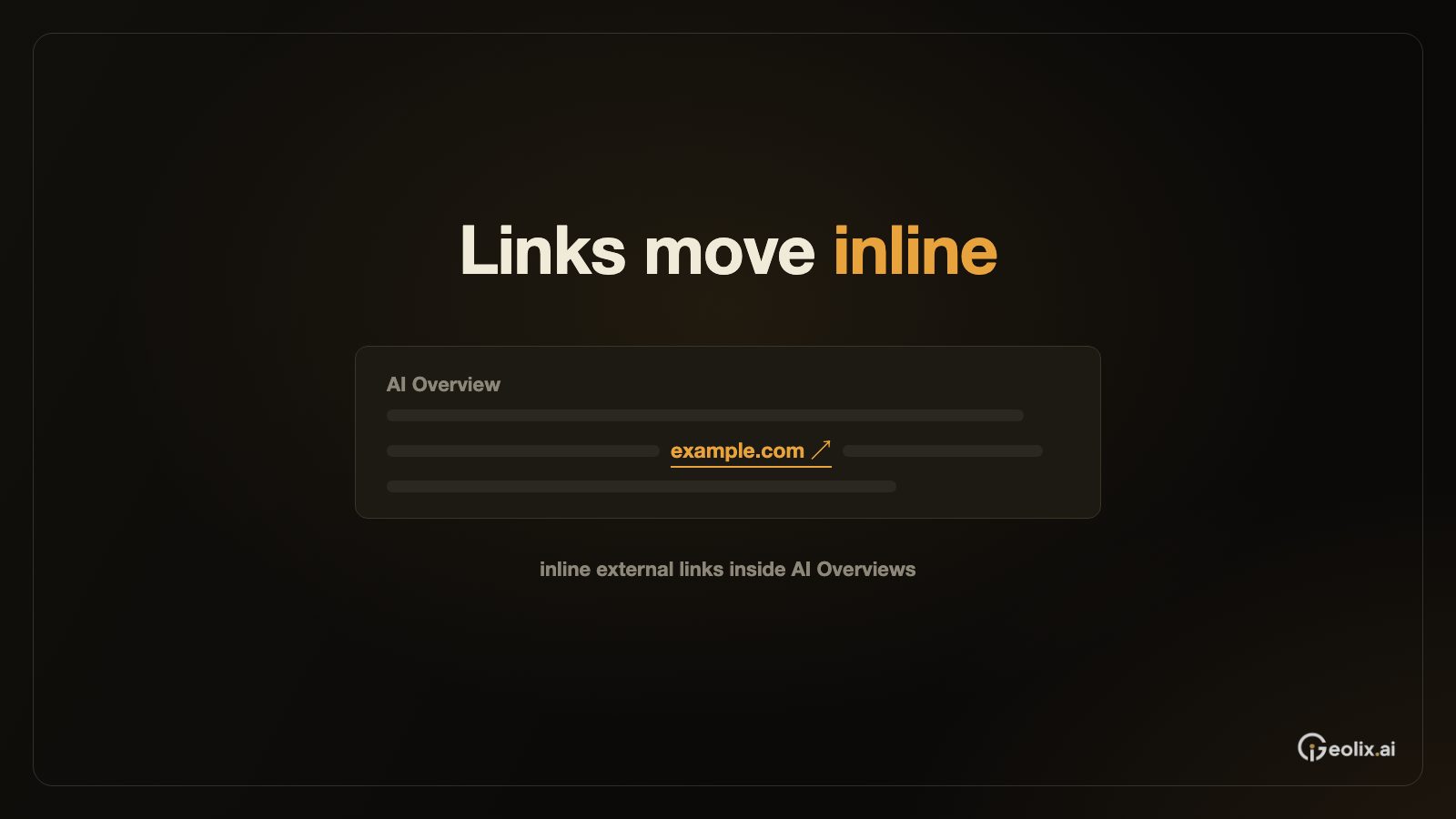

Analytics vendor Peec reported an increase in Google AI Overviews containing links to external websites within the answer text in September, according to Search Engine Journal. A separate recording showed an underlined link opening Google's AI Mode. The observations concern different destinations and provide no figures for the visits generated by either type of link.
The chart, posted on X on September 21 by Malte Landwehr of Peec AI, tracked the daily share of sampled AI Overviews containing an external link within the answer text. It covered August 25 through September 20. The plotted share stayed near zero before a jump around September 11, then finished the series at 26.2%. That percentage describes the vendor's observed sample and a particular link display.
The publication identified gaps in the chart's methodology. It did not supply a query count, geographic or device breakdown, or a full explanation of how it distinguished embedded links from citation cards and other suggestions. Without those details, the series cannot establish the share across all Google AI Overviews. It also cannot resolve whether the abrupt change came from Google's interface or from the vendor's collection process.
A separate, 18-second recording posted on X by Gagan Ghotra showed underlined answer text opening AI Mode after a click. The recording establishes the destination for that interaction. It does not establish how often Google shows the element, whether it replaces an external link or how it affects publisher traffic. Google's mobile experience had already offered a route from an AI Overview follow-up into AI Mode since January.
Google has described other changes to link presentation as well. Its May announcement included more links beside relevant answer text, article suggestions and previews of public discussions. The announcement did not specify a complete set of markets, display counts or a completion date for the inline-link change. The September observations therefore cannot, on their own, identify a single worldwide rollout corresponding to those earlier descriptions.
Search Console measures interactions according to their destination and type. Its help documentation says a click from an AI Overview to an outside page counts as a click. A query-refinement link, which launches another Google search, generates no click or impression for that link itself. The help page does not say whether the element in Ghotra's recording counts as a query-refinement link.
The reporting figures also describe different activities. According to Search Engine Journal's review, the generative AI performance report presents impressions for AI Overviews and AI Mode, without separate clicks or CTR. Those impressions already sit within the wider Web performance data. Dividing all Web clicks by AI-only impressions would combine incompatible populations, rather than calculate the click-through rate of AI results.
Geolix.ai, which tracks how brands are cited across nine AI engines including Google AI Overviews and AI Mode, has run into the same measurement problem. In a July 2026 analysis of its own production data, published as “The GEO Market Is Splitting Into Four Delivery Models”, Geolix excluded AI Overviews and AI Mode from one comparison because collection success was too low. A change in collection can move a curve like Peec's as easily as an interface change. Geolix also measures a page being cited separately from a brand being recommended, a distinction set out in “Why does AI cite your page but not recommend your brand?”. More inline links would raise the first; on their own, they say nothing yet about the second.
Neither Peec's chart nor Ghotra's recording includes clicks to outside websites. More frequent links in sampled answers may give users more opportunities to visit a source, but the observations do not show whether website traffic increased.